
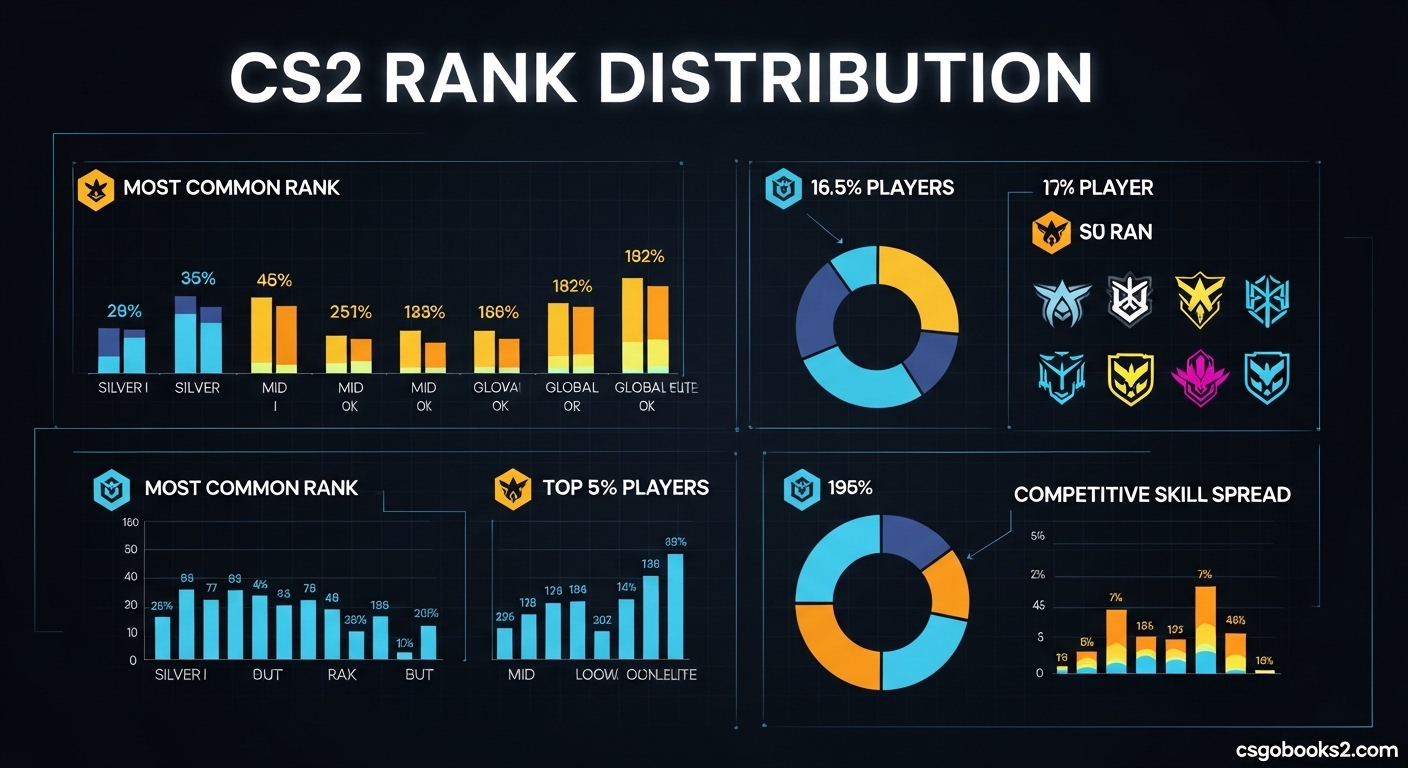
Understanding CS2 rank distribution helps you see exactly where you stand among millions of players worldwide. Whether you’re grinding Premier mode or climbing Competitive, knowing the real percentages behind each tier gives you valuable context for your journey.
In 2026, Valve’s CS2 ranking system continues evolving with seasonal updates, calibration changes, and the ongoing shift from CS:GO’s legacy system. The CS2 rank distribution reveals fascinating insights about player skill levels, the rarity of high ranks, and what it truly takes to reach the elite tiers.
After analyzing data from major analytics platforms and community sources, I’ll break down exactly how players are distributed across Premier and Competitive modes in 2026. You’ll see the real percentages, understand what your rating means, and discover how the ranking system actually works behind the scenes.
CS2 Ranking Systems Overview (October 2026)
CS2 uses two separate ranking systems that work independently: Premier mode with CS Rating (numerical Elo) and Competitive mode with traditional skill tiers. Understanding the difference between these systems is essential for tracking your progress accurately.
Premier mode uses a CS Rating system ranging from 0 to 30,000+, divided into seven color-coded tiers (Gray, Blue, Cyan, Purple, Pink, Red, Gold). Your CS Rating is a single number that applies across all maps and playlists in Premier, making it a unified measure of your skill level.
Competitive mode retains the classic CS:GO-style ranks (Silver 1 through Global Elite), but these are now map-specific. Your rank on Mirage might differ from your rank on Ancient, reflecting the CS2 philosophy that map knowledge matters alongside raw mechanical skill.
The CS2 ranking system is based on Elo rating principles, where you gain or lose points based on the expected outcome of each match. Beat a higher-rated team? You gain more points. Lose to lower-rated opponents? You lose more. This self-correcting system aims to place everyone at their true skill level over time.
CS2 Rank Distribution in Premier Mode
Premier mode’s CS2 rank distribution follows a bell curve pattern, with most players clustered in the middle tiers. The color-based system makes it easy to identify skill brackets at a glance, but the underlying percentages reveal just how rare the top ranks truly are.
Here’s the complete Premier mode rank distribution breakdown for 2026, showing exactly what percentage of players occupy each color tier:
Gray Tier (0-4,999 CS Rating): 8% of players
The Gray tier represents new players and those still learning fundamental mechanics. Most players spend only a few matches here before calibrating into their true tier. If you’re in Gray, focus on aim training, learning smokes, and understanding economy basics.
Blue Tier (5,000-14,999 CS Rating): 42% of players
Blue is the most populated tier in CS2, encompassing the true center of the player base. A 10,000 CS Rating falls squarely in the middle of Blue, representing the statistical average player. This tier ranges from casual players to dedicated grinders, making matchmaking quality vary significantly.
Cyan Tier (15,000-19,999 CS Rating): 28% of players
Cyan represents above-average players who have mastered the fundamentals. If you’re at 15,000+ CS Rating, you’re in approximately the top 30% of all CS2 players. Cyan players typically have good aim, decent game sense, and can execute basic strategies consistently.
Purple Tier (20,000-24,999 CS Rating): 14% of players
Purple is where dedicated players land. Reaching 20,000 CS Rating places you in the top 22% of the player base. Purple players have strong mechanics, understand team composition, and can frag reliably against most opponents.
Pink Tier (25,000-29,999 CS Rating): 6% of players
Pink represents highly skilled players who’ve invested significant time into improvement. At 25,000+ CS Rating, you’re in the top 8% globally. Pink players consistently top-frag, understand advanced utility usage, and can carry games single-handedly.
Red Tier (30,000-34,999 CS Rating): 1.5% of players
Red is the realm of exceptional players. Fewer than 2% of CS2 players reach 30,000 CS Rating, making this an elite achievement. Red players have near-perfect aim, deep map knowledge, and the ability to read opponents like a book.
Gold Tier (35,000+ CS Rating): 0.5% of players
Gold is the pinnacle of CS2 Premier ranking. Only half a percent of players achieve 35,000+ CS Rating, placing them in the top 0.5% globally. These players are essentially semi-professional level, with many competing in tier 2-3 tournaments.
The CS2 rank distribution in Premier mode shows that reaching 20,000+ CS Rating is already a significant achievement, putting you ahead of roughly 80% of the player base. The truly elite ranks (Red and Gold) are incredibly rare, with fewer than 2% of players ever reaching these heights.
Competitive Mode Rank Distribution
Competitive mode uses the traditional CS:GO-style ranking system, but with map-specific ranks that can vary based on your performance on each map. The CS2 rank distribution in Competitive shows similar patterns to Premier, with most players clustered in the middle tiers.
Silver Ranks (Silver 1 – Silver Elite Master): 18% of players
Silver ranks constitute nearly one-fifth of the Competitive player base. These players are still developing core skills like recoil control, crosshair placement, and economy management. Silver matches often feature inconsistent gameplay and variable tactical knowledge.
Gold Nova Ranks (Gold Nova 1 – Gold Nova Master): 35% of players
Gold Nova is the statistical average rank in CS2 Competitive, with Gold Nova III specifically representing the 50th percentile player. If you’re Gold Nova, you have solid fundamentals, decent aim, and understand basic team play. This is where most players settle after reaching their skill ceiling.
Master Guardian Ranks (MG1 – DMG): 25% of players
Master Guardian players are above-average and dedicated to improvement. At this tier, you have good mechanics, understand utility usage, and can coordinate with teammates. MG1 through DMG represents the top 22% of Competitive players.
Elite Ranks (LE – SMFC): 15% of players
Legendary Eagle through Supreme Master First Class represents highly skilled players. Reaching LE places you in approximately the top 15% globally. These players have excellent aim, deep game sense, and can consistently perform at a high level.
The Global Elite: 7% of players
Global Elite is the pinnacle of CS2 Competitive, achieved by roughly 7% of players. These are exceptional players with near-perfect mechanics, extensive map knowledge, and the ability to dominate matches consistently. Many Global Elite players compete in semi-professional tournaments or coach other players.
The CS2 rank distribution in Competitive mode shows that Gold Nova III is the true average, meaning if you’re Gold Nova or higher, you’re already above the median player skill level.
CS:GO vs CS2 Rank Comparison
Many players transitioning from CS:GO wonder how their old rank translates to CS2’s new systems. The CS2 rank distribution differs significantly from CS:GO’s historical data, primarily due to the introduction of Premier mode and the CS Rating system.
In CS:GO, the rank distribution was more compressed, with a larger percentage of players in the mid-tier ranks (Gold Nova through Master Guardian). CS2’s Premier mode has created more differentiation at the high end, with additional tiers (Pink, Red, Gold) that didn’t exist in CS:GO’s system.
Here’s a rough CS:GO to CS2 rank conversion based on percentile equivalents:
– CS:GO Silver Nova = CS2 Gray/Blue (5,000-10,000 CS Rating)
– CS:GO Gold Nova = CS2 Blue (10,000-14,999 CS Rating)
– CS:GO Master Guardian = CS2 Cyan (15,000-19,999 CS Rating)
– CS:GO Legendary Eagle = CS2 Purple (20,000-24,999 CS Rating)
– CS:GO Supreme = CS2 Pink (25,000-29,999 CS Rating)
– CS:GO Global Elite = CS2 Red (30,000-34,999 CS Rating)
The CS2 rank distribution shows slight rank inflation compared to CS:GO, partly due to new players flooding into the system and calibration changes that tend to place players higher initially. However, the long-term distribution stabilizes as players play more matches and settle into their true skill tier.
How the CS2 Ranking System Works?
Understanding the mechanics behind CS2 rank distribution helps you make sense of your own journey. The ranking system uses hidden MMR (Matchmaking Rating) that differs from your visible CS Rating, creating a buffer against rapid rank changes.
Your CS Rating updates after every Premier match based on:
1. Expected Outcome
The system predicts which team should win based on average CS Ratings. Winning as the underdog grants more points than winning as the favorite.
2. Individual Performance
Your personal stats (kills, deaths, MVPs, adr) factor into your rating change. A strong losing performance might result in minimal rating loss, while a weak win gives smaller gains.
3. Streak Bonus
Win streaks accelerate your climb, while losing streaks accelerate your fall. This helps players reach their true rank faster during calibration or rank decay.
Calibration matches are critical in determining your initial CS Rating. New accounts play 10 placement matches, after which the system assigns a starting rating based on performance and opponent skill levels. Most players calibrate between 8,000-18,000 CS Rating, placing them in Blue or Cyan tier.
The CS2 rank distribution shifts slightly during calibration periods, as new players flood into lower tiers before climbing to their true level. This creates temporary rank inflation at the start of each season.
Rank Decay and Season Resets
CS2 Premier uses a seasonal system with periodic resets that affect the CS2 rank distribution. Each season lasts approximately three months, after which ratings undergo soft reset mechanics.
Season Reset Mechanics
At season end, your CS Rating doesn’t reset to zero. Instead, the system applies a percentage-based reduction that compresses the distribution slightly. High-rated players lose more absolute points, while lower-rated players lose less, creating a more level playing field for the new season.
Rank Decay
Unlike CS:GO, CS2 Premier doesn’t have aggressive rank decay for inactivity. However, extended absences (30+ days) may result in small rating deductions to encourage active play. This decay is minimal compared to CS:GO’s system, which could drop multiple ranks after weeks of inactivity.
Calibration After Reset
After each season reset, players play 5-7 calibration matches to re-establish their CS Rating. This creates temporary volatility in the CS2 rank distribution, as players flood into tiers that may not reflect their true skill level. The distribution typically stabilizes 2-3 weeks after season launch.
What Percentile Are You In?
Understanding your percentile helps contextualize your CS Rating within the broader CS2 rank distribution. Here’s a quick reference guide:
– 10,000 CS Rating (Blue): 50th percentile – average player
– 15,000 CS Rating (Cyan): 70th percentile – above average
– 20,000 CS Rating (Purple): 86th percentile – top 15%
– 25,000 CS Rating (Pink): 94th percentile – top 6%
– 30,000 CS Rating (Red): 98th percentile – top 2%
– 35,000 CS Rating (Gold): 99.5th percentile – elite
If you’re at 20,000 CS Rating or higher, you’re already in the top 15% of all CS2 players. The CS2 rank distribution shows that reaching Red or Gold tier places you in genuinely rare territory, with fewer than 2% of players achieving these ranks.
Faceit vs CS2 Premier Rank Comparison
Many competitive players compare their CS2 rank distribution to Faceit levels, as Faceit is often seen as a more accurate measure of true skill. Here’s how the systems roughly correlate:
– Faceit Level 1-3 = CS2 Blue (5,000-14,999)
– Faceit Level 4-5 = CS2 Cyan (15,000-19,999)
– Faceit Level 6-7 = CS2 Purple (20,000-24,999)
– Faceit Level 8 = CS2 Pink (25,000-29,999)
– Faceit Level 9-10 = CS2 Red/Gold (30,000+)
Faceit generally has a more skilled player base at higher levels, as serious competitive players often migrate there for better matchmaking and anti-cheat. However, the CS2 rank distribution in Premier mode has improved significantly, with Red and Gold tiers now comparable to Faceit Level 8+ skill levels.
FAQs
Is 10k rating good in CS2?
A 10,000 CS Rating places you in the Blue tier (10,000-14,999), which represents the statistical average player. Approximately 42% of CS2 players fall within the Blue tier, making it the most populated skill bracket. You’re in the 50th percentile, meaning you’re exactly average – competent but with room for improvement.
What rank is 20k Elo in CS2?
A 20,000 CS Rating places you in the Purple tier (20,000-24,999), representing the top 14% of all CS2 players. This is considered an above-average rank achieved by dedicated players with solid mechanics, good game sense, and consistent performance. At 20k, you’re ahead of roughly 86% of the player base.
What percentile is 20k Premier?
Players with 20,000+ CS Rating are in approximately the 86th percentile, meaning only about 14% of players achieve this rank. Those with 25,000+ reach the 94th percentile (top 6%), while 30,000+ places you in the 98th percentile (top 2%). The highest ranks (35,000+) are the 99.5th percentile, achieved by less than 0.5% of players.
What rank is 15000 Elo in CS2?
A 15,000 CS Rating places you in the Cyan tier (15,000-19,999), representing the top 30% of players. This is considered an above-average rank achieved by players who have mastered fundamentals and developed decent game sense. At 15k, you’re ahead of approximately 70% of the CS2 player base.
When do CS2 ranks reset?
CS2 Premier seasons reset approximately every three months, triggering a soft reset that applies a percentage-based reduction to all CS Ratings. This compresses the distribution slightly, requiring 5-7 calibration matches to re-establish your rank. Competitive mode ranks do not reset seasonally but can decay with inactivity.
What CS2 ranks can play together?
In Premier mode, any players can queue together regardless of CS Rating difference, though this may result in unbalanced matchmaking. In Competitive mode, party restrictions typically limit rank differences to 5 tiers (e.g., Gold Nova 1 can queue with Master Guardian but not Legendary Eagle). These restrictions prevent smurfing and ensure fair matches.
Conclusion
The CS2 rank distribution in 2026 reveals a competitive landscape where skill levels vary dramatically across tiers. Understanding where you fit into this distribution helps set realistic goals and appreciate your progress, whether you’re grinding through Blue or pushing for Gold.
Remember that rank is just one measure of improvement. Focus on consistent practice, aim training, and game sense development rather than obsessing over rating fluctuations. The CS2 rank distribution will naturally shift as you improve, but the skills you build along the way matter most.
Whether you’re an average Blue tier player or elite Gold tier competitor, the CS2 ranking system provides a clear path for progression. Use the distribution data to understand your percentile, set appropriate goals, and enjoy the climb toward your true potential.