
If you’ve been confused by CS2’s ranking system, you’re not alone. The CS2 ranking system explained premier rating is one of the most searched topics by players trying to understand why their rating jumps 300 points one match and barely moves the next. CS2 actually uses two completely different ranking systems simultaneously, and understanding both is crucial for tracking your progress and setting realistic goals.
When I first started playing CS2, I spent weeks frustrated by inconsistent rating gains until I finally dug into how the systems actually work. Whether you’re grinding Premier mode for that high CS Rating or working through Competitive ranks on your favorite maps, this guide will break down exactly how everything works behind the scenes.
CS2 Has Two Ranking Systems: Premier vs Competitive
CS2 uses two separate ranking systems that work independently of each other. This is the first thing that confuses most players, and it’s why you might have a 15,000 CS Rating in Premier but be stuck in Gold Nova on Competitive.
Premier Mode uses a numerical CS Rating system that ranges from about 1,000 to over 30,000 for the best players. Your rating is global across all maps, so you have one unified number that represents your skill level. Premier is designed for serious competitive play with full team stacks, map pick/ban phases, and seasonal leaderboards.
Competitive Mode, on the other hand, uses the traditional 18-rank system from CS:GO, but with a twist. Your rank is now map-specific, meaning you can be Master Guardian on Mirage but Silver on Nuke. This system feels more familiar to veterans but requires you to rank up separately on each map you want to play competitively.
The key difference is that Premier gives you one global rating while Competitive gives you up to 9 separate map-specific ranks. Both systems use hidden MMR (Matchmaking Rating) to calculate matches, but they display your skill differently and serve slightly different purposes in the CS2 ecosystem.
How CS2 Premier Rating System Works?
The CS2 Premier ranking system is built around a numerical CS Rating that starts at 1,000 and theoretically has no upper limit, though most players top out between 15,000 and 25,000. When you first play Premier, you’ll need to complete placement matches to establish your initial rating, and then your rating will fluctuate based on wins, losses, and various performance factors.
The 7 Color-Coded Tiers Explained
CS2 Premier divides players into seven color-coded tiers based on their CS Rating, making it easy to identify skill levels at a glance. These tiers are displayed as colored badges on your profile and in matchmaking lobbies.
Gray Tier (1,000 – 4,999): The starting tier for new players. Most people spend their first 20-50 hours here as they learn fundamentals and find their true skill level.
Light Blue Tier (5,000 – 9,999): Low to mid-tier players. This is where many casual players settle, and it represents basic competency with game mechanics.
Blue Tier (10,000 – 14,999): The average CS2 player falls here. You understand the game, can execute basic strategies, and consistently contribute to your team.
Purple Tier (15,000 – 19,999): Above-average players. You’ve put serious time into the game, have good aim and game sense, and can carry matches regularly.
Pink Tier (20,000 – 24,999): Highly skilled players. This is where dedicated grinders and former high-level CS:GO players typically land. Your mechanics are polished, and your game sense is strong.
Red Tier (25,000 – 29,999): Elite territory. You’re among the top players globally, with exceptional aim, movement, and tactical understanding.
Yellow Tier (30,000+): The absolute best players in CS2. These are the professionals, top-tier Faceit players, and legends of the game.
Numerical Rating Scale (1,000 to 30,000+)
Your CS Rating is a precise number within these tiers, and that’s where the real ranking information lives. Two players might both be in the Blue tier, but one could be 10,500 while another is 14,800, and that 4,300-point difference represents a significant skill gap.
The numerical system allows for more granular tracking of progress compared to the broad Competitive ranks. You can see yourself improving by small increments over time, which is rewarding for players who actively track their stats. However, it also means you might feel like you’re stagnating when your rating plateaus, even if you’re actually maintaining a high skill level.
Placement Matches: Getting Your First Rating
New players must complete placement matches to receive their initial CS Rating. You’ll play 10 matches, and after each one, you’ll see an estimate of where your rating might land. The system uses these matches to assess your skill level across multiple factors including kills, deaths, MVP awards, and most importantly, whether you win or lose.
Most players finish placements between 8,000 and 15,000 CS Rating, depending on their FPS experience and CS:GO history. If you’re completely new to Counter-Strike, expect to start in the 5,000-10,000 range. Former CS:GO players with Prime status transferring their ranks often start higher, around 12,000-18,000.
The placement system is designed to find your true skill level quickly, so don’t be discouraged if you start lower than expected. The system is notoriously conservative with initial placements, and it’s usually easier to rank up from a lower starting point than to climb from an inflated one.
How Rating Gains and Losses Work?
This is where most players get confused, and it’s the source of countless Reddit threads about the system being “broken.” Your rating changes after every match based on several factors, and the gains can seem inconsistent because the algorithm considers more than just win or loss.
Winning always increases your rating, but the amount varies. Beating a higher-rated team yields bigger gains than crushing a lower-rated team. Losing decreases your rating, but losing to a much stronger team might only cost you a few points, while getting upset by a weaker team can cost hundreds.
The system also considers your individual performance. A 30-bomb in a loss might minimize your rating drop, while going 0-15 in a win could reduce your gain. However, performance is secondary to the match result, which is why some players feel the system “doesn’t reward skill” enough.
Win streaks significantly amplify your gains. When you win multiple matches in a row, the system assumes you’re underrated and accelerates your climb. Conversely, loss streaks can lead to plummeting ratings as the system aggressively adjusts you downward. This is why players often feel stuck, like they’re fighting against an invisible resistance, when they’re at their true skill level and alternating wins and losses.
CS2 Competitive Ranks: From Silver to Global Elite (October 2026)
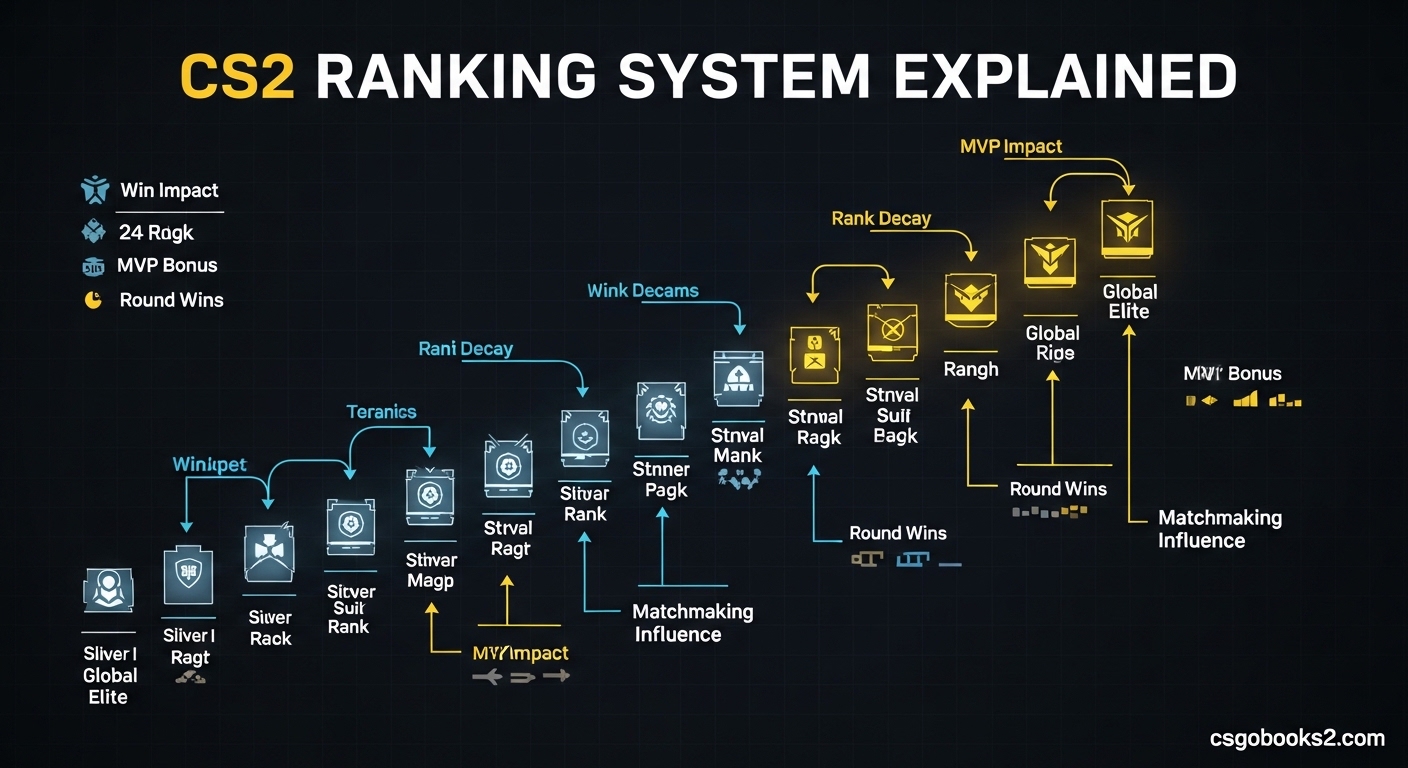
The CS2 ranking system explained wouldn’t be complete without covering Competitive mode, which uses the classic 18-rank system that CS:GO players know and love. These ranks are divided into six tiers, each with multiple divisions, and they’re assigned separately for each map in the pool.
The 18 Competitive Ranks
Silver I: The absolute starting point. New players begin here after placements.
Silver II: Slightly above complete beginner. You understand basic shooting.
Silver III: You can hold your own sometimes but lack consistency.
Silver IV: The top of Silver. You’re ready to move up with more practice.
Silver Elite: Breaking into Nova territory. You understand economy and basic teamwork.
Silver Elite Master: The gateway to Gold Nova. Consistent improvement needed.
Gold Nova I: Average player territory. You have solid fundamentals.
Gold Nova II: You understand most maps and can execute basic strats.
Gold Nova III: Above average. You’re a reliable teammate.
Gold Nova Master: The bridge to MG. You’re consistently good.
Master Guardian I: Skilled player. You understand the game deeply.
Master Guardian II: You can carry matches and lead teams.
Master Guardian Elite: High-level play. Your aim and game sense are polished.
Distinguished Master Guardian: You’re among the top players. Consistency is your strength.
Legendary Eagle: Elite territory. You’re exceptional at the game.
Legendary Eagle Master: You’re nearly at the top. Few players reach this level.
Supreme Master First Class: The second-highest rank. You’re among the best globally.
The Global Elite: The pinnacle of CS2 Competitive. Fewer than 1% of players ever reach this rank.
Map-Specific Ranking Explained
Unlike Premier’s global rating, Competitive ranks you separately for each map. You can be Legendary Eagle on Mirage but Master Guardian on Ancient. This system reflects the reality that CS2 players often specialize on certain maps and struggle on others.
When you first play Competitive on a new map, you’ll need to complete placement matches for that specific map. After your initial placement, your rank on that map will evolve independently based on your performance there. This means you can be an Ancient specialist while grinding your way up on Vertigo separately.
Map-specific ranks make sense for players who want to focus on their favorite maps, but it can be frustrating for players who want to play whatever they want without maintaining multiple separate ranks. It also means queue times can vary significantly between maps, as players concentrate on their strongest ones.
Rank Groups and Tiers
The 18 ranks are organized into six groups: Silver, Gold Nova, Master Guardian, Legendary Eagle, Supreme, and Global Elite. Within each group, there are typically three divisions (I, II, III) or Elite/Master distinctions, creating a clear progression path.
Moving up within a tier (like from Gold Nova II to Gold Nova III) usually requires a few wins, but crossing tier boundaries (like from Gold Nova Master to Master Guardian I) often demands a more substantial winning streak or extended period of strong performance. The system is designed to prevent rapid rank fluctuation, so you’ll typically spend several hours at each rank before moving up or down.
How CS2 Ranking Mechanics Work Behind the Scenes?
Understanding the visible ranks and ratings is one thing, but grasping the hidden mechanics that drive them is another. The CS2 ranking system explained premier rating algorithm uses several factors behind the scenes to calculate your skill level, and knowing these can help you understand why your rating behaves the way it does.
What Affects Your Rating Gains?
The primary factor is match outcome, pure and simple. Winning is the only way to increase your rating over the long term. However, the magnitude of each gain or loss depends on the rating difference between teams and your individual performance.
Beating a team with a higher average rating yields larger gains because the system assumes you performed better than expected. Similarly, losing to a lower-rated team costs more points because it indicates you underperformed. Close matches between evenly-matched teams typically result in smaller rating changes regardless of outcome.
Your individual stats do matter, but less than most players think. A player who goes 30-10 in a loss might lose 50 points while a teammate who went 10-20 loses 80. The system rewards contribution, but not enough to completely override the loss. This is why some players feel their performance doesn’t matter, and in a way, they’re right, wins are weighted more heavily than individual stats.
Why Rating Gains Feel Inconsistent?
This is the number one complaint from players on Reddit and Steam forums, and it’s valid. You can win two identical matches in a row and gain 200 points one time and 50 the next. The system isn’t broken, but it is complex.
The rating system tries to predict match outcomes based on team ratings, and when the prediction is wrong, it makes larger adjustments to correct. If you win a match you were “supposed” to lose, the system updates your rating aggressively. If you win a match you were heavily favored to win, the adjustment is minimal because the result was expected.
This creates the perception of inconsistency because you can’t see the hidden prediction behind each match. From your perspective, you won two matches, but from the system’s perspective, one win was an upset and the other was expected, resulting in different gains.
Win Streaks and Performance Impact
Win streaks are the fastest way to gain rating in CS2 Premier. The system interprets consecutive wins as evidence that you’re underrated, and it will progressively increase your gains with each victory. A five-game win streak can net you 1,000+ rating points, while the same number of wins spread out with losses might only gain you 300 points.
Conversely, loss streaks are devastating to your rating. The system accelerates your decline during losing streaks, which is why players often feel they’re “stuck” after a bad run, it takes much longer to climb back than it took to fall.
Your performance during these streaks does moderate the gains and losses, but again, not enough to completely override the streak bonus. A 30-bomb loss streak still drops your rating significantly, just slightly less than if you were bottom fragging every game.
Matchmaking Balance System
Valve’s matchmaking tries to create balanced matches by combining players with similar ratings, but this sometimes results in lopsided teams. You might see a 15,000-rated player queued with 9,000-rated players, creating frustration for everyone involved.
The system does this to reduce queue times, especially at off-peak hours or in less-populated regions. It would rather create a slightly imbalanced match quickly than make you wait 20 minutes for a perfectly balanced one. This is another source of player frustration, but it’s a necessary trade-off for playable queue times.
CS2 Premier Rating to Competitive Rank Conversion
Players constantly ask about converting between the two systems, and while there’s no official conversion, we can estimate equivalencies based on player distribution and skill level. This CS2 ranking system explained conversion helps you understand where you stand in both systems.
Tier-to-Rank Equivalency Chart
Gray Tier (1,000 – 4,999) = Silver I to Silver IV: New players learning the fundamentals.
Light Blue Tier (5,000 – 9,999) = Silver Elite to Gold Nova II: Casual players with basic competence.
Blue Tier (10,000 – 14,999) = Gold Nova III to Master Guardian I: The average CS2 player. Solid mechanics and game sense.
Purple Tier (15,000 – 19,999) = Master Guardian II to Distinguished Master Guardian: Above-average players. Can carry matches regularly.
Pink Tier (20,000 – 24,999) = Legendary Eagle to Legendary Eagle Master: Highly skilled. Top 10-15% of players.
Red Tier (25,000 – 29,999) = Supreme Master First Class: Elite players. Top 5% globally.
Yellow Tier (30,000+) = The Global Elite: The best players in the game.
Why the Systems Don’t Match Perfectly?
The conversion is rough because the systems measure slightly different things. Premier rating is global and considers all maps equally, while Competitive ranks are map-specific. You might be a Mirage specialist with a high rating but struggle on Nuke, resulting in different ranks.
Additionally, the player pools overlap but aren’t identical. Some players only touch Premier, others only play Competitive, and this creates slight discrepancies in the skill curves between the two systems. Use this conversion as a general guideline, not a precise mapping.
How to Rank Up Faster in CS2?
Now that you understand how the CS2 ranking system explained premier rating works, let’s talk about practical strategies to climb faster in both systems. These tips come from analyzing high-level players and common patterns among those who rank up consistently.
Premier Mode Ranking Tips
Play during peak hours when the player pool is largest. This creates more balanced matches and reduces the likelihood of being matched against much stronger or weaker teams. Queue times might be longer, but the quality of matches is better.
Stack with friends who are close to your rating. Five-stack teams have more control over their matches because they can coordinate, communicate effectively, and avoid the randomness of solo queue teammates. A coordinated team of 12,000-rated players can beat a disorganized mix of 15,000-rated players.
Focus on winning, not stats. The system rewards wins above all else, so playing for the team victory will rank you up faster than chasing kills. Support your teammates, trade kills, and play objective-based CS2.
Competitive Mode Ranking Tips
Specialize on 2-3 maps rather than trying to rank up on all of them. Becoming exceptional on Mirage, Inferno, and Ancient is better than being mediocre on nine maps. Map knowledge, grenade spots, and common angles give you a significant advantage.
Use deathmatch and aim training to warm up before playing Competitive. Going into ranked matches cold is the fastest way to lose games you should have won. Spend 15-20 minutes practicing aim and movement before queuing.
Watch your own demos. Recording your matches and reviewing them helps you identify mistakes, bad habits, and missed opportunities. Self-analysis is one of the fastest ways to improve, yet few players do it consistently.
Avoiding Rank Decay
CS2 doesn’t have traditional rank decay like some games, but your skill can deteriorate if you don’t play regularly. Taking long breaks can make you rusty, and you might lose several matches before returning to your previous form.
Play at least a few matches per week to maintain your mechanics and game sense. Even deathmatch and casual modes help keep your skills sharp during busy periods when you can’t commit to full competitive matches.
Don’t queue while tilted. Losing streaks affect your decision-making and can lead to poor performance that accelerates rating loss. Take a break after a few losses, reset mentally, and come back when you’re playing your best.
Frequently Asked Questions About CS2 Ranking
How does the CS2 Premier ranking system work?
CS2 Premier uses a numerical CS Rating from 1,000 to 30,000+ that increases with wins and decreases with losses. Your rating changes based on match outcome, opponent strength, and individual performance. The system groups players into seven color-coded tiers and updates your rating after every match.
What is the difference between Premier and Competitive mode?
Premier Mode uses a global CS Rating (1,000-30,000+) across all maps with seasonal leaderboards, while Competitive Mode uses map-specific ranks from Silver to Global Elite. Premier is designed for serious competitive play with full teams, while Competitive offers traditional ranked play on individual maps.
How many wins does it take to get a rank in CS2?
New players must complete 10 placement matches in both Premier and Competitive modes to receive their initial rank. After placements, your rank or rating updates after every match, with no fixed number of wins required to reach the next level.
Can you lose your rank in CS2?
Yes, you can lose rank or rating in CS2. Losing matches decreases your Competitive rank and Premier rating. CS2 doesn’t have traditional time-based rank decay, but extended inactivity can lead to skill deterioration and poor performance when you return.
What is the highest CS2 Premier rating?
The highest CS2 Premier ratings exceed 30,000, placing players in the Yellow tier. These ratings represent the absolute best players globally, including professionals and top-tier competitive players. Fewer than 1% of players ever reach 30,000+.
How do I get my first rank in CS2?
Complete 10 placement matches in either Premier or Competitive mode to receive your initial rank. The system evaluates your performance during these matches, considering wins, losses, and individual stats to determine your starting skill level.
Conclusion: Mastering CS2’s Ranking Systems
The CS2 ranking system explained premier rating is complex, but understanding how both Premier and Competitive systems work will help you track your progress more effectively and set realistic goals. Whether you’re grinding for that 30,000 CS Rating or working toward Global Elite on your favorite maps, remember that consistency and team play matter more than individual stats.
Focus on winning matches, play with coordinated teams when possible, and don’t get discouraged by inevitable losing streaks. The system is designed to find your true skill level, so plateaus are normal, and occasional rating drops are part of the process. Keep practicing, stay patient, and you’ll see your rating climb over time.