
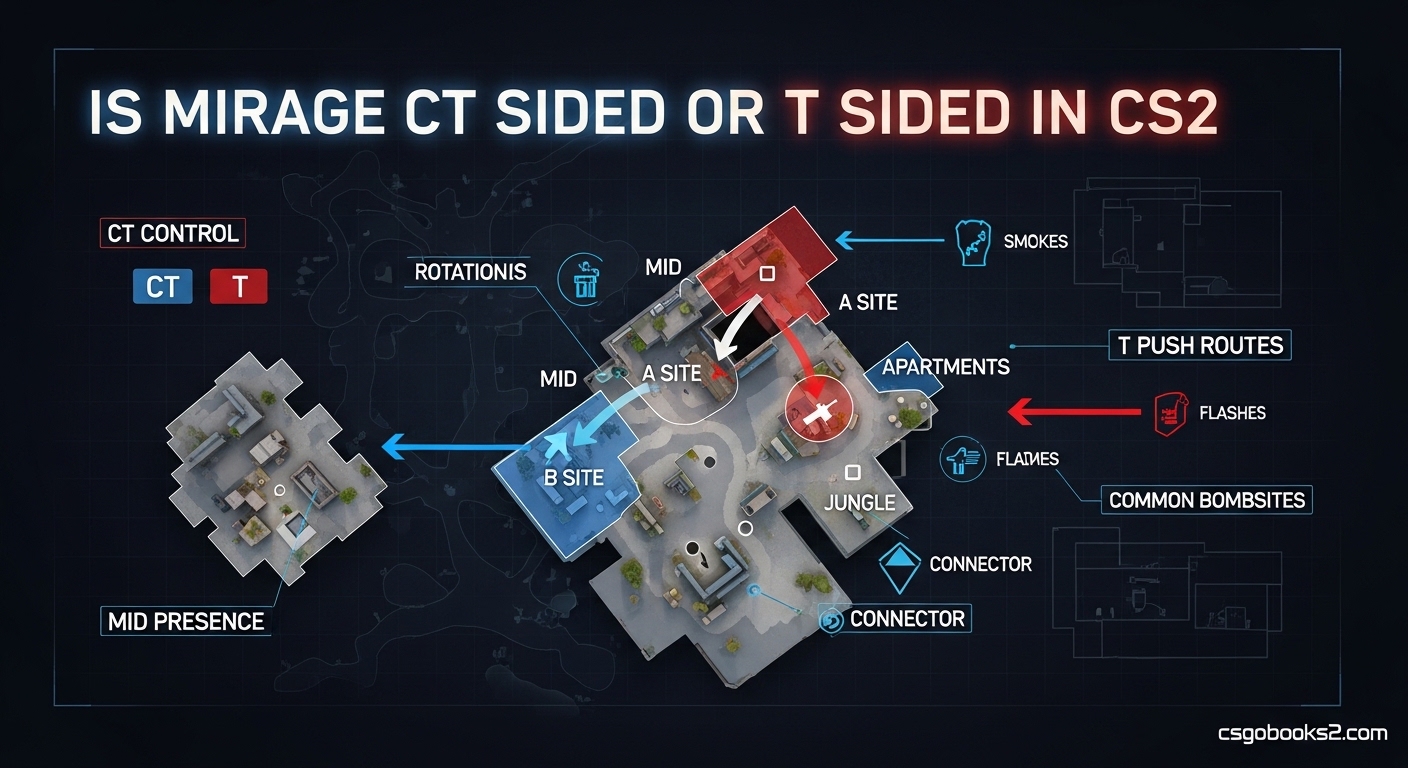
Mirage is CT-sided in CS2. Based on competitive data from over 1 million FACEIT matches, Counter-Terrorists win approximately 54.2% of rounds on Mirage, giving them a notable 8.4% advantage over Terrorists. This makes Mirage one of the more CT-favored maps in the current CS2 map pool, though not to the extreme degree of maps like Nuke. Understanding this inherent advantage helps players adjust their strategies and expectations when playing or watching matches on this classic map.
Is Mirage CT Sided or T Sided?
Mirage is definitively CT-sided. The 54.2% CT win rate represents a significant statistical advantage that holds true across most skill levels. This means that if teams were equally skilled, the CT side would win roughly 11 out of every 20 rounds played. The map’s design inherently favors defenders through its layout, chokepoint placement, and rotation timing. However, this doesn’t mean T side is impossible – it simply requires more coordination and better execution to overcome the structural disadvantages.
The CT advantage on Mirage becomes even more pronounced in lower ranks where coordination is harder to achieve. I’ve seen countless matches where teams go 11-4 or 10-5 on CT side, only to struggle when switching to T side. This asymmetry is exactly why understanding map sidedness matters for your competitive strategy and mental game preparation.
Why Mirage Is CT Sided – Map Layout Factors
Mirage’s CT advantage stems from several key design elements that work together to favor defenders. The map features open bombsites that allow CTs to see and engage attackers from multiple angles, making it difficult for Ts to execute cleanly. Unlike more closed maps, Mirage’s A-site and B-site both have multiple entry points that CTs can cross-fire and cover simultaneously.
The rotation paths on Mirage are exceptionally fast for CTs. A player defending A can reach B in under 10 seconds through mid, and vice versa. This quick rotation capability means CTs can play aggressively early, fall back if needed, and still arrive in time to support retakes. Terrorists don’t have this luxury – once they commit to a site, they’re essentially all-in.
Mid control plays a crucial role in Mirage’s CT-sidedness. As long as CTs maintain mid control, T’s only push options become narrow choke points that aren’t too hard to hold if handled properly. The apartments, jungle, and connector all funnel Ts into predictable areas where well-placed CTs can wait with utility and cross-fire setups.
Open Bombsites Advantage
Both bombsites on Mirage feature relatively open designs that benefit defenders. A-site has the classic palace and stairs area where CTs can hold from multiple angles, while B-site offers the van, market, and window positions that create cross-fire opportunities. These open sightlines mean CTs can see Ts coming from distance and engage before attackers can effectively plant or execute their utility.
Terrorists trying to take a site must clear multiple angles simultaneously, which requires perfect coordination. In pug matches and lower ranks, this coordination rarely happens, giving CTs an even larger advantage. The open nature also makes smokes and flashes less effective for Ts since CTs can often see around or through utility with proper positioning.
Chokepoint Design
Mirage’s chokepoints are designed to favor defenders. The main entries to both sites – apartments for A and tunnels for B – are narrow corridors where Ts must push single-file or in small groups. This makes them vulnerable to grenades, molotovs, and well-aimed shots from CTs waiting in position. Once Ts commit to pushing through these chokepoints, they have limited escape options if things go wrong.
The connector area serves as another chokepoint that CTs can use to their advantage. By controlling connector, CTs can effectively divide the map and prevent Ts from rotating between areas or supporting their teammates. This creates isolation situations where CTs can essentially fight 5v3 or 5v2 engagements if they’ve properly positioned themselves.
CT Side Advantages on Mirage
Playing CT on Mirage offers numerous strategic advantages beyond just map layout. The defensive side can use the environment to create unpredictable holding positions, force unfavorable engagements, and maximize the effectiveness of their utility. I’ve found that CT side on Mirage rewards creativity and game sense more than raw aim, allowing smart players to outmaneuver opponents regardless of mechanical skill.
The economy management on CT side is also more forgiving. Even if CTs lose a round, they can often buy together the following round due to the kill bounty and lower weapon costs compared to full T buys. This economic resilience means CTs can maintain their defensive structure more consistently throughout the match, while one bad round for Ts can spiral into an economic reset.
Defensive Positioning Options
CTs on Mirage have access to numerous holding positions that make them difficult to predict and counter. On A-site alone, defenders can play from palace, stairs, jungle, sandwich, ticket booth, or even aggressive positions in apartments or T spawn. This variety means Ts never know exactly where CTs are waiting, forcing them to check multiple angles during executes.
The ability to mix passive and aggressive holds keeps Ts guessing. Some rounds CTs might play deep and wait for Ts to push, other rounds they might pressure apartments or connector early to disrupt T timing. This unpredictability is a core advantage of CT side on Mirage and explains why coordinated CT teams can dominate even against skilled opponents.
Utility Effectiveness
CT utility on Mirage is exceptionally effective due to the map’s geometry and chokepoint design. Molotovs can block apartment pushes, stairs, or jungle for extended periods. HE grenades can damage players pushing through narrow areas like connector or B tunnels. Smoke screens can cut off mid control or delay site executes until support arrives from the opposite site.
The map’s design also makes CT utility easier to use effectively. Many CT utility spots are simple one-button throws that don’t require complex lineup practice, while T utility on Mirage often requires precise coordination and timing to be effective. This means CTs can get more value from their utility even in less organized matches.
T Side Challenges and Strategies
Despite the CT advantage, T side on Mirage is far from impossible. The key is understanding what you’re working with and playing to your strengths. I’ve found that successful T sides on Mirage focus on taking mid control, faking executes to draw CT rotations, and hitting sites with overwhelming numbers and utility rather than trying to pick apart CT holds one by one.
The biggest challenge for Ts is the lack of map control in the early round. Without mid control, Ts have limited information about CT positions and must execute into potentially stacked sites. This is why mid control is so contested at high levels – the team that wins mid usually dictates how the round plays out. Without mid control, T side becomes significantly harder and requires near-perfect executes to succeed.
Mid Control Importance
Mid control is the single most important factor for T side success on Mirage. When Ts control mid, they gain information about CT positions, can fake executes more convincingly, and have multiple routes to both sites. Mid control also opens up sneaky plays like palace takes, B apps control, or window smoke opportunities that can catch CTs off guard.
Winning mid control requires coordination but pays dividends throughout the round. A simple 2-1-2 setup with mid presence can quickly turn into a 4-1 or 5-0 attack on either site depending on CT rotations. The flexibility that mid control provides is exactly why coordinated teams have much more success on T side Mirage than unorganized pugs.
A-Site Execution Tips
Taking A-site on Mirage requires proper utility usage and timing. The most common approach involves smoking stairs, jungle, and connector while molotoving palace and ticket booth. This utility setup creates a safe plant zone but requires multiple players to execute properly. The apartments route also needs coordination – one player should flash for others, and someone needs to watch for CTs rotating from connector or CT spawn.
The biggest mistake I see Ts make on A-site is peeking one at a time without utility support. This plays directly into CT cross-fire setups and makes taking the site nearly impossible. Instead, Ts should commit together, throw all their utility at once, and rush the plant position as a team. Even if the first player dies, the following players can trade and secure the site.
B-Site Execution Tips
B-site executes on Mirage often focus on controlling B apartments and using the window smoke to block CT vision from market. A coordinated B-hit typically involves smoking window, flashing market, and molotoving backsite while players push from apartments and B tunnels. The key is speed – CTs can rotate very quickly from A or mid, so hesitation gives them time to stack the site.
Like A-site, B executes require multiple players to work together. One player should focus on getting the window smoke, another on flashing market, and others on watching CT rotations from top mid or connector. The plant itself should happen immediately after clearing the main positions – there’s no time to wait around or CTs will arrive and make retaking significantly easier.
How Mirage Sidedness Changes by Rank?
Mirage’s CT-sidedness isn’t consistent across all skill levels. In lower ranks, the map becomes even more CT-sided because T side requires more coordination and game knowledge to execute effectively. I’ve watched countless Silver to Nova matches where teams go 11-4 or 12-3 on CT side, then struggle to win even a single round on T side.
As ranks increase, Mirage becomes slightly more balanced. At Global Elite and Faceit levels, T sides are much more effective because teams have better communication, more developed strategies, and can properly execute mid control and site takes. The map still favors CTs at high levels, but the advantage shrinks from 8.4% to maybe 5-6% because Ts can minimize their mistakes and maximize their utility.
This rank-based difference explains why Mirage feels oppressively CT-sided to some players while others find it reasonably balanced. Your experience on Mirage depends heavily on your rank and the quality of your teammates. In solo queue pugs, T side will always feel harder because coordination is inherently limited.
CS2 Map Sidedness Overview – How Mirage Compares
Mirage sits in the middle-to-upper tier of CT-sided maps in CS2. It’s not as extreme as Nuke, which can reach 58-60% CT win rate, but it’s more CT-favored than relatively balanced maps like Ancient or Overpass. Understanding where Mirage falls in the map pool hierarchy helps contextualize its design and why certain strategies are more effective than others.
The current CS2 map pool includes several CT-sided maps (Nuke, Mirage, Ancient), a few T-sided maps (Vertigo, Anubis, Inferno), and some relatively balanced options (Overpass). This variety keeps the game interesting and forces teams to adapt their playstyle based on the map. Mirage specifically rewards good CT fundamentals like cross-fire positioning, quick rotations, and effective utility usage.
All CS2 Maps Ranked by CT Win Rate:
Nuke (~59% CT) – Most CT-sided map due to verticality and difficult bomb sites
Mirage (~54% CT) – Strong CT advantage from open sites and quick rotations
Ancient (~52% CT) – Slight CT favor due to chokepoint design
Overpass (~51% CT) – Nearly balanced with slight CT edge
Inferno (~49% CT) – Slight T favor from narrow chokepoints
Anubis (~47% CT) – T-sided due to water control and open mid
Vertigo (~45% CT) – Most T-sided from difficult CT positions
As you can see, Mirage’s 54.2% CT win rate makes it notably CT-sided but not to an extreme degree. This balance is likely why Mirage has remained one of the most popular and enduring maps in Counter-Strike history – it rewards good fundamentals on both sides without feeling completely unfair to either team.
FAQs
Is Mirage a CT side or T side?
Mirage is a CT-sided map in CS2. Counter-Terrorists win approximately 54.2% of rounds on Mirage, giving them a significant statistical advantage over Terrorists. This CT advantage comes from the map’s open bombsites, quick rotation paths, and chokepoint design that favors defenders.
What maps are CT and T-sided in CS2?
CT-sided maps in CS2 include Nuke (59% CT win rate), Mirage (54% CT), Ancient (52% CT), and Overpass (51% CT). T-sided maps include Vertigo (45% CT), Anubis (47% CT), and Inferno (49% CT). These statistics are based on millions of matches played across all skill levels.
Is Mirage attacker or defender sided?
Mirage is defender-sided, meaning Counter-Terrorists have the advantage. Defenders win 54.2% of rounds on Mirage due to favorable positioning, quick rotations between bombsites, and chokepoint design that makes it difficult for attackers to execute successfully without excellent coordination.
Why is Mirage so CT-sided in lower ranks?
Mirage feels even more CT-sided in lower ranks because T side requires coordination and communication to execute effectively. In Silver through Nova ranks, teams rarely have the coordination to properly execute site takes or control mid, making CT side significantly easier to play. This often results in lopsided scores like 11-4 or 12-3 in favor of CTs.
How do I play T-side Mirage effectively?
Effective T-side Mirage requires focusing on mid control, coordinating executes with proper utility usage, and committing together as a team rather than peeking one at a time. Take mid early to gain information, use fakes to draw CT rotations, and hit sites with multiple players and full utility. Don’t try to pick apart CT holds individually – you’ll lose the cross-fire battles.
Does Mirage favor CTs more at certain ranks?
Yes, Mirage is more CT-sided at lower ranks and becomes slightly more balanced at higher ranks. In Silver to Nova matches, T side is extremely difficult due to lack of coordination. At Global Elite and Faceit levels, T sides become much more effective because teams have better communication and strategies, reducing the CT advantage from 8.4% to around 5-6%.
Conclusion
Mirage is CT-sided in CS2 with Counter-Terrorists winning 54.2% of rounds overall. This advantage comes from the map’s open bombsites, quick CT rotation paths, and chokepoint design that favors defenders. However, Mirage is not extremely CT-sided like Nuke – skilled teams with good coordination can find success on T side by focusing on mid control and coordinated executes.
Understanding that Mirage is CT-sided helps you adjust your expectations and strategies. If you start on CT side, aim to maximize your advantage by holding good positions and using your utility effectively. If you start on T side, focus on taking mid control and coordinating with your team rather than trying to win individual duels. With the right approach, you can overcome Mirage’s CT advantage and help your team secure victories regardless of which side you start on.