
Ever stared at a 35-second bomb timer with your heart pounding, knowing you need to retake the site or lose the round? That feeling never gets easier, but you can get better at handling it. This CS2 retake guide post plant situations breakdown will transform how you approach the most intense moments in Counter-Strike.
After analyzing hundreds of retake scenarios and studying how pros handle post-plant pressure, I’ve identified the exact patterns that separate consistent clutch winners from players who crumble. The difference isn’t aim—it’s preparation, positioning, and decision-making under pressure.
In this guide, you’ll learn a complete CS2 retake guide post plant situations framework covering both CT-side retakes and T-side afterplant defense. We’ll cover everything from basic mechanics to advanced techniques like bomb taps and ninja defuses that can turn certain defeats into round-winning plays.
What Are Retakes in CS2?
Retakes in CS2 are post-plant scenarios where the CT team must fight back into a bombsite, eliminate defending T players, and defuse the bomb before the 40-second timer expires. The retake mode in CS2 simulates these high-pressure situations repeatedly, letting you practice without the stakes of a competitive match.
Here’s how retakes work: Ts spawn first, plant the bomb at either site A or B, then set up defensive positions. CTs spawn around the bombsite area and must coordinate their approach to retake control. In the official retake mode, you’ll play 5v5 scenarios with randomized weapons, utility, and spawn positions to keep you adapting.
The bomb timer is your biggest constraint in retakes. At 40 seconds, you have less than half the time of a full round to make decisions, execute trades, and complete the defuse. Every second matters, which is why having a pre-planned approach beats improvising every time.
Why Mastering Retakes Matters?
Winning retakes directly correlates with your rank and win rate. When the bomb is down, the round outcome depends entirely on how well you handle post-plant situations. Players who excel at retakes win more rounds, climb faster, and consistently perform in clutch moments.
Retakes matter even more in 2026 because the updated mechanics reward structured team play over individual heroics. CS2’s improved smoke visibility, flashbang changes, and molotov mechanics all favor coordinated retakes over solo pushes. If you’re still playing retakes like it’s CSGO, you’re leaving advantages on the table.
The skill gap in retake situations is massive at every rank. Silver players panic and run in one by one. Global Elites set up crossfires, trade effectively, and use utility to create advantages. Mastering retakes isn’t just about winning more rounds—it’s about becoming the player your team trusts when the timer is ticking.
CS2 Retake Guide Post Plant Situations: Step-by-Step Process (October 2026)
This step-by-step framework is the core of effective retakes. Follow this sequence every time, and you’ll eliminate decision paralysis and execute with purpose.
Step 1: Assess Player Count and Positions
Before you peek a single angle, know exactly what you’re facing. Check the scoreboard: how many Ts are alive? Where did they last play? This information tells you whether to force a retake or cut your losses and save.
If you’re outnumbered 1v3 or 1v4, forcing a retake is usually the wrong play. Preserve your weapon for the next round unless the bomb timer is under 10 seconds. If it’s 2v2 or 3v3, you have a realistic chance with proper execution.
Listen for audio cues: footsteps, weapon pickups, scope zoom sounds. These tell you where Ts are positioning and whether they’re expecting your push. Good comms from alive teammates who are spectating can give you position info—use it.
Step 2: Check Bomb Timer and Kit Status
The bomb timer dictates your entire approach. With 30+ seconds remaining, you have time to fake, reset, and retake properly. Under 15 seconds, you need to force fights and take risks. Under 8 seconds, you’re in panic territory—sometimes a direct sprint to the bomb is your only play.
Defuse kit status changes everything. With a kit, you need 5 seconds to defuse. Without one, you need 10 seconds. That 5-second difference determines whether you can fake defuse, reposition, or must commit immediately. If you don’t have a kit and the timer is under 12 seconds, your chances drop significantly.
Always communicate kit status to your team. “I have no kit, 15 seconds left” tells your teammates they need to win duels or create space for you. This information prevents miscommunication and bad timing.
Step 3: Plan Utility Usage
Utility wins retakes more than raw aim. Before executing, decide who’s smoking what, who’s flashing, and what angles you’re clearing. Randomly throwing grenades mid-fight is waste—planned utility creates advantages.
Your utility sequence should follow this pattern: smokes first to cut off sightlines, then flashes to enable entry, then molotovs to clear corners and force enemies out of position. Coordinate with teammates so you’re not throwing overlapping utility or leaving gaps in your coverage.
Save utility for key moments. A well-timed flash to open the site is worth more than throwing it randomly into a corner. A molotov that forces a T off the bomb creates defuse opportunities. Every grenade should have a specific purpose.
Step 4: Set Up Crossfire Angles
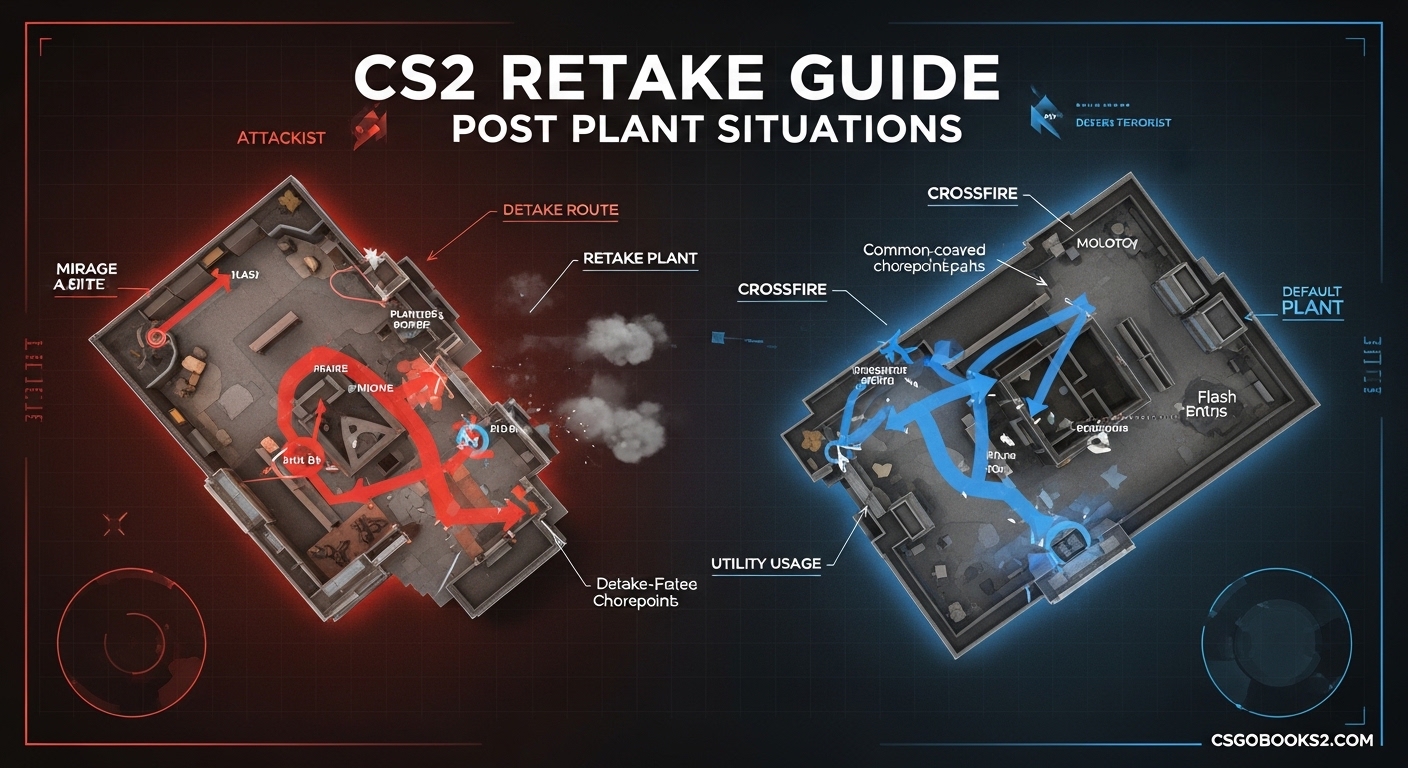
Crossfires are the single most important retake mechanic. Instead of peeking the same angle as your teammate, position yourself to cover their exposed areas. If they peek long and die, you trade. If they get info, you act on it.
Good crossfire positioning means spacing 5-10 feet apart—close enough to trade, far enough to avoid getting sprayed together. One player takes tight angles, the other watches wide. One watches high ground, the other low. This complementary coverage makes it nearly impossible for Ts to win both duels.
Avoid stacking with teammates. When three CTs peek from the same position, one well-placed molotov or spray transfer can end the retake instantly. Spread out, cover multiple angles, and make Ts choose which duel to lose.
Step 5: Execute Trade Kills
Trading is the mechanic that makes retakes possible. When your teammate dies peeking an angle, you must immediately peek and trade the kill. This requires positioning yourself to see the engagement before it happens and being ready to fire the moment your teammate goes down.
The trade window in CS2 is tiny—maybe 0.5-1 second before the T repositions. If you’re too far back or too slow, you miss the trade. Stay close enough to your teammates to trade, but not so close that one utility piece takes both of you out.
Communication enables trading. Call where you’re peeking, what you see, and when you need a trade. “Peeking long now, trade me” gives your teammate the heads-up to be ready. Silent retakes work for ninja defuses, but coordinated trading requires comms.
Step 6: Defuse with Backup
Once the site is cleared, the defuse begins—but you’re not safe yet. Always have a teammate watching your back while defusing. They cover angles where Ts could be lurking or rotating back. Never defuse alone unless absolutely necessary.
Position yourself to see the most likely approach angles while defusing. If Ts are pushing from long, face that direction. If they could come from short, keep your crosshair there. Awareness during the defuse prevents last-second deaths that turn certain wins into losses.
Fake defuses can be powerful tools. A quick tap on the defuse can bait Ts into peeking, giving your teammates free kills. Use this when you have time andTs are playing passively. But don’t overuse it—one well-timed molotov on a fake defuse ends the round.
Utility Usage for Effective Retakes
Proper utility usage separates average retake players from great ones. Each grenade type has specific applications in post-plant situations, and knowing when to use what makes all the difference.
Smoke Grenades
Smokes are your most important utility in retakes. They cut off vision, create safe paths to the bomb, and force Ts into unfavorable positions. Smoke the main angle Ts are holding, then push through the smoke or use it as cover to reposition.
One-way smokes are particularly powerful in retakes. If you know a common T holding position, smoke slightly in front of it. You can see their silhouette against the smoke while they can’t see you at all. This asymmetry gives you free kills when timed right.
Chain smokes together to create complete vision denial. Smoke one angle, swing through, smoke the next, repeat. This systematic approach clears the site methodically instead of peeking everything at once and getting traded.
Flashbangs
Flashes enable you to win duels you’d otherwise lose. In retakes, use flashes to open sightlines, clear corners, and create entry opportunities. A well-thrown flash can blind multiple Ts, giving your team the opening needed to take control.
Pop flashes are the most effective flash type in retakes. Thrown so they explode just as you peek, they leave no reaction time for enemies. Practice pop flash lineups for common retake angles on each map—having these ready makes you a threat in any post-plant situation.
Coordinate flashes with teammates. One player flashes, the other peeks. This timed sequence makes it nearly impossible for Ts to win both duels. Just be careful not to flash your own teammates—communicate who’s flashing and who’s peeking.
Molotovs and Incendiaries
Molotovs are area denial tools that force Ts out of position. During retakes, throw molotovs at common holding spots to clear corners without peeking. If a T is playing a tight angle, a molotov forces them to move or burn—either way, you gain an advantage.
Molotovs are also clutch defuse tools. If you suspect a T is lurking near the bomb, throw a molotov before defusing. This either reveals their position or forces them away, buying you precious seconds to complete the defuse safely.
Incendiaries on CT side work the same way but with larger area coverage. Use them to block off chokepoints, clear multiple angles at once, or deny Ts from retaking their own position after you’ve taken the site.
Best CS2 Retake Servers for Practice
Practice is the only way to internalize retake mechanics, and the right servers make that practice more effective. Here are the best options for improving your retake game in 2026.
Official CS2 Retake Mode
The official retake mode in CS2 is the most accessible practice option. Found in the game mode selection, it offers 5v5 retake scenarios with randomized weapons, utility, and bomb positions. The queue times are fast, the skill matching is decent, and you get consistent practice without needing to find community servers.
Official retakes award XP and help level up your service medal, making them rewarding beyond just practice. The randomized nature forces you to adapt to different situations, building versatility that transfers to competitive play.
CYBERSHOKE Retake Servers
CYBERSHOKE offers premium retake servers with configurable scenarios, better tickrate, and more consistent player skill levels. Their servers feature pre-set bomb positions, specific utility loadouts, and the ability to practice particular situations repeatedly—perfect for mastering specific site retakes.
Access CYBERSHOKE servers through the community server browser. Search “CYBERSHOKE” in the tags, filter by retake mode, and join a server with good ping. The player base tends to be more serious about practice, leading to higher-quality retake scenarios.
XPLAY Retake Servers
XPLAY is another popular community server option with well-maintained retake servers. Their setup emphasizes balanced teams, fair weapon distribution, and a variety of bomb plant positions. The servers run at 128 tick for smoother gameplay and more accurate practice.
Find XPLAY servers through the community browser or connect directly via console using their IP addresses. The community is generally welcoming to new players, making it a good place to learn retake fundamentals without getting destroyed by pros.
Workshop Maps and YPrac
For solo practice, workshop maps like YPrac’s retake scenarios let you practice specific angles, pop flashes, and utility lineups without the pressure of live opponents. Load these maps in offline mode and run through the same scenario dozens of times until the mechanics become muscle memory.
Search the CS2 workshop for “retake practice” or “YPrac retakes” to find the most popular options. These maps are particularly useful for learning smokes, flashes, and molotov positions for specific bombsites on each map.
Common Retake Mistakes to Avoid
Even experienced players make these mistakes in post-plant situations. Recognizing and eliminating them from your game will instantly improve your retake win rate.
Taking First Contact Alone
Peeking an angle alone when you have teammates is the quickest way to die in retakes. Unless you’re the last player alive, wait for your team before engaging. Let someone else take first contact while you position to trade. This simple change turns certain deaths into traded kills.
Not Checking the Bomb Timer
How often have you seen someone fake defuse with 2 seconds left, only to die before the defuse completes? Not checking the timer leads to fatal mistakes. Always know exactly how much time you have and adjust your play accordingly. Under 10 seconds, speed is everything. Over 20 seconds, you can be methodical.
Throwing Utility at Wrong Times
Smoking after you’ve already peeked, flashing your own team, throwing molotovs that block your own path—these utility mistakes waste grenades and get you killed. Plan your utility before executing, throw it at the right moment, and coordinate with teammates to avoid overlap.
Panic Peeking in Clutch Situations
When you’re the last player alive, panic sets in and you start running without thinking. This is how you lose winnable rounds. Take a breath, assess the situation, check the timer, and make a plan. Even 5 seconds of deliberate thinking beats 5 seconds of panic spraying.
Not Communicating Information
Silent retakes work sometimes, but communication wins more rounds. Call what you see, where you’re going, and what you need. “Two long, one short, I’m pushing catwalk, need flash” gives your teammates the information to support you. Silent play leaves everyone guessing.
Advanced Retake Techniques
Once you’ve mastered the fundamentals, these advanced techniques give you edges in specific situations. Use them sparingly—when they work, they look amazing, but when they fail, you lose rounds you should have won.
Bomb Tap Mechanic
Bomb tapping is canceling a defuse in progress to bait enemies into peeking, then finishing the defuse after winning the duel. Start the defuse, wait for the sound to draw Ts in, cancel at the last second, kill the peeking player, then restart the defuse.
This technique works best when Ts are playing passively and you have time to waste. Time it wrong—canceling too early or too late—and you either don’t bait anyone or don’t have time to finish. Practice bomb taps in retake servers before trying them in competitive matches.
Fake Defuse Baits
Similar to bomb tapping but done with full intent to bait. Start a loud defuse, hide nearby, and wait for Ts to challenge. Kill them during their approach, then return to the bomb. This requires good positioning and timing—if they check your hiding spot first, you die without accomplishing anything.
Fake defuses work best when Ts are rushed and not checking corners carefully. Use this in low-time situations when they’re desperate to stop the defuse and might run in without clearing properly.
Ninja Defuse Opportunities
Ninja defuses are completed without clearing the entire site. When Ts are positioned far from the bomb or not watching it closely, you can sneak in, defuse, and escape without ever engaging. This requires precise timing, knowledge of T positions, and a bit of luck.
Listen for audio cues that indicate Ts are far away or distracted. Use smoke cover to approach the bomb unseen, then defuse as quickly as possible. Ninja defuses are high-risk, high-reward—when they work, you win impossible rounds. When they fail, you die without fighting back.
T-Side Afterplant Defense
Playing the T-side of retakes is an underappreciated skill. After planting, your job is to delay the defuse and trade kills. Position yourself to cover the bomb while remaining alive. Use utility to deny CT approaches and create time for your teammates to rotate back.
Good afterplant defense means not overcommitting to duels. Survive with the bomb in view, make CTs peek you, and trade if they kill you. One alive T with the bomb in play can win the round against multiple CTs if positioned correctly.
Frequently Asked Questions
Did CS2 remove retakes?
No, CS2 did not remove retakes. The retake game mode is still available and has been improved with updated mechanics and better matchmaking. You can access it through the game mode selection menu or find community retake servers through the server browser.
How does retakes work in CS2?
In CS2 retakes, terrorists spawn first and plant the bomb at either site A or B, then set up defensive positions. Counter-terrorists spawn around the bombsite and must coordinate to retake control, eliminate the Ts, and defuse the bomb before the 40-second timer expires. The mode features randomized weapons, utility, and spawn positions for variety.
Are retake servers good practice?
Yes, retake servers are excellent practice for CS2 players of all skill levels. They let you experience post-plant situations repeatedly without the stakes of competitive matches, building muscle memory for positioning, utility usage, and clutch decision-making. Regular retake practice translates directly to improved performance in actual matches.
Do you get XP from retakes in CS2?
Yes, you earn XP from playing the official CS2 retake mode. XP gains contribute to your profile rank and service medal progression just like other game modes. Community retake servers may not award XP depending on their configuration, but official matchmaking retakes definitely do.
How many players are in CS2 Retakes?
CS2 Retakes features 5 players per team in standard matchmaking, creating 5v5 post-plant scenarios. This matches the competitive format and lets you practice team coordination. Some community servers may offer different player counts, but 5v5 is the standard for both official mode and most popular retake servers.
Conclusion
Mastering CS2 retake guide post plant situations takes practice, but having a structured approach accelerates the process. Follow the step-by-step framework, use your utility deliberately, and avoid common mistakes. Your retake win rate will improve steadily.
The best players in 2026 didn’t get good at retakes by accident—they practiced specific situations repeatedly until the mechanics became instinct. Use official retake mode, community servers, and workshop maps to build that same muscle memory. Focus on one aspect at a time: trading, utility, positioning, then combine them into complete retakes.
Next time you’re staring at that 35-second timer with the bomb down, take a breath. Check your teammates, assess the situation, and execute your plan. You’ve got this.