
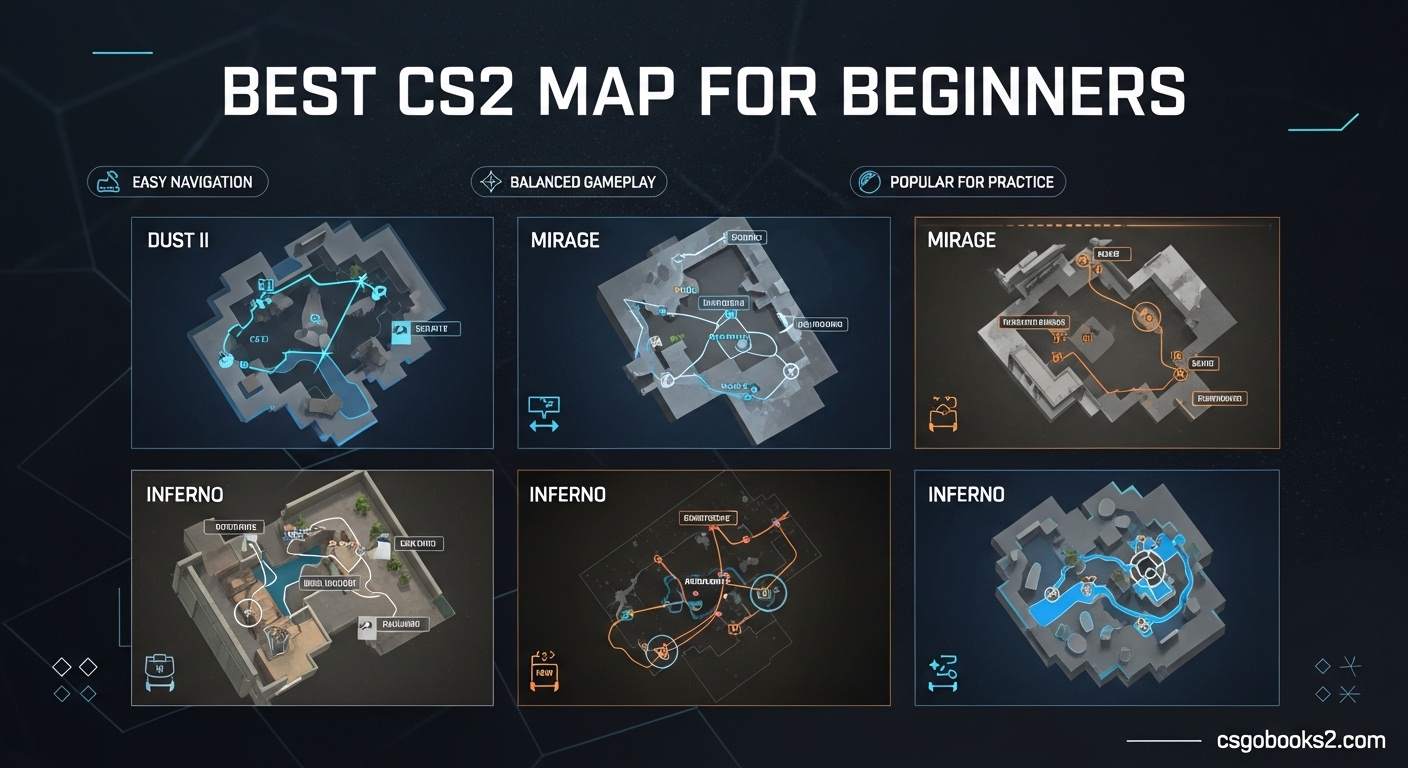
If you’re just starting your Counter-Strike 2 journey, choosing the right map can make or break your learning experience. After analyzing hundreds of community discussions and competitive gameplay data, I can confidently say that Dust II is the best CS2 map for beginners. Its simple three-lane layout, clear chokepoints, and widespread popularity make it the perfect training ground for new players to learn fundamentals without getting overwhelmed.
Map selection matters more than most beginners realize. Start on a complex map like Nuke or Vertigo, and you’ll spend more time confused than improving. The right beginner map lets you focus on crosshair placement, movement, and game sense instead of memorizing convoluted layouts.
In this guide, I’ll walk you through why Dust II is the ideal starting point, rank the best CS2 maps for beginners by difficulty, and give you a clear roadmap for progressing through the map pool in 2026.
Why Dust II is the Best CS2 Map for Beginners?
Dust II has been the starting point for Counter-Strike players since 2001, and for good reason. The map features a straightforward three-lane layout (Long A, Short, and Mid) that’s easy to visualize and navigate. Every angle makes sense, every chokepoint has a clear purpose, and you can learn the basic callouts in your first few matches.
What makes Dust II perfect for beginners is its balance. Neither side feels overwhelmingly advantageous, and individual skill matters more than complex team coordination. You can clutch rounds as a solo player, which builds confidence during those crucial first 100 hours.
The community consensus is overwhelming. On Reddit’s r/LearnCSGO, experienced players consistently recommend Dust II as the first map to learn. One user put it perfectly: “Dust II teaches you CS fundamentals without punishing you for not knowing pixel-perfect smoke lineups.”
Another advantage: you’ll never struggle to find Dust II matches. It’s consistently among the most-played maps in casual, deathmatch, and competitive queues. More matches mean more practice, and more practice means faster improvement.
Best CS2 Map for Beginners: Top 5 Ranked by Difficulty (October 2026)
After extensive research and community input, here’s the definitive ranking of CS2 maps for beginners, from easiest to most challenging:
1. Dust II – The Perfect Starting Point
Dust II is undisputed as the best CS2 map for beginners. The symmetrical layout means learning one side helps you understand the other. Sightlines are predictable, angles are standard, and there are no surprise positions that will catch you off guard.
Key beginner advantages:
- Clear three-lane structure (Long A, Short, Mid)
- Standard engagement distances perfect for rifle practice
- Simple verticality (only heaven on A site)
- Essential grenades are easy to learn
- Thousands of tutorials available
Expect to spend 20-30 hours feeling comfortable on Dust II. Once you can navigate without checking your radar and know basic smoke positions, you’re ready to expand your map pool.
2. Inferno – Simple Layout, Essential Utility
Inferno is the natural second map after Dust II. The layout is arguably even simpler—essentially two main paths to each bomb site—but CS2’s Inferno requires more utility knowledge. You’ll need to learn smokes for banana, arch, and library to be effective.
Why it’s beginner-friendly:
- Linear paths with clear objectives
- Close-quarters combat builds confidence
- Teaches fundamental utility usage
- Strong CT-side teaches positioning
The learning curve jumps slightly because poor utility execution gets punished harder than on Dust II. Budget 25-35 hours to become competent on Inferno.
3. Mirage – The Intermediate Bridge
Mirage introduces slightly more complexity with multiple routes to each site and more vertical positions to check. It’s still manageable for beginners but requires better game sense and map awareness.
Beginner challenges on Mirage:
- Multiple angles to check in apartments
- Window and connector require constant attention
- T-side requires more coordination
- More complex smoke setups
Mirage is where many beginners plateau. If you find yourself struggling, spend more time in deathmatch mastering the common engagement angles before queueing competitive.
4. Anubis – Modern Design, Beginner-Friendly
Despite being newer to the competitive pool, Anubis is surprisingly beginner-friendly. The mid-focused design creates natural team movement, and the map rewards standard positioning over complex strategies.
Why Anubis works for new players:
- Mid control is straightforward to understand
- Bomb sites have clear entry points
- Water area provides unique but simple mechanics
- Less meta-dependent than older maps
Anubis is a great alternative if you’re burned out on Dust II and Inferno but aren’t ready for Mirage’s complexity.
5. Ancient – Slightly More Complex
I debated including Ancient in the top 5, but it earns the final spot due to its relatively simple bomb site layouts. The mid area can be confusing for beginners, and CT-side requires good utility coordination.
Beginner considerations:
- T-side is straightforward with clear executes
- CT-side requires more communication
- Mid control is crucial but learnable
- Some verticality introduces new concepts
Save Ancient for after you’re comfortable on the first four maps. It’s a bridge to more complex maps rather than a starting point.
CS2 Maps to Avoid as a Beginner
Just as important as knowing which maps to learn is knowing which to avoid. These maps punish inexperience and will slow your improvement:
Nuke: The vertical complexity is overwhelming for beginners. Outside, heaven, hell, secret—there are too many layers to track simultaneously. Even experienced players struggle with Nuke’s angles.
Overpass: The multi-layer design creates confusing sightlines and requires deep map knowledge. Bathroom, playground, fountain—the callouts alone can be intimidating. Save this map for later.
Vertigo: Height mechanics and unique architecture make Vertigo a nightmare for beginners. One wrong step and you’re off the map. The scale is unlike any other CS2 map, which hurts muscle memory development.
Recommended Learning Order for CS2 Maps in 2026
Based on community consensus and competitive analysis, here’s the optimal learning progression:
- Weeks 1-3: Dust II only. Master the layout, basic smokes, and common angles.
- Weeks 4-5: Add Inferno. Focus on banana control and CT-side positioning.
- Weeks 6-7: Incorporate Mirage. Spend extra time in apartments and mid.
- Week 8: Learn Anubis as a secondary option.
- Week 9-10: Add Ancient to your pool.
- After 10 weeks: Consider Nuke, Overpass, or Vertigo.
This progression lets you build skills gradually. Each map introduces new concepts without overwhelming you with entirely new mechanics.
Best Game Modes for Learning CS2 Maps
The game mode you choose matters as much as the map itself. Here’s how to structure your practice:
Deathmatch: Start here. No economic pressure, no objectives—pure aim practice. Spend 10-15 minutes warming up on the map you’re learning. Focus on crosshair placement and pre-aiming common angles.
Casual: Your primary learning environment. The 10v10 format means less pressure, and you can experiment with positions and utility without ruining a competitive match. Play casual until you can navigate without checking your radar.
Premiere/Competitive: Only queue these modes once you’re comfortable on the map in casual. Nothing kills confidence faster than being the player who doesn’t know basic callouts or gets lost during executes.
Best Workshop Training Maps for Beginners
While competitive maps build game sense, workshop maps build raw skill. These community-created maps are essential for rapid improvement:
Aim Training Maps
aim_botz: The gold standard for aim training. Practice reflex shots, tracking, and spray control against bots that spawn predictably. Even 10 minutes before your sessions will noticeably improve your aim.
Aim Lab: Offers structured training scenarios that target specific skills. Great for diagnosing weaknesses in your aiming mechanics.
Recoil Pattern Practice
Recoil Master: Visual spray patterns teach you exactly how to control each weapon’s recoil. The AK-47 and M4A4 patterns are muscle memory you need to develop early.
Spend 15 minutes daily on recoil training until you can consistently control full sprays. It’s the single most impactful skill you can develop as a beginner.
Utility and Grenade Lineups
CS2_Aim_Bot: Not just for aim—includes grenade practice areas. Learn smoke, flash, and molotov lineups without wasting time in matches.
Map-specific lineup maps: Search the workshop for “[Map Name] lineups” to find collections of essential throws. Dust II lineups, Inferno smokes—these maps save hours of trial and error.
Movement Training
Surf maps: While not essential for beginners, surf maps build movement control that translates to better positioning. Start with easy surf maps like surf_beginner.
Bhop maps: Teach strafe jumping and movement optimization. Fun way to break up aim training while building valuable skills.
Common Beginner Mistakes When Learning Maps
After reading hundreds of forum posts and watching new players learn, here are the mistakes that slow progress:
Queueing competitive too early: You need 50-100 hours in casual and deathmatch before touching ranked. Jumping into competitive with zero map knowledge frustrates teammates and destroys confidence.
Learning multiple maps simultaneously: Pick one map and master it before moving on. Jack of all trades, master of none applies to CS2 maps. Deep knowledge of two maps beats shallow knowledge of five.
Ignoring utility: Smokes, flashes, and molotovs are force multipliers. Learn 3-5 essential grenades for each map. They’ll win rounds that pure aim can’t.
Not using radar: Your radar tells you everything. Teammate positions, enemy sightings, bomb location. Glance at it every 5-10 seconds until it becomes second nature.
Playing without sound: Footsteps, weapon switches, grenade throws—sound is information. Good headphones and proper audio settings give you an unfair advantage over players who don’t listen.
FAQs
Is CS2 beginner friendly?
Yes, CS2 is beginner friendly compared to previous versions. The updated graphics and improved matchmaking make it easier for new players to learn. Starting with beginner-friendly maps like Dust II and using workshop training maps accelerates improvement.
What is the best map in CS2 for new players?
Dust II is the best map in CS2 for new players. Its simple three-lane layout, clear chokepoints, and balanced sides make it perfect for learning fundamentals. The widespread popularity means you’ll always find matches and tutorials.
What is the best game mode for beginners in CS2?
Deathmatch is the best game mode for pure aim practice, while casual mode is ideal for learning map layouts. Start with 10-15 minutes of deathmatch warmup, then play casual until you’re comfortable with callouts and positioning before trying competitive.
How long does it take to learn a CS2 map?
Most beginners need 20-30 hours of playtime to feel comfortable on a basic map like Dust II. More complex maps like Nuke or Overpass can take 50+ hours. Focus on mastering one map at a time rather than learning multiple maps simultaneously.
Should I play casual or competitive as a beginner?
Start with casual mode. The lower pressure and 10v10 format let you learn maps without hurting your team. Only move to competitive once you can navigate the map without checking your radar and know basic callouts and utility lineups.
Final Thoughts on the Best CS2 Map for Beginners
The best CS2 map for beginners is undoubtedly Dust II. Its simple layout, balanced gameplay, and community support make it the perfect starting point for your Counter-Strike 2 journey in 2026. Master Dust II first, then progress through Inferno, Mirage, Anubis, and Ancient before tackling the complex maps.
Remember: everyone started as a beginner. The players you see with 5,000 hours once didn’t know what “long” meant on Dust II. Focus on gradual improvement, use workshop maps to build skills, and don’t rush into competitive before you’re ready.
Your CS2 journey is a marathon, not a sprint. Build solid foundations on beginner-friendly maps, and the advanced maps will feel much more manageable when you’re ready to tackle them.