
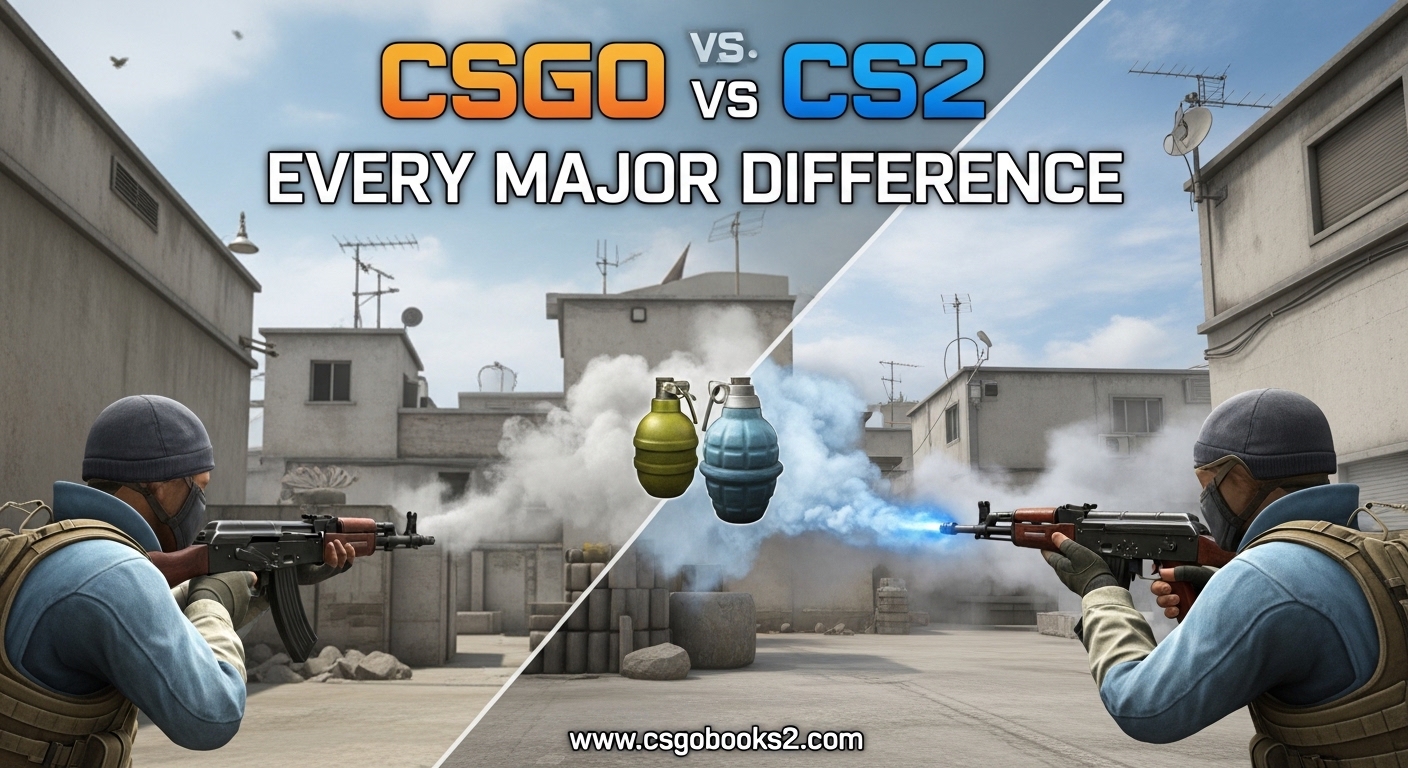
When Valve released Counter-Strike 2 in September 2023, it wasn’t just an update—it was a complete engine overhaul that fundamentally changed how the game plays, feels, and performs. As someone who has spent thousands of hours in both games, I can tell you that CSGO vs CS2 every major difference comes down to one thing: the Source 2 engine. This upgrade transformed everything from graphics and networking to smokes and matchmaking, creating a game that looks modern but plays differently than its predecessor.
Understanding these differences matters whether you’re a longtime CSGO player considering the switch, a newcomer deciding where to start, or a competitive player needing to adapt your strategies. The changes affect recoil patterns, smoke utility, movement, and even how matches are structured. Let me break down every significant difference between the two games based on hands-on experience and community feedback.
The Biggest Changes Between CSGO and CS2
Before diving deep, here’s a quick overview of the major differences:
– Source 2 engine replaces the old Source engine, bringing better graphics, lighting, and physics
– Sub-tick system eliminates traditional tick rate limitations
– Dynamic volumetric smoke grenades that interact with bullets and grenades
– MR12 match format instead of MR15
– Premier Mode with CS Rating system replaces old ranked matchmaking
– Maps classified as Touchstone, Upgrades, or Overhauls with visual improvements
– New buy menu with loadout system
– Improved audio with occlusion-aware sound
Source 2 Engine: The Foundation of CS2
The Source 2 engine is the single biggest difference between CSGO and CS2. Valve built the new Counter-Strike on the same engine that powers Half-Life: Alyx and Dota 2, bringing modern rendering capabilities, improved physics, and better CPU optimization. This isn’t just a visual upgrade—it changes how the game performs and feels.
Graphics and lighting received the most noticeable improvements. CS2 features photorealistic lighting with real-time shadows, better texture resolution, and improved environmental effects. Maps look brighter and more colorful, which some players love while others find it makes spotting enemies harder. The engine supports better reflections, particle effects, and overall visual fidelity that makes the game feel modern.
The physics engine changed too. CS2 uses Rubikon, a new physics system that handles grenade throws, body collisions, and environmental interactions differently than CSGO. This is why Molotovs don’t bodyblock the same way, and why grenades may feel slightly different when thrown. The new physics also enable the dynamic smoke system.
Performance optimization is another key improvement. Source 2 uses multi-threading better than the old engine, meaning CS2 can utilize modern CPUs more effectively. Many players report better FPS in CS2 compared to CSGO, though this varies depending on your hardware. The engine also supports better GPU utilization for smoother gameplay on higher-end systems.
Sub-Tick System vs Traditional Tick Rate
The sub-tick system is perhaps the most significant technical change in CS2, and it completely replaces how networking worked in CSGO. In CSGO, servers ran at specific tick rates—64-tick for official matchmaking and 128-tick for third-party services like ESEA or FACEIT. This created discrepancies in how inputs registered, with 128-tick servers providing noticeably better hit registration.
CS2’s sub-tick system eliminates this problem entirely. Instead of updating the game state at fixed intervals, CS2 registers every player input—movement, shooting, throwing utility—with perfect precision regardless of server tick rate. The server processes actions continuously rather than in discrete steps, meaning there’s no difference between official and third-party servers anymore.
How does this affect gameplay? Shooting and movement feel more consistent because the server captures your exact input timing. Peeking corners should be more reliable, spray transfer should register more accurately, and in general, what you see on screen should match what the server processes. This was a major pain point in CSGO, where players would blame “64-tick” for missed shots.
However, the sub-tick system isn’t perfect. Some players report that shooting feels less crisp or responsive than CSGO, which may be related to how the new system handles input processing. There’s also been ongoing discussion about whether the sub-tick system truly delivers on its promises, with some competitive players preferring the feel of CSGO’s 128-tick servers.
Dynamic Smoke Grenades: Volumetric Revolution
Smoke grenades in CS2 are completely different from CSGO, and they’re one of the most impactful changes for gameplay. In CSGO, smokes were simple cylinders that blocked vision. In CS2, they’re volumetric 3D objects that interact with the environment, bullets, and other grenades.
The biggest change is that smokes are now responsive. Bullets can create holes through smoke, revealing glimpses of what’s behind. This changes how you use smokes defensively—you can’t just hide in smoke anymore because enemies can see your silhouette when shooting through. It also changes how you execute strategies, as players can clear smokes by firing through them rather than waiting for them to fade.
Grenades interact with smokes too. High-explosive grenades can dissipate smoke clouds, creating new tactical possibilities. You can now clear a smoke by throwing an HE grenade into it, which wasn’t possible in CSGO. This adds another layer to utility usage and makes grenade lineup execution more complex.
Smokes also interact with the environment. They’ll flow around corners, fill spaces more naturally, and dissipate more realistically. The timing has changed slightly too—smokes in CS2 may last a bit longer than CSGO smokes, which affects round timing and execute strategies. Players have had to relearn smoke lineups for every map because the volumetric system throws differently than the old cylinder smokes.
Matchmaking Overhaul: Premier Mode and CS Rating
Competitive matchmaking received a complete overhaul in CS2. The old system of competitive matchmaking with skill groups (Silver to Global Elite) has been replaced by Premier Mode, which uses a numerical CS Rating instead. This is one of the most significant CSGO vs CS2 differences for competitive players.
Premier Mode is the new ranked experience. Instead of queuing for specific maps, you queue for Premier and then go through a map veto process with the other team. The match format is MR12 instead of MR15, meaning teams play to 13 rounds instead of 16. This shortens match length while maintaining the competitive integrity of the format. Overtime has also been revamped, with ties possible after two OT halves.
The CS Rating system is more granular than CSGO’s skill groups. Ratings start around 1,000 and go up to 30,000+, with color tiers (Yellow, Blue, Red, Purple) indicating general skill level. This provides more precise matchmaking and gives players a clearer sense of progression. A rating of 19,000, for example, places you in the mid-Red tier, roughly equivalent to high-Master/low-FACEIT level in CSGO terms.
Regular matchmaking still exists but is less prominent. You can queue for specific maps outside of Premier, but the competitive focus has shifted toward the Premier mode. This change reflects Valve’s attempt to create a more unified competitive ecosystem, similar to what third-party services offered in CSGO.
Map Changes: Touchstone, Upgrades, and Overhauls
Valve took a three-tier approach to maps in CS2, classifying them as Touchstone, Upgrades, or Overhauls based on how extensively they were reworked. This classification system helps players understand what to expect when loading into familiar maps.
Touchstone maps are faithful recreations that maintain the same gameplay as CSGO but with Source 2’s visual improvements. Dust 2 and Mirage are Touchstone maps—they play the same way but look better. The layouts, timings, and angles remain identical to CSGO, so your muscle memory transfers directly. These maps received lighting improvements and texture upgrades but no gameplay changes.
Upgrade maps have received significant visual improvements alongside some gameplay tweaks. Ancient and Nuke fall into this category. They look dramatically better thanks to Source 2 lighting, and Valve made minor adjustments to improve balance or fix exploits. The core gameplay remains similar, but you’ll notice visual changes that affect how you read angles and positions.
Overhaul maps are complete redesigns with new layouts, visuals, and gameplay. Overpass is the prime example—it looks almost unrecognizable compared to its CSGO version. The layout changed significantly, with new areas, modified angles, and different sightlines. These maps require relearning from scratch because the old strategies and positioning knowledge don’t apply anymore.
Here’s a quick reference for all active duty maps:
– Dust 2: Touchstone (faithful recreation)
– Mirage: Touchstone (faithful recreation)
– Ancient: Upgrade (visual + gameplay improvements)
– Nuke: Upgrade (visual + gameplay improvements)
– Overpass: Overhaul (complete redesign)
– Inferno: Overhaul (complete redesign)
– Anubis: Overhaul (complete redesign)
– Vertigo: Overhaul (complete redesign)
UI and Gameplay Changes
The user interface received a significant refresh in CS2, making it cleaner and more modern. The buy menu is the most noticeable change—it’s now a grid-based system with loadouts. You can set different loadouts for CT and T sides, meaning you don’t have to buy items individually every round. This streamlines the buying process and saves precious seconds at round start.
The HUD has been redesigned to be less intrusive while providing more information. Health, ammo, and utility information are clearer, and the overall aesthetic matches Source 2’s modern look. Valve also added a grenade inspection feature, letting you see exactly how you’re holding utility before throwing. This helps with consistency in executing lineups.
Sound design received major improvements too. CS2 features occlusion-aware audio, meaning the game simulates how sound travels through walls and around corners. You can more accurately pinpoint enemy positions based on footsteps and gunfire. The audio engine also supports better directional sound, making it easier to hear where actions are happening. For competitive players, audio information is crucial, and CS2’s improvements provide an advantage.
How CS2 Feels Compared to CSGO?
After two years of CS2, the community has developed a nuanced view of how the game feels compared to CSGO. The most common complaint early on was that CS2 felt “underwater” or like wearing a “weight vest.” Players described movement as sluggish, shooting as less responsive, and overall feedback as muted compared to CSGO’s crisp feel.
This sensation stems from multiple factors. The new animations in CS2 are smoother but harder to read—CSGO’s animations were more exaggerated, making it easier to see what opponents were doing. Movement physics changed slightly with the new engine, affecting how you strafe, stop, and peek. Shooting feedback is different too, with some players reporting less satisfying hit markers and kill confirmations.
However, sentiment has improved over time. As players adapted and Valve made adjustments, many now rate CS2 as a solid 7.5 or 8 out of 10 compared to CSGO’s perfect 10. The game has become “almost passable” as a replacement, and most competitive players have switched despite the initial resistance. The graphics improvements, better networking, and continued development have won over many skeptics.
That said, some players still prefer CSGO’s feel. The animations were clearer for reading gameplay, movement felt more responsive, and shooting feedback was more satisfying. These aren’t just nostalgia—there are legitimate differences in how the games handle input and feedback. If you’re transitioning from CSGO, it will take time to adjust to CS2’s feel.
Can You Still Play CSGO?
When CS2 launched, Valve effectively replaced CSGO. The old game was removed from Steam and replaced with CS2—you can’t download or play CSGO anymore. Your entire inventory, including skins, knives, and other items, transferred automatically to CS2. This was a smooth process, and players kept everything they collected over the years.
System requirements for CS2 are similar to CSGO, though Source 2 is slightly more demanding. You’ll want a modern CPU and GPU for the best experience, but the game still runs on older hardware. If you could play CSGO, you can likely play CS2—you might just need to adjust some settings for optimal performance.
Most players have switched to CS2 because there’s no alternative. The professional scene moved entirely to CS2, all third-party services support CS2, and the active player base is on CS2. While some players miss CSGO’s feel, the community has largely accepted and adapted to the new game. CS2 is the future of Counter-Strike, and continued updates and seasons keep the game evolving.
FAQ’s
What is the biggest difference between CS:GO and CS2?
The biggest difference is the Source 2 engine, which powers CS2. This engine upgrade brings improved graphics, realistic lighting, better physics, and enables new features like volumetric smoke grenades and the sub-tick networking system. Source 2 fundamentally changes how the game looks, performs, and feels compared to CSGO’s older Source engine.
How many CS2 Majors are there every year?
Valve typically hosts two CS2 Major championships per year, one in the first half and one in the second half of the year. These are the premier esports tournaments for Counter-Strike, featuring the best teams worldwide competing for million-dollar prize pools. The Major format has remained similar to CSGO, with qualifiers, a Challenger stage, Legends stage, and Champions stage.
What rank is 19000 in CS2?
A CS Rating of 19,000 places you in the middle of the Red tier, which roughly corresponds to high-Master level or low-FACEIT level in CSGO terms. The Red tier spans approximately 15,000 to 20,000 CS Rating, so 19k is toward the upper end of Red. You’re an above-average player at this rating, competing with others who have solid game sense and mechanical skill.
Is CS2 better than CSGO?
CS2 is technically more advanced with better graphics, improved networking through sub-tick, and modern engine features. However, whether it’s ‘better’ depends on what you value. Many players prefer CSGO’s crisp feel and clearer animations. CS2 has improved significantly since launch and most players now consider it a worthy successor, even if some aspects of CSGO are missed.
Can you still play CSGO after CS2 release?
No, CSGO is no longer available to play. When CS2 launched, Valve replaced CSGO entirely on Steam. All player inventories including skins transferred automatically to CS2. There is no way to download or play the original CSGO anymore—CS2 is the only version of Counter-Strike available.
What is sub-tick in CS2?
Sub-tick is CS2’s new networking system that eliminates traditional tick rate limitations. Instead of updating the game state at fixed intervals like CSGO’s 64-tick or 128-tick servers, sub-tick registers every player input with perfect precision regardless of server tick rate. This means movement, shooting, and utility throwing are processed more consistently, with no difference between official and third-party servers.
What is MR12 in CS2?
MR12 means matches are played to 13 rounds (first to 13 wins) instead of CSGO’s MR15 format (first to 16 wins). This shortens match length from 30 rounds maximum to 24 rounds maximum, reducing typical match time by 15-20 minutes. MR12 has become the standard competitive format in CS2’s Premier Mode and professional play, with overtime rules adjusted to accommodate the shorter format.
Are smokes different in CS2?
Yes, smoke grenades are completely different in CS2. They’re now volumetric 3D objects instead of simple cylinders. Smokes interact with bullets—you can shoot holes through them to see what’s behind—and grenades can dissipate them. Smokes also flow around corners more naturally and have slightly different timing. These changes make smoke utility more dynamic and complex compared to CSGO.
Do CSGO skins transfer to CS2?
Yes, all CSGO skins and inventory items transferred automatically to CS2 when it launched. You kept every skin, knife, glove, sticker, and other item from your CSGO inventory. The transfer was seamless and required no action from players. Your CS2 inventory contains everything you collected in CSGO, with the same wear conditions and stickers.
Why does CS2 feel different from CSGO?
CS2 feels different due to several factors: the Source 2 engine changed movement physics and animation blending, making it feel less crisp than CSGO. Animations are smoother but harder to read. Shooting feedback is less pronounced. Many players describe CS2 as feeling ‘underwater’ or sluggish compared to CSGO’s responsive feel. These differences are real, not just imagination—they stem from fundamental engine changes.
Conclusion
CSGO vs CS2 every major difference ultimately comes down to the Source 2 engine and everything it enables: better graphics, the sub-tick system, volumetric smokes, improved audio, and modern networking. These changes make CS2 a more advanced game technically, even if some players prefer how CSGO felt. The matchmaking overhaul with Premier Mode and CS Rating creates a more unified competitive ecosystem, while the map classification system helps players understand what to expect from each map.
Should you play CS2 or CSGO? The question is moot because CSGO no longer exists. CS2 is the current and future version of Counter-Strike, and while the transition wasn’t perfect for everyone, the game has improved significantly since launch. The graphics are better, the networking is more consistent, and Valve continues to update the game with seasonal content. If you’re new to Counter-Strike, start with CS2. If you’re a CSGO veteran, give CS2 time—it may feel different at first, but the core gameplay that made Counter-Strike great is still there.