
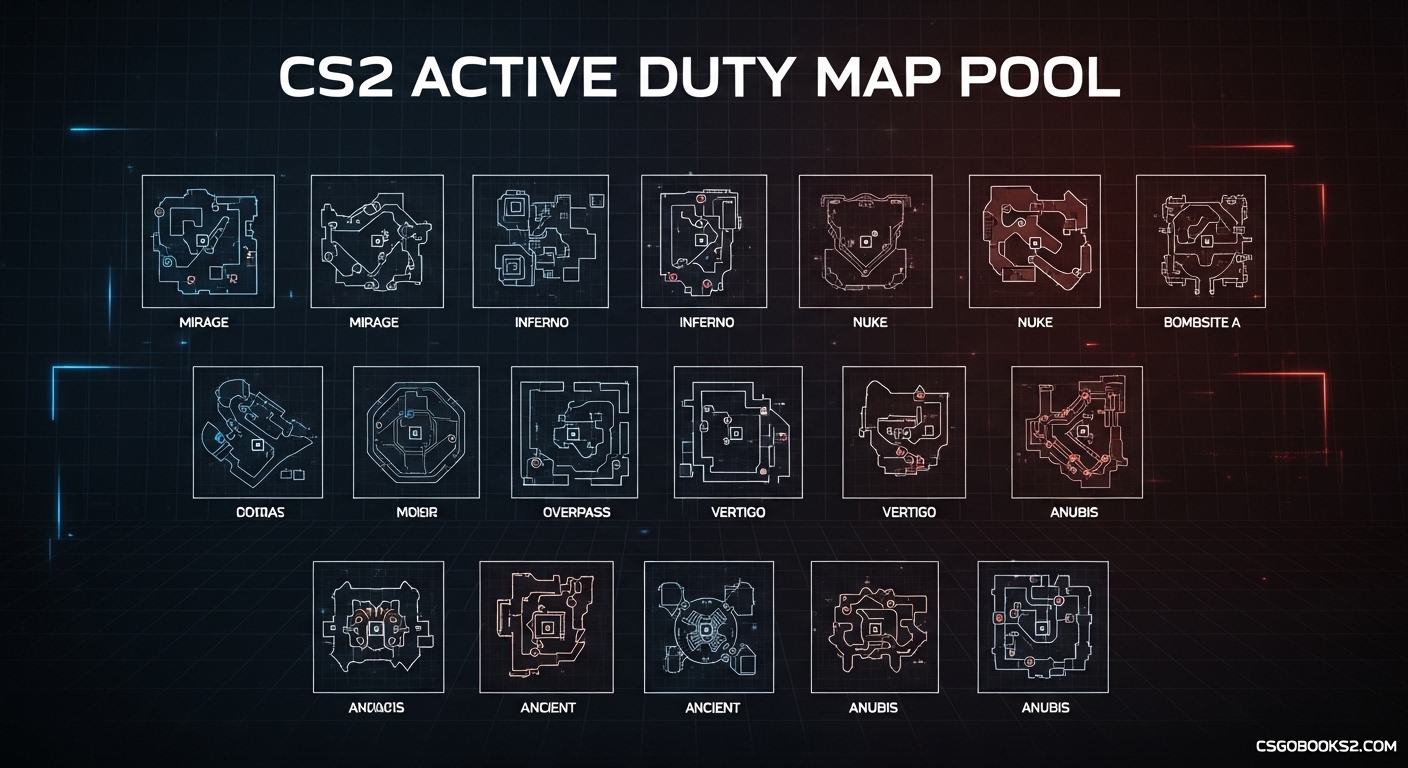
If you’re looking for the current CS2 active duty map pool, you’ve come to the right place. As of April 2026, there are exactly 7 maps in the Active Duty rotation used for Premier matchmaking and professional tournaments. This guide covers every map, the April 2026 changes that brought Anubis back, and strategic insights to help you master each one.
Whether you’re grinding Premier Season 4 or just want to understand which maps matter in competitive CS2, knowing the active duty map pool is essential. These seven maps form the foundation of competitive play at every level, from casual matchmaking to Major championships.
What is the CS2 Active Duty Map Pool?
The CS2 active duty map pool consists of the 7 official maps used in Premier mode and all professional tournaments. Valve maintains this separate rotation to ensure competitive balance and keep the professional meta fresh. Active Duty maps differ from the broader competitive pool because they’re the only maps played in Majors and Premier Season play.
Premier Season 4, which kicked off in April 2026, uses these 7 maps exclusively. When you queue for Premier, you’ll only encounter maps from this specific pool. The same applies to professional leagues and Major tournaments, where the Active Duty maps form the complete map selection.
Valve typically updates the Active Duty pool twice per year, often coinciding with Premier Season launches. The most recent change happened in April 2026, when Anubis returned to Active Duty and Train was removed. This rotation system keeps the competitive meta evolving while giving players time to master each map before changes occur.
April 2026 Map Pool Changes
The most significant update to the CS2 active duty map pool occurred in April 2026 with the launch of Premier Season 4. Valve made one key change: Anubis returned to the Active Duty pool after being removed in late 2025, while Train was moved to the Reserve pool.
Anubis’s return was well-received by the community. The Egyptian-themed map offers unique vertical gameplay with its water mechanics and elevated positions. Its reintroduction added variety to the pool and addressed player fatigue with Train, which had become one of the least popular maps in Premier matchmaking.
Train’s removal wasn’t surprising. Data from Premier Season 3 showed Train was frequently vetoed by players and had the lowest pick rate among all Active Duty maps. The map’s complex layout and CT-sided nature made it unpopular at many skill levels. Moving it to the Reserve pool allows it to remain available in other game modes while removing it from the competitive rotation.
The 7 Active Duty Maps
Anubis
Anubis brings a unique Egyptian temple setting to CS2 with mechanics you won’t find anywhere else. The map features water areas that slow player movement and create interesting tactical opportunities. Verticality is key here, with elevated positions around mid and bomb sites that favor good spacing and cross-map positioning.
Key callouts include Market, Temple, and Canal on the T-side, with Heaven and Water being critical positions around bombsites. The water mechanic makes Anubis play differently than other maps, as rushing through water leaves you vulnerable to well-timed utility. Mid control is crucial on Anubis, with teams that secure the central area having multiple attack options.
CT-side success on Anubis often comes from aggressive mid pushes and proper use of the elevated positions. The map’s vertical nature means holding angles from above can be devastating, especially around A site where Heaven provides a dominant view. T-side strategies typically focus on splitting attacks through mid and executing with well-timed smokes to block CT vision.
Ancient
Ancient takes place in an archeological excavation site with open areas and multiple elevation changes. The map’s defining feature is its verticality, with bombsites positioned at different heights and numerous angles to check. Ancient rewards teams that communicate well and coordinate their utility usage.
Important callouts include Donut, Tunnels, and Ruins for T-side approaches, while CT-side positions focus on Mountain, Site, and Jungle. The mid area on Ancient is particularly important, with control of this space determining which team can effectively rotate between sites.
The large open areas on Ancient make rifles and AWPs particularly effective. CT-side players need to be careful about peeking too aggressively, as the open sightlines favor patient crosshair placement. T-side executes often involve splitting through multiple routes simultaneously, making utility timing crucial for opening up bomb sites.
Dust II
Dust II is perhaps the most iconic map in Counter-Strike history, and its three-lane layout remains a staple of competitive play. The map’s simplicity makes it accessible for new players while offering enough depth for professionals to develop complex strategies. Long, Mid, and Short form the three primary routes, with CT-side positions focused around A site, B site, and CT spawn.
Essential callouts include Long, Short, and Mid on the T-side, with CT positions centered around Long A, Short, Car, and B Tunnels. Mid control on Dust II is critical, with the team winning mid battles usually dictating the pace of the round. The map’s open sightlines make AWP players particularly dangerous, especially from CT spawn looking down Long.
Dust II rewards fundamental CS skills: crosshair placement, movement, and basic utility usage. CT-side success often comes from holding angles and trading efficiently, while T-side strategies typically involve executing onto a single site with well-placed smokes and flashes. The map’s balance makes it popular at all skill levels, though some players feel it’s overplayed in the current pool.
Inferno
Inferno is defined by its tight corridors and choke points, making utility usage absolutely critical. The banana control area is the most contested space on the map, with CT-side players fighting to establish presence there and T-side players attempting to push through. Molotovs are king on Inferno, capable of denying areas and forcing enemies into unfavorable positions.
Key callouts include Banana, Apartments, and CT for T-side approaches, while CT positions focus on Arch, Pit, and Boiler. The map’s narrow corridors mean shotguns and SMGs can be devastating in close quarters, though rifles remain the primary weapons for most players due to the longer sightlines around mid and bombsites.
Inferno is often considered one of the most tactical maps in the pool, with team coordination and utility timing being more important than individual mechanics. CT-side success comes from establishing banana control early and maintaining pressure throughout the round. T-side strategies often involve slow executes, building utility over time before committing to a site take.
Mirage
Mirage revolves around mid control, with the central area serving as a battleground that determines which team can effectively execute their strategies. The map features two distinct bombsites with different characteristics, A site being more open and B site being tighter with more close-quarter combat opportunities.
Essential callouts include Window, Ramp, and Palace for T-side approaches, with CT positions focused on Connector, Underpass, and Van. The mid area on Mirage is complex, with multiple levels and angles to check, making mid control fights some of the most intense in the game. Window control is particularly important, offering views into both mid and CT spawn areas.
Mirage rewards teams that can adapt their strategies based on mid control. If T-side wins mid, they have options to hit both sites effectively. If CT-side holds mid, they can rotate quickly and support either bombsite. The map’s balance makes it a competitive favorite, with professional teams often developing highly specific strategies for different mid control scenarios.
Nuke
Nuke stands out for its extreme verticality and complex layout. The map features two distinct levels, with outside areas connecting to internal bombsite areas. The vertical nature of Nuke creates unique tactical situations, with players needing to check multiple levels and angles constantly.
Important callouts include Outside, Secret, and Heaven for T-side approaches, while CT positions focus on Ramp Room, Hut, and Hell. The outside area on Nuke is critical, with control of this space determining which team can effectively rotate between levels. The map’s complexity makes it one of the most challenging to learn, with new players often struggling with the multi-level engagements.
Nuke rewards players with good gamesense and positioning. CT-side success comes from holding aggressive angles and using the vertical layout to their advantage. T-side strategies often involve faking one level to attack the other, with well-timed executes being crucial for breaking through CT defenses. The map’s difficulty curve is steep, but mastering Nuke gives teams a significant advantage in map pool versatility.
Overpass
Overpass features an urban setting with long rotation paths and bomb sites that favor different tactical approaches. The map’s defining characteristic is its lengthy rotations, which put pressure on CT-side players to make quick decisions about when to rotate and how to approach retake scenarios.
Key callouts include Long, Playground, and Fountain for T-side approaches, with CT positions centered around Construction, Water, and Pillbox. The B bombsite on Overpass is particularly challenging to retake, with CT-side players often needing to commit fully to the defense or risk losing the site to a well-executed T-side push.
Overpass rewards patience and good gamesense. The long rotations mean CT-side players need to anticipate T-side movements early, while T-side teams can punish slow CT reactions by executing quickly once they commit to a site. The map’s complexity makes it a favorite among tactical players, with its unique challenges requiring teams to develop specialized strategies different from other maps in the pool.
Other Game Modes and Map Pools
Beyond the Active Duty maps used in Premier and professional play, CS2 offers several other map pools for different game modes. The standard Competitive mode includes all 7 Active Duty maps plus Vertigo, giving players an 8-map rotation for traditional matchmaking. Vertigo was moved from Active Duty to the Competitive pool in 2025 but remains popular among casual players.
Casual and Deathmatch modes feature even larger map selections, including maps not available in competitive play. These modes are great for warming up and practicing your aim on various layouts without the pressure of ranked competition. Deathmatch in particular is excellent for learning map layouts since constant respawns let you explore different areas and angles without waiting for the next round.
Wingman, CS2’s 2v2 mode, has its own dedicated map pool designed specifically for smaller team sizes. Maps like Sanctum and Season offer Wingman-exclusive experiences with layouts optimized for two-player teams. The smaller scale makes these maps perfect for practicing close-quarters combat and quick decision-making.
Arms Race, CS2’s gun game mode, features maps designed specifically for fast-paced combat and quick rotations. These maps prioritize constant action over tactical depth, making them ideal for practicing weapon mechanics and reflexes. The April 2026 update also introduced several new community maps to various game modes.
The April 2026 update brought five new community maps to CS2: Warden, Stronghold, Alpine, Sanctum, and Poseidon. These maps were created by community members and officially integrated into the game, with some appearing in specific game modes. Warden and Stronghold joined the competitive map pool, while Sanctum and Poseidon were designed specifically for Wingman mode. These additions demonstrate Valve’s commitment to supporting community creators and expanding map variety beyond the traditional Active Duty rotation.
| Map | Premier | Competitive | Casual | Deathmatch | Wingman | Arms Race |
|---|---|---|---|---|---|---|
| Anubis | Yes | Yes | Yes | Yes | No | No |
| Ancient | Yes | Yes | Yes | Yes | No | No |
| Dust II | Yes | Yes | Yes | Yes | No | No |
| Inferno | Yes | Yes | Yes | Yes | No | No |
| Mirage | Yes | Yes | Yes | Yes | No | No |
| Nuke | Yes | Yes | Yes | Yes | No | No |
| Overpass | Yes | Yes | Yes | Yes | No | No |
| Vertigo | No | Yes | Yes | Yes | No | No |
How to Learn CS2 Maps Faster?
Mastering the CS2 active duty map pool takes time, but there are proven methods to speed up the learning process. Deathmatch is one of the best ways to learn map layouts since the constant respawns let you explore different areas without pressure. Focus on learning callouts for each area rather than just memorizing the geometry, as knowing the names of positions helps with communication during matches.
Watching professional players is another excellent way to learn maps efficiently. Pay attention to how pros position themselves, which angles they hold, and how they use utility. You don’t need to copy their exact strategies, but understanding the reasoning behind their positioning will improve your own map knowledge. Streamers and educational content creators often break down map strategies in detail, providing insights you might not discover on your own.
Reviewing your own matches helps identify areas where your map knowledge is lacking. Watch rounds where you died due to poor positioning or not knowing where enemies were coming from. These moments reveal gaps in your map knowledge that you can address specifically in future practice sessions. Custom servers with bots let you practice specific situations without the pressure of a real match, allowing you to experiment with different positions and strategies.
Community resources like map callout guides and strategy breakdowns provide structured information about each map. These guides often include visual overlays showing common positions, utility lineups, and strategic points of interest. Combining structured learning with practical experience in real matches gives you the best of both approaches, letting you understand the theory behind map strategies while developing practical experience applying that knowledge.
FAQs
How many maps are in the CS2 Active Duty pool?
What maps are played in CS2 Majors?
What changed in the CS2 map pool in 2026?
How often does the CS2 map pool change?
What is the difference between Active Duty and Competitive map pools?
Which CS2 maps are best for beginners?
Will Cache return to CS2 Active Duty?
Why was Train removed from CS2 Active Duty?
Conclusion
The CS2 active duty map pool consists of 7 diverse maps that form the foundation of competitive play in 2026. From the classic three-lane layout of Dust II to the vertical complexity of Nuke, each map offers unique challenges and strategic depth. Mastering these maps is essential for anyone serious about climbing the competitive ladder in Premier or understanding professional CS2.
The April 2026 changes that brought Anubis back to the Active Duty pool demonstrate Valve’s commitment to keeping the meta fresh while maintaining competitive balance. While some players express frustration with certain maps feeling overplayed, the current rotation offers good variety and strategic options for different playstyles.
Map knowledge remains one of the most important skills in CS2, separating average players from those who consistently rank up. Take time to learn callouts, practice utility lineups, and study professional play on each Active Duty map. The investment in map knowledge pays dividends in every match you play, from casual games to Premier competition.