
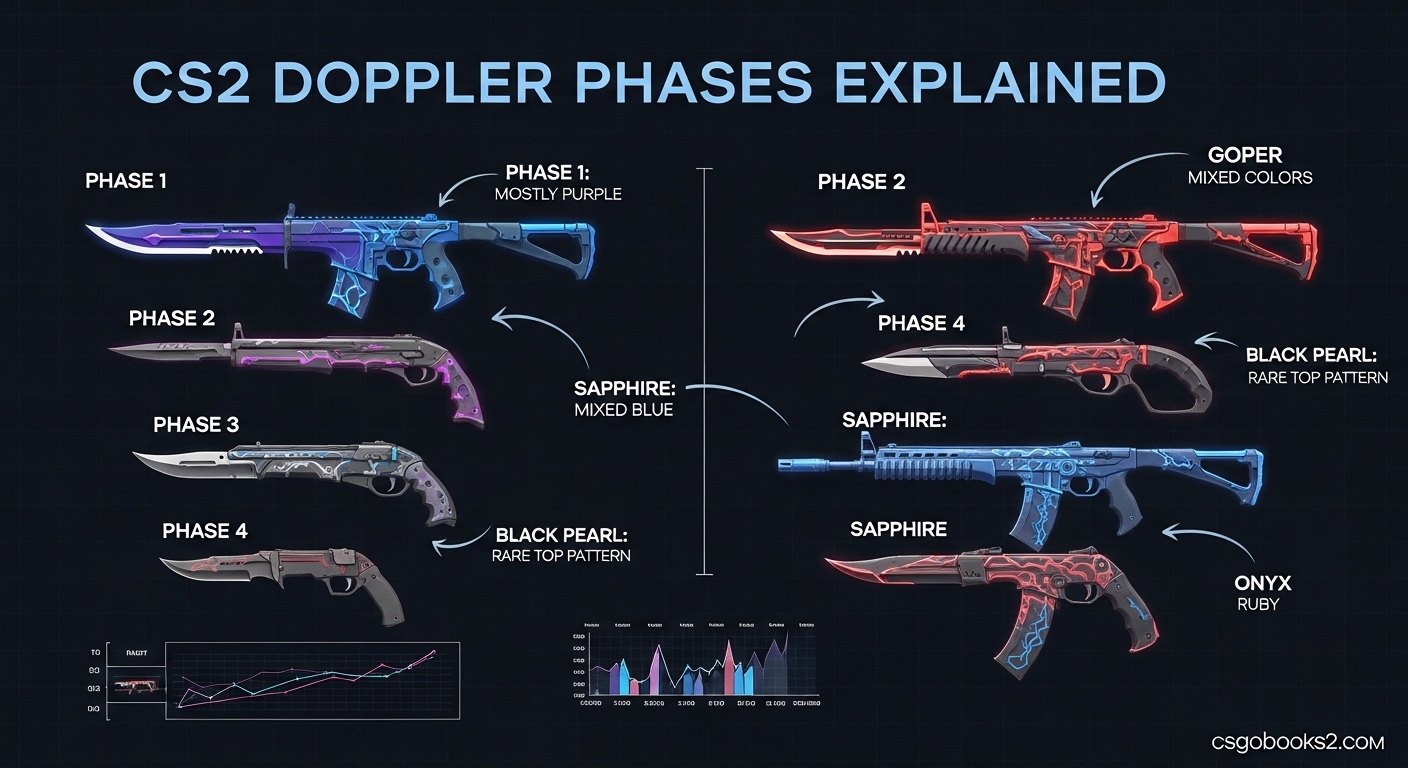
CS2 doppler phases explained simply: these are the different color patterns that appear on Doppler knife skins in Counter-Strike 2. Each phase has a unique combination of colors ranging from deep purple to vibrant blue, pink, and even solid gem-like finishes. I’ve been collecting and trading Doppler knives since CS:GO, and the transition to CS2 brought some surprising changes that every collector should understand.
Whether you’re trying to identify which phase you own, looking to buy your first Doppler, or just curious about why some knives sell for thousands while others cost much less, this guide will break down everything you need to know about CS2 doppler phases explained in plain English.
What Are CS2 Doppler Phases?
CS2 doppler phases are groups of different visual finishes on Doppler-patterned knife skins that determine the color composition and pattern of the blade. The Doppler finish was introduced in the Chroma Case and later in the Gamma Case, creating one of the most sought-after knife collections in the game.
Each Doppler phase is determined by its pattern index, a number between 0-999 that controls how colors are distributed across the knife surface. The pattern index system means that even within the same phase, no two knives look exactly alike. Some patterns are more desirable than others, creating a tier system within each phase that affects value significantly.
The share of blue, pink, purple, and other colors on a Doppler knife determines which phase it belongs to. Standard phases (1-4) feature mixed color schemes, while rare variants (Ruby, Sapphire, Black Pearl) display nearly solid colors that make them incredibly valuable and distinctive.
Doppler Phase 1: The Dark Purple Foundation
Phase 1 Doppler features a dark purple base color with blue elements and occasional pink accents. In CS:GO, Phase 1 was often considered the least desirable phase due to its darker, more muted appearance. However, something interesting happened with the CS2 transition.
The Source 2 lighting engine in CS2 dramatically changed how Phase 1 appears in-game. What once looked dark and flat now has depth and vibrancy that many collectors prefer over Phase 2. I’ve spoken with dozens of traders who used to avoid Phase 1 but now actively seek it out for the improved appearance.
Phase 1 typically occupies the lower pattern indices, and while it still generally costs less than Phase 2, the gap has narrowed considerably in 2026. The purple-to-blue gradient creates a sophisticated look that stands out in gameplay, especially on knife models like the Karambit and M9 Bayonet where the curve accentuates the color transition.
Doppler Phase 2: The Pink-Dominant Popular Phase
Phase 2 Doppler is dominated by vibrant pink coloration with blue and purple elements mixed throughout. For years, Phase 2 has been the most popular and consistently expensive standard phase, prized for its eye-catching pink appearance that looks great in-game and screenshots.
The pink dominance makes Phase 2 instantly recognizable, and it became the go-to choice for players wanting their knife to stand out. However, CS2’s new lighting affected Phase 2 differently than other phases – many players report that Phase 2 now appears more matte and less glossy than it did in CS:GO, slightly diminishing its signature shine.
Despite the lighting changes, Phase 2 remains the most desirable standard phase for most collectors. The vibrant pink creates a bold statement that pairs well with many skin combinations, and its popularity means it holds value well on the trading market. If you’re buying a Doppler as an investment, Phase 2 is still the safest bet among the standard phases.
Doppler Phase 3: Blue with Green Accents
Phase 3 Doppler features a blue-dominant color scheme with distinctive green accents and spots throughout the pattern. The green elements are what set Phase 3 apart from Phase 4 – while both phases are primarily blue, only Phase 3 displays these characteristic green spots that can appear anywhere on the blade.
The amount of green varies significantly between individual Phase 3 knives. Some show just a few small green flecks, while others have large green patches covering substantial portions of the blade. This variation creates sub-tiers within Phase 3, with patterns featuring more and larger green areas generally being more desirable.
Phase 3 has gained popularity in 2026 as more players appreciate the unique blue-green combination that differs from the more common pink or solid blue phases. The green accents can create striking visual interest, especially on larger knife models where the pattern has more room to develop.
Doppler Phase 4: The Blue-Dominant Phase
Phase 4 Doppler is characterized by its dominant blue coloration with minimal purple or pink elements and no green spots. Unlike Phase 3, Phase 4 displays a cleaner blue appearance that can range from deep navy to bright cyan depending on the specific pattern.
The distinction between Phase 3 and Phase 4 confuses many collectors, but the presence or absence of green spots is the key identifier. If your blue Doppler shows any green, it’s Phase 3. If it’s pure blue without green, it’s Phase 4. This simple rule eliminates most identification confusion.
Phase 4 has developed a dedicated following among players who prefer cleaner, more uniform color schemes. The blue-dominant appearance pairs beautifully with blue-themed skins and creates a cohesive loadout. In the trading community, Phase 4 is often seen as the “sleeper” phase – underrated but increasingly appreciated as collectors look beyond the obvious Phase 2 popularity.
Rare Doppler Variants: Ruby, Sapphire, and Black Pearl
Beyond the standard four phases exist three ultra-rare Doppler variants that command prices many times higher than even the best Phase 2 patterns. These variants occur when the pattern index creates nearly solid coloration across the entire knife surface.
Doppler Ruby: The Red Gem
Doppler Ruby displays a deep, gem-like red coloration across the entire blade with minimal color variation. The Ruby variant is one of the most prestigious knife finishes in CS2, with pristine examples selling for tens of thousands of dollars depending on the knife model and float value.
The red coloration must be dominant and consistent across the blade to qualify as a true Ruby. Lower-quality Rubies may show some pink or orange hints, but top-tier patterns display uniform crimson that looks like a precious gemstone. The Ruby variant works particularly well on knives with more surface area like the Butterfly or M9 Bayonet.
Doppler Sapphire: The Blue Gem
Doppler Sapphire features a solid blue gem appearance with consistent blue coloration and minimal variation. Like its Ruby counterpart, the Sapphire variant represents the pinnacle of Doppler collecting, with prices that can exceed $20,000 for factory new specimens on desirable knife models.
The blue in a Sapphire can range from deep royal blue to brighter cyan tones, but the key is uniformity across the blade. Sapphires are especially popular among players who prefer cool color schemes, and they pair beautifully with blue-themed inventories. The clean, solid blue appearance is instantly recognizable and commands respect in any lobby.
Doppler Black Pearl: The Rarest Phase
Doppler Black Pearl is the rarest of all Doppler phases, featuring a black base color with blue and purple highlights that create a pearlescent effect. Black Pearls are so uncommon that many longtime players have never seen one in-game, and they command astronomical prices on the rare occasions they appear for sale.
The black coloration must be clearly dominant with blue and purple elements creating highlights rather than dominating the pattern. The effect resembles a black pearl gemstone, hence the name, with an iridescent quality that changes appearance under different lighting conditions. Black Pearls are the ultimate status symbol for serious collectors.
CS2 Doppler Phases Comparison
| Phase | Primary Colors | Identifying Features | Rarity Level | Relative Value |
|---|---|---|---|---|
| Phase 1 | Dark purple, blue | Purple base, blue elements | Common | $$ |
| Phase 2 | Pink dominant | Vibrant pink with blue/purple | Common | $$$ |
| Phase 3 | Blue with green | Blue dominant with green spots | Common | $$ |
| Phase 4 | Blue dominant | Solid blue, no green spots | Common | $$ |
| Ruby | Solid red | Gem-like red uniform color | Ultra Rare | $$$$$ |
| Sapphire | Solid blue | Gem-like blue uniform color | Ultra Rare | $$$$$ |
| Black Pearl | Black with blue/purple | Black base, pearlescent highlights | Ultra Rare | $$$$$$$ |
How to Identify Your Doppler Phase?
Identifying your Doppler phase correctly is essential for understanding your knife’s value and trading potential. I’ve helped hundreds of players identify their phases, and these steps will help you determine exactly what you have.
Step 1: Check for solid coloration. Examine your knife in good lighting. If the blade shows uniform red, blue, or black coloration with minimal variation, you likely have a rare variant (Ruby, Sapphire, or Black Pearl). These are unmistakable and dramatically more valuable than standard phases.
Step 2: Look for green spots. If your knife isn’t a solid color variant, check carefully for green spots or patches in the pattern. Green spots indicate Phase 3 – this is the only phase that displays green, making it easy to identify. The amount of green varies, but any green confirms Phase 3.
Step 3: Identify the dominant color. For knives without green and without solid coloration, determine which color dominates. Pink dominance indicates Phase 2, while blue dominance without green suggests Phase 4. Dark purple with blue elements points to Phase 1.
Step 4: Use pattern checking tools. For definitive identification, use community resources like float.db where you can enter your knife’s pattern index (found in inspect links or through trading sites). These tools will tell you exactly which phase you have and often include pattern quality ratings.
Step 5: Get a second opinion. If you’re still unsure, post screenshots in trading communities or consult experienced collectors. The CS2 trading community is generally helpful, and experienced eyes can quickly identify phases that might confuse newcomers.
CS2 vs CS:GO: How Lighting Changes Affect Doppler Phases
The transition from CS:GO to CS2 brought significant changes to how Doppler phases appear in-game due to the new Source 2 lighting engine. These changes have reshaped phase preferences and values in ways that still surprise many collectors.
Phase 1 experienced the most dramatic transformation. In CS:GO, Phase 1 was widely considered the least desirable phase due to its dark, flat appearance. The new lighting in CS2 added depth and vibrancy to Phase 1, making it look significantly better than before. Many collectors who previously avoided Phase 1 now appreciate its improved appearance, narrowing the price gap with Phase 2.
Phase 2 was affected differently – many players report that Phase 2 appears more matte and less glossy in CS2, losing some of its signature shine. While still popular and valuable, the lighting change has made some traders reconsider whether Phase 2 deserves its premium price point.
The blue phases (3 and 4) also benefited from CS2’s lighting, which makes blue colors appear more vibrant and true-to-life. The green accents in Phase 3 now pop more, increasing the phase’s visual appeal and contributing to its growing popularity in 2026.
What Is Gamma Doppler?
Gamma Doppler refers to Doppler finishes from the Gamma Case rather than the original Chroma Case. While visually similar to standard Doppler phases, Gamma Doppler has its own phase system (Gamma Phase 1-4) with some distinct color variations that differ from Chroma phases.
Gamma Phase 1-2 typically feature more blue and less pink than their Chroma counterparts, while Gamma Phase 3-4 often display cyan blue tones that many collectors find highly appealing. The cyan appearance in Gamma Phase 3-4 has made these variants increasingly popular as alternatives to standard Doppler phases.
Gamma Doppler knives are generally less expensive than Chroma Doppler variants, offering good value for players who want the Doppler look without the premium price. However, the most desirable Gamma patterns (especially clean Gamma Phase 4) can still command significant prices on the trading market.
Doppler Phase Pricing Overview
Doppler phase pricing varies dramatically based on phase rarity, pattern quality, knife model, and float value. While exact prices fluctuate daily, understanding the general value tiers will help you make informed buying and selling decisions.
Standard Phase Pricing (lowest to highest): Phase 1 typically costs the least among standard phases, followed closely by Phase 3 and Phase 4 which often trade at similar price points. Phase 2 commands a premium of 20-50% over other standard phases due to its sustained popularity.
Rare Variant Pricing: Ruby and Sapphire variants typically cost 10-20 times more than standard phases, with prices varying based on color uniformity and knife model. Black Pearl exists in its own tier, often costing 2-3 times more than even premium Ruby or Sapphire examples due to extreme rarity.
Pattern Quality Impact: Within each phase, pattern quality significantly affects value. “Max tier” patterns with ideal color distribution can cost 2-5 times more than average patterns of the same phase. This pattern tier system is why some Phase 1 knives with exceptional patterns sell for more than mediocre Phase 2 examples.
Float Value Considerations: Lower float values (closer to factory new) always command premiums, especially for rare variants where condition dramatically affects the solid color appearance. A well-worn Ruby may show significant pink or orange, while a factory new example displays perfect red uniformity.
FAQs
Which doppler phase is best in CS2?
Phase 2 remains the most popular and consistently expensive standard phase due to its vibrant pink appearance, though Phase 1 has gained popularity with CS2’s lighting changes. Among rare variants, Ruby is generally considered the best for investment due to consistent demand.
What doppler phase is the rarest?
Black Pearl is the rarest Doppler phase, occurring when specific pattern indices create a black base with blue and purple highlights. Black Pearls are so uncommon that many longtime players have never seen one in-game.
What is the most desirable Doppler phase?
Phase 2 is considered the most desirable standard phase due to its vibrant pink coloration and widespread popularity. Among rare variants, Ruby typically commands the highest prices and most consistent demand from collectors.
What is the difference between Doppler Phase 1 and 3?
Phase 1 features a dark purple base color with blue elements and occasional pink accents, while Phase 3 is blue-dominant with distinctive green spots. The key difference is that Phase 1 is purple-based while Phase 3 is blue-based with green – no other phase displays green spots.
How do you tell what phase a doppler is?
Identify solid colors first (Ruby=red, Sapphire=blue, Black Pearl=black). If not solid, look for green spots which indicate Phase 3. For remaining knives, identify dominant color: pink=Phase 2, blue without green=Phase 4, dark purple with blue=Phase 1. Use pattern checking tools like float.db for definitive identification.
Conclusion
CS2 doppler phases explained comes down to understanding how pattern indices create the different color combinations that make each phase unique. From the common Phase 1-4 variations to the ultra-rare Ruby, Sapphire, and Black Pearl variants, each phase offers a distinct aesthetic that appeals to different collectors.
The CS2 transition reshaped phase preferences through lighting changes that made some phases more appealing while diminishing others. Phase 1’s renaissance demonstrates how game updates can dramatically affect skin values, making it essential to stay informed about both current appearances and market trends.
Whether you’re a seasoned collector or new to Doppler knives, understanding phase identification, pricing factors, and the differences between variants will help you make smarter decisions in the CS2 skin market. Use the identification guide, comparison table, and FAQ reference as you explore the fascinating world of CS2 doppler phases.