
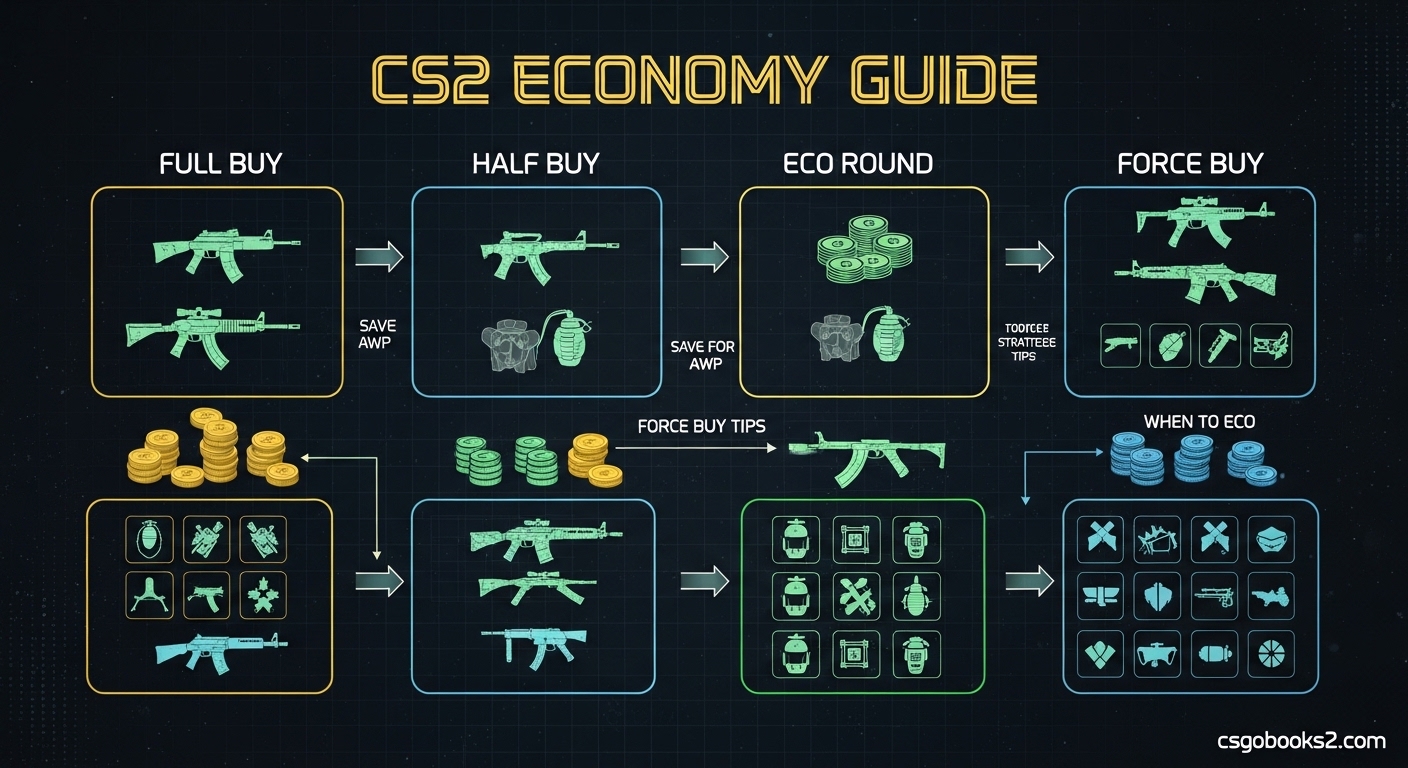
If you have ever wondered why pro teams seem to always have rifles while your team is stuck with pistols, the answer lies in CS2 economy management. After analyzing hundreds of matches across multiple ranks, I have found that economy discipline is the single biggest factor separating consistent winners from inconsistent players. This CS2 economy guide breaks down exactly how buy rounds, eco rounds, and money decisions work in 2026.
Whether you are a new player trying to understand when to save, or an experienced player looking to refine your economy game, this guide covers everything you need to know. I have pulled insights from professional play, competitive matchmaking, and community discussions to give you practical strategies you can apply immediately.
How CS2 Economy Works – The Money System Explained (April 2026)
The CS2 economy system rewards smart money management over aggressive spending. Every round you earn money through kills, round outcomes, and special bonuses. Understanding these mechanics is the foundation of good economy decisions.
Starting money in CS2 is $800 for everyone. From there, your economy grows or shrinks based on your actions. Kill rewards vary by weapon type, with pistols granting $300, SMGs giving $600, and rifles awarding $300. The AWP offers a massive $100 kill reward but costs much more to purchase. This system rewards using SMGs in anti-eco situations while punishing unnecessary AWP deaths.
Round outcome rewards are straightforward. Winning a round grants $3,250 to everyone on the team, while losing gives increasing amounts based on your loss streak. The first loss provides $1,400, second loss $1,900, third loss $2,400, and fourth loss (and beyond) $2,900. This loss bonus means teams that lose consecutive rounds can eventually afford full buys even without getting kills.
Bomb plants as T-side add an extra $300 to your team economy, which can make the difference between a half buy and full buy in following rounds. Defuse kits as CT-side cost $400 but can save rounds, making them essential purchases in full buy situations.
The money system in CS2 is designed around team economy, not individual wealth. One player saving while the rest force creates a split-tier situation that usually leads to losing the next round anyway. Understanding this team-based economy is crucial for making smart decisions.
CS2 Economy Guide: Complete Buy Round Strategy
A complete buy round strategy is essential for competitive CS2 play. When your team has sufficient funds, a full buy includes rifles, armor, helmets, and full utility. This typically costs between $4,500 and $6,000 per player depending on weapon choices and utility loadout.
Full buy rounds are your best chance to win rounds against opponents with equal equipment. The key is recognizing when your team can afford full buys and coordinating purchases. I have seen too many rounds lost because three players bought while two saved, creating a disadvantaged 5v3 situation before the round even starts.
When executing full buy rounds, prioritize utility for execute scenarios. Smoke grenades, flashbangs, and molotovs create opportunities for safe entry and bomb plants. As CT-side, utility is even more critical for defending sites and retaking situations.
The ideal full buy composition varies by team composition and map control. Entry fraggers might prioritize armor and rifles first, while support players need utility budget flexibility. AWPers require dedicated drop economy from teammates due to the high cost of the weapon.
Full buy rounds work best when synchronized across the entire team. If you cannot afford a complete buy with armor, rifle, and utility, consider alternative round types instead of half-committing to a full buy.
Eco Rounds in CS2 – When to Save for Future Rounds
Eco rounds in CS2 are when your team intentionally saves money to afford better equipment in future rounds. The purpose is sacrificing one round with minimal investment to build toward full buy capability in the following round. This strategic sacrifice is fundamental to long-term economy management.
During eco rounds, players typically stick with default pistols or minimal upgrades like armor. Some players buy SMGs for the higher kill reward, but this risks the economy if you die without getting kills. The safest eco round is a full save with only pistols, guaranteeing maximum money accumulation for the next round.
Understanding when to eco comes down to team money assessment. If your team averages less than $2,000 per player, a full eco is usually the correct call. One eco round into a full buy is often more productive than buying SMGs every round and never reaching full rifle utility combinations.
Winning an eco round against a full buy is difficult but possible. Stack sites, use unexpected aggression, and aim for exit kills rather than full retakes. Every kill on an eco round is valuable because it provides money while denying the enemy economy.
The community consensus on eco rounds emphasizes team coordination over individual decisions. If four players are saving and one buys, you create a split economy that hurts the team for multiple rounds. Communication during buy phase is essential for proper eco execution.
Force Buy Rounds in CS2 – Risks and When to Use Them
Force buy rounds happen when your team spends available money on incomplete equipment rather than saving. This might mean buying armor and SMGs, or deagles with armor, but not having enough for full rifles and utility. Force buys are high-risk, high-reward economy decisions.
The risk of force buying is losing without getting value from your purchases. If you spend $3,000 on equipment and die without getting kills, you lose that money and fall further behind economically. Force buys can create a cycle of poverty where your team never reaches full buy status.
Force buys make sense in specific situations. If the enemy team is on a loss streak, their economy will reset regardless of whether you win or lose. In these cases, force buying can catch them off guard and reset their economy while preserving your own momentum.
Another valid force buy scenario is when your team has accumulated enough loss bonus to afford reasonable equipment. After two or three consecutive losses, the loss bonus provides enough money for armor and decent weapons without completely sacrificing future economy.
Common mistakes with force buys include forcing every round as a habit, forcing when the enemy team has strong economy, and forcing without team coordination. The best force buys are team decisions where everyone commits to the strategy rather than individual players making independent choices.
Half Buy and Semi-Buy Strategy for CS2
Half buys and semi-buys represent the middle ground between full saves and full commitment. A half buy typically involves spending $2,000-3,000 on armor and an SMG or cheap rifle. A semi-buy might include armor and a better weapon but limited utility. These intermediate purchases require careful judgment.
Half buys work best when your team has moderate money but not enough for full equipment. The key advantage is maintaining some fighting power while still building toward full buys in future rounds. SMGs are popular in half buys because their $600 kill reward can quickly build economy.
The danger of half buys is creating a split economy where some players have rifles while others have SMGs. This puts your team at a significant disadvantage against enemy full buys. Half buys should be team decisions where everyone commits to the same strategy.
Effective half buy scenarios include anti-eco rounds where SMGs excel, rounds following a partial reset, and situations where armor alone can provide value. The decision should always consider what the enemy team is likely buying and whether your half buy can compete effectively.
Forum discussions consistently emphasize that half buys are the most confusing economy decisions for new players. The rule of thumb that emerges is simple: if you cannot afford at least armor and a rifle, consider a full save instead of a half buy.
Quick-Reference Decision Table for Round Types
Based on my experience analyzing competitive play and community discussions, here is a practical decision framework for choosing round types. This table simplifies economy decisions into clear guidelines you can apply during buy phase.
Full Buy: Team average above $4,500 per player. Buy rifles, armor, helmets, full utility. Synchronize purchases across entire team. Priority: maximum combat effectiveness.
Half Buy: Team average $2,500-4,500 per player. Buy armor and SMGs or budget rifles. Coordinate across team. Good for anti-eco situations. Priority: economy recovery with some fighting power.
Force Buy: Critical round situations, enemy on loss streak reset. Spend available money on best equipment possible. Team commitment required. Priority: win round at cost of economy.
Full Eco: Team average below $2,000 per player. Save with pistols only. Coordinate save locations. Priority: maximize money for next round.
Anti-Eco: Enemy team likely saving. Buy SMGs for kill rewards. Avoid unnecessary deaths. Priority: maximize kills without losing valuable weapons.
This decision framework works because it simplifies complex economy decisions into clear thresholds. The key is always coordinating with your team during buy phase to ensure everyone follows the same strategy.
CT vs T Economy Differences in CS2
The economy works differently for CT and T sides due to weapon costs, utility expenses, and objective rewards. Understanding these differences helps you make better decisions based on which side you are playing.
T-side has economy advantages due to cheaper rifles. The AK-47 costs $2,700 compared to the M4A4 at $3,100. This $400 difference matters significantly over multiple rounds. T-side also earns $300 for bomb plants, providing additional economy for executing rounds. The AWP costs the same for both sides, but T-side often runs one AWP while CT-side may run two due to higher individual economy potential.
CT-side economy is strained by utility costs. Defuse kits cost $400 each and are essentially mandatory for CT-side play. Smoke grenades, flashbangs, and molotovs add up quickly when multiplied across five players. CT-side also typically needs more utility for defending sites compared to T-side utility for executing takes.
The bomb plant economy is crucial for T-side. Getting the plant even in a lost round provides $300 for each T player, which can make the difference between being able to buy in the following round or needing another eco. This is why exit kills and bomb plants should be priorities even in lost rounds.
CT-side economy recovery is slower due to higher equipment costs. This means CT-side often needs to play more conservatively with economy, avoiding unnecessary force buys that can create extended economy disadvantage. CT-side also benefits more from coordinated saves since saved rifles and armor retain full value.
Anti-Eco Rounds – Maximizing Economy Advantage
Anti-eco rounds occur when your team has full equipment against opponents who are saving. These rounds are opportunities to build economy through kill rewards while minimizing risk. Proper anti-eco execution separates good teams from great teams.
The goal of anti-eco rounds is maximizing kills without dying. SMGs are ideal because their $600 kill reward quickly builds individual economy. However, the risk is that SMGs lose gunfights against pistols if you play aggressively. The key is balanced positioning that denies enemy weapons while protecting your own.
Common anti-eco mistakes include over-aggressive plays that lead to unnecessary deaths, not respecting pistols enough, and failing to coordinate as a team. Every player death in an anti-eco round is an economy loss that could have been avoided with smarter positioning.
Effective anti-eco strategy involves holding angles that protect your weapons, trading effectively if teammates die, and avoiding 1v1 situations where possible. The utility usage should be minimal since enemies likely have no utility to contest.
Professional teams excel at anti-eco rounds because they understand the economy math. One player death with a rifle loses the team potential kill rewards and damages the economy. Saving weapons and staying alive matters more than getting early frags in anti-eco situations.
The 2-Round Plan – Thinking Ahead in CS2 Economy
Advanced economy management involves thinking two rounds ahead rather than just reacting to the current situation. The 2-round plan framework helps you make decisions that set up your team for success in future rounds rather than just maximizing the current round.
The concept is simple: consider how your current buy affects your economy for the next round and the round after. This means evaluating whether buying now will leave you broke for two rounds, or whether saving now will set you up for two strong rounds afterward.
For example, if your team has moderate money after a loss, buying now might leave you with poor economy next round regardless of outcome. However, saving this round could set you up for full buys in both the next and subsequent rounds, giving you two strong rounds instead of one mediocre round.
The 2-round plan is particularly important after pistol rounds. Winning pistol round creates a decision: buy second round for potential 2-0 start, or save for guaranteed full buy in round three? The answer depends on team coordination and enemy likely response.
Loss bonus timing also factors into 2-round planning. Understanding where you are in the loss streak helps predict how much money you will have in future rounds. This allows you to plan buys that maximize strong rounds while minimizing weak economy rounds.
Common Economy Mistakes in CS2
After reviewing hundreds of matches and analyzing forum discussions, I have identified the most common economy mistakes that hold players back. Avoiding these mistakes will immediately improve your win rate without changing your mechanical skill.
Forcing every round is the most common mistake. Players buy whatever they can afford every round, never building enough economy for full buys. This creates constant low-economy rounds where your team is disadvantaged against coordinated full buys from opponents.
Not syncing with team buys creates split economies that lose rounds. If four players save and one buys, the team is at a disadvantage. If three buy and two save, you create a situation where neither the buy round nor the save round works properly. Team coordination is essential for economy success.
Ignoring loss bonus timing leads to poor buy decisions. Buying when your loss bonus is about to increase wastes the potential additional money. Similarly, not recognizing when the enemy team is on loss streak leads to missed opportunities for force buys.
Poor utility budgeting leaves teams without essential tools. Spending all money on weapons with no utility limits effectiveness on both T and CT sides. Utility is what creates advantages and wins rounds, so budgeting for grenades and kits is essential.
Over-aggressive play in anti-eco situations wastes economy. Dying with expensive weapons against eco opponents loses kill rewards and damages team economy. Playing conservatively in advantageous economy positions is a skill that many players fail to develop.
Team Coordination and Buy Sync in CS2
Team economy beats individual economy every time. Five coordinated buys with average equipment beat five individual purchases with mixed quality. The most important economy skill is communicating and coordinating with your team during buy phase.
Buy sync means all players making the same economy decision together. If the team decides to full buy, everyone buys. If the team decides to eco, everyone saves. This synchronization maximizes the effectiveness of each round type and prevents split economies that lead to losses.
Communication during buy phase should include money status, proposed buy type, and utility requests. A simple economy call like “Full buy, I can drop AWP” or “Eco round, save together” helps everyone get on the same page quickly.
Playing with random teammates makes coordination harder but not impossible. Using buy phase to communicate money and intentions helps align the team. If you cannot coordinate, following the majority decision is usually better than going your own way.
Drop economy is an advanced concept where richer players support teammates who cannot afford full equipment. This requires trust and communication but maximizes team fighting power. Drops should be planned during buy phase, not improvised after the buy phase ends.
Frequently Asked Questions
What to buy on Eco Rounds CS2?
On eco rounds, stick to default pistols or buy armor only if you have $1000+. Some players buy SMGs for the higher $600 kill reward, but this is risky if you die without getting kills. The safest approach is a full save with only pistols to guarantee maximum money for the next round. Coordinate with your team so everyone saves together.
What to buy every round CS2?
Always buy armor and helmet if you can afford it – armor provides the most value per dollar. Defuse kits are essential for CT-side and should be purchased every full buy round. Smoke grenades and flashbangs are crucial utility buys every full buy. Prioritize rifle purchases over pistols once you have $3000+. Avoid buying every round – sometimes saving is the best purchase.
What is an eco round in CS2?
An eco round in CS2 is when a team saves money by not purchasing weapons or utility, instead using default pistols or minimal upgrades. The purpose is sacrificing one round to build toward a stronger buy in subsequent rounds. Eco rounds are typically used when team money is low (under $2000 per player) and full buys are not affordable. The goal is preserving economy for future rounds rather than trying to win the current round.
When to force buy CS2?
Force buy when the enemy team is on a loss streak and their economy will reset regardless of round outcome. Also consider forcing when your team has accumulated enough loss bonus (after 2-3 consecutive losses) to afford decent equipment. Never force when your team can eco for a full buy next round. Coordinate force buys with your entire team – split forces are usually unsuccessful. Critical match points may warrant force buys regardless of economy.
Conclusion – Mastering CS2 Economy Guide
Mastering CS2 economy management takes practice, but the principles outlined in this guide will give you a solid foundation. Remember that economy decisions are about multi-round planning, not just maximizing the current round. Team coordination beats individual wealth, and synchronized buys are more effective than split economies.
The best way to improve your economy game is to review your matches and identify mistakes in buy decisions. Ask yourself whether your buys were coordinated with your team, whether you forced at the wrong times, and whether you maximized value in anti-eco situations. Every round is an economy decision, and consistency in these decisions separates good players from great players.
This CS2 economy guide covers the essential knowledge you need for buy rounds, eco rounds, and money management in 2026. Apply these strategies in your matches, communicate with your team during buy phase, and watch your win rate improve through better economy decisions alone.