
Counter-Strike 2 Majors have undergone their most significant format change in years, expanding from 24 teams to 32 teams starting in 2026. This new CS2 major format with 32 teams introduces a three-stage Swiss system, replaces the long-standing RMR (Regional Major Rankings) with MRQ (Major Regional Qualifiers), and increases regional representation across the globe. Whether you’re a casual viewer trying to understand the tournament structure or an aspiring player looking to qualify, this guide breaks down everything you need to know about the new 32-team system.
What is the CS2 Major 32-Team Format?
The CS2 Major 32-team format is Valve’s new tournament structure that expands the championship from 24 to 32 competing teams. This expansion introduces a third Swiss stage, bringing the total tournament stages to three before the single-elimination playoffs. The format change aims to increase global representation, provide more matches for viewers, and create a more accessible qualification path for teams from emerging regions.
Before this change, CS:GO Majors (and early CS2 Majors) used a 24-team format with two Swiss stages. The new 32-team system represents the biggest structural overhaul since 2018, when Valve first moved away from the 16-team format. The change officially began with the BLAST Austin Major in Spring 2026, marking a new era for Counter-Strike esports.
How the 32-Team CS2 Major Format Works?
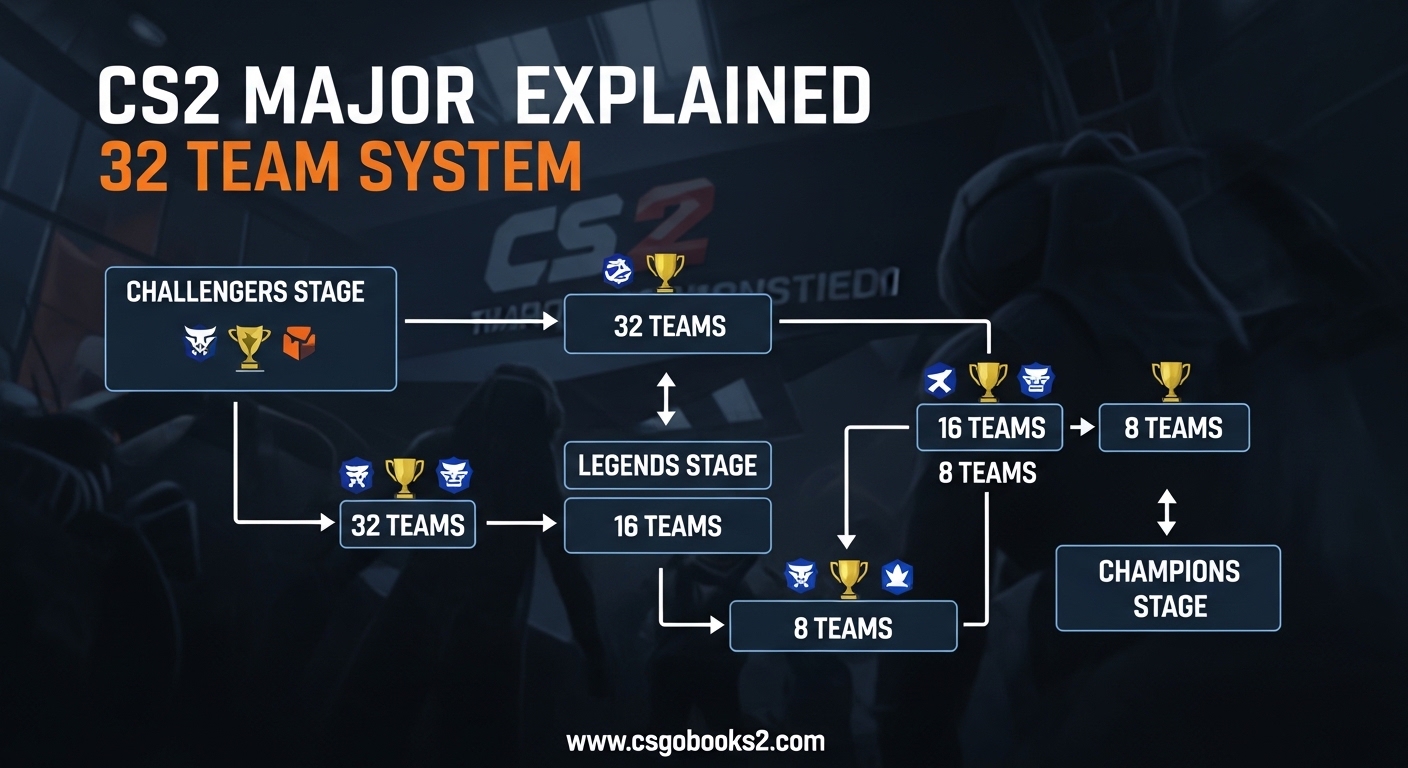
The CS2 major format with 32 teams works through a progression of three Swiss stages followed by an eight-team playoff bracket. Here’s the basic structure:
- Stage 1: 32 teams compete in Best-of-One (Bo1) Swiss rounds
- Stage 2: 16 teams advance, mixed Bo1 and Best-of-Three (Bo3) matches
- Stage 3: 16 teams compete, all Bo3 format
- Playoffs: Top 8 teams advance to single-elimination bracket (all Bo3)
The Swiss system means teams with similar records face each other, ensuring competitive matches throughout. A team is eliminated after three losses or advances after three wins, creating multiple elimination and advancement points across each stage.
The Three Swiss Stages Explained
The three Swiss stages are the core of the new 32-team CS2 Major format. Each stage serves a specific purpose in filtering teams from 32 down to the final 8 playoff contenders. Let me break down exactly how each stage works.
Stage 1: Opening Swiss (32 Teams)
Stage 1 begins with all 32 teams divided into groups based on their seeding. All matches are Best-of-One (Bo1), making every single map crucial. The Swiss system ensures teams with 1-0 records face other 1-0 teams, 0-1 teams face other 0-1 teams, and so on.
Teams advance to Stage 2 after winning three matches or are eliminated after losing three matches. Typically, 16 teams advance from Stage 1, though the exact number can vary based on tournament format. The Bo1 format creates high stakes and plenty of upsets, as one bad map can send a team home.
Stage 2: Middle Swiss (16 Teams)
Stage 2 features the 16 advancing teams from Stage 1, with a mix of Bo1 and Bo3 matches depending on the round. The opening rounds typically use Bo1 format, while elimination and advancement matches often switch to Bo3 to reward consistency.
This stage is where the tournament really separates contenders from pretenders. Teams that survived Stage 1 through lucky draws often struggle here, as the competition level increases. Again, three wins advances to Stage 3, while three losses means elimination.
Stage 3: Final Swiss (16 Teams)
Stage 3 is unique because it brings in 8 new teams (high seeds who qualified directly to this stage) alongside the 8 teams advancing from Stage 2. All matches in Stage 3 are Best-of-Three, reducing randomness and rewarding the better-prepared teams.
The top 8 teams from Stage 3 advance to the playoffs. This stage is crucial because it determines the playoff bracket seeding and gives the top performers extra rest before the knockout phase begins.
How Swiss System Progression Works
The Swiss system can be confusing if you’re new to it. Here’s how teams move through each stage:
- Round 1: All teams play, seeded matchups
- Round 2: Teams with same records face each other (1-0 vs 1-0, 0-1 vs 0-1)
- Round 3: Again, same-record matchups
- Round 4: Some teams can advance with 3-0, others eliminated with 0-3
- Round 5: Final advancement/elimination decisions for teams with 2-2 or 1-3 records
This system ensures that by the end of each stage, teams are sorted by their actual performance level, creating the most competitive matchups possible.
How Teams Qualify: MRQ and VRS System
Understanding qualification is crucial because the CS2 major format 32 team system introduced major changes to how teams earn their spots. The old RMR system has been replaced by MRQ (Major Regional Qualifiers), and a new VRS (Valve Ranking System) determines automatic invitations.
What is MRQ (Major Regional Qualifiers)?
MRQ stands for Major Regional Qualifiers, replacing the previous RMR system. Under MRQ, each region (Europe, Americas, Asia) runs separate qualifier tournaments leading to the Major. This change gives Valve more control over the qualification process and allows for more flexible slot distribution.
The MRQ system consists of open and closed qualifiers in each region. Teams can earn spots through online open qualifiers or receive direct invites based on their regional performance. The top teams from each MRQ event qualify directly to specific stages of the Major.
What is VRS (Valve Ranking System)?
VRS is Valve’s new automated ranking system that determines which teams receive automatic invitations to the Major. Unlike the old RMR system, which used a season-long points race, VRS takes a snapshot of team performance at a specific date and awards invites based on regional rankings.
The VRS considers results from Valve-sponsored events and major tournaments over a qualifying period. Teams at the top of each region’s VRS standings receive direct invites to Stage 3 of the Major, skipping the earlier stages entirely.
Qualification Path Breakdown
Here’s how teams can qualify for a 32-team CS2 Major:
- VRS Invite: Top teams receive automatic invites to Stage 3 based on Valve Ranking System
- MRQ Winners: Teams win their regional MRQ events to qualify for Stage 1 or Stage 2
- MRQ Placings: High placings in MRQ events can also earn Stage 1 or Stage 2 spots
- Previous Major Performance: Some spots may be reserved for top performers from the previous Major
The exact distribution of VRS invites vs. MRQ qualifiers varies by Major, but typically around half the field comes from MRQ events while the rest receive VRS invites or other qualification paths.
Regional Slot Distribution for 32-Team Majors
One of the biggest changes in the CS2 major format 32 team system is how regional slots are distributed. The expansion from 24 to 32 teams allowed Valve to increase representation from underrepresented regions, particularly Asia.
Current Regional Breakdown
The 32-team slot distribution is typically:
- Europe: 16 teams (50% of the field)
- Americas: 11 teams (34% of the field)
- Asia: 5 teams (16% of the field)
This represents a significant increase for Asia, which previously only had 2 guaranteed slots in the 24-team format. The Americas also gained additional spots, while Europe’s share decreased slightly in percentage terms though it still receives the most slots overall.
How Regional Slots Are Determined?
Valve determines regional slot distribution based on several factors:
- Regional team performance in recent Majors
- Depth of competitive talent in each region
- Viewer interest and market size
- Efforts to grow Counter-Strike in emerging regions
The slot distribution isn’t fixed permanently. Valve can adjust it for future Majors based on how regions perform and their strategic goals for growing CS2 globally.
Why Asia Got More Slots?
The increase from 2 to 5 Asian slots reflects the growing Counter-Strike scene in countries like China, Mongolia, and Southeast Asia. These regions have shown significant improvement in recent years, and Valve wants to encourage further growth by giving more teams a chance to compete on the biggest stage.
The additional slots also address criticism that the previous 24-team format was too Eurocentric, with limited opportunities for teams outside Europe and North America to prove themselves.
Bo1 vs Bo3 Format Debate
The CS2 major format with 32 teams has sparked debate about the continued use of Best-of-One matches in Swiss stages. Many players and fans prefer Bo3 for its reduced randomness, while others argue Bo1 creates more exciting moments and storylines.
Under the current format, Stage 1 uses exclusively Bo1, Stage 2 mixes Bo1 and Bo3, and Stage 3 uses only Bo3. This gradual shift balances the need to filter teams quickly (Bo1) with rewarding consistency (Bo3) as the tournament progresses.
Valve has defended Bo1’s continued use, noting that it allows for more matches to be played in a shorter timeframe and creates the “upset potential” that makes Majors exciting. However, criticism persists, particularly from top teams who feel one bad map shouldn’t eliminate them from contention.
Frequently Asked Questions
How many teams play in the CS2 Major?
The CS2 Major features 32 teams competing through three Swiss stages followed by an 8-team single-elimination playoff bracket. This is an increase from the previous 24-team format used in CS:GO and early CS2 Majors.
How does the 32 team CS2 Major format work?
32 teams compete in Stage 1 (Bo1 Swiss), with 16 advancing to Stage 2 (mixed Bo1/Bo3). Stage 3 features 16 teams (8 from Stage 2, 8 direct invites) playing Bo3 Swiss. The top 8 teams from Stage 3 advance to single-elimination playoffs.
What is MRQ in CS2?
MRQ stands for Major Regional Qualifiers, replacing the old RMR system. It’s a series of regional qualification tournaments where teams compete to earn spots in the Major. Each region (Europe, Americas, Asia) runs separate MRQ events.
How do teams qualify for CS2 Majors?
Teams qualify through VRS invites (automatic based on Valve Ranking System), by winning or placing high in MRQ regional qualifiers, or through previous Major performance. The exact mix varies by tournament.
Why did CS2 Majors expand to 32 teams?
Valve expanded to 32 teams to increase regional representation (especially Asia), provide more matches for viewers, create more qualification opportunities, and grow the global CS2 ecosystem. The change began in 2026.
What are the three Swiss stages in CS2 Majors?
Stage 1: 32 teams, Bo1 format; Stage 2: 16 teams, mixed Bo1/Bo3; Stage 3: 16 teams (8 advancing + 8 direct invites), all Bo3. Teams advance after 3 wins or are eliminated after 3 losses in each stage.
How long does a 32-team CS2 Major last?
A typical 32-team CS2 Major lasts approximately 2 weeks. The three Swiss stages take about 8-10 days, followed by 3-4 days of playoff matches. The exact duration depends on the tournament organizer’s schedule.
Final Thoughts on the CS2 Major 32-Team Format
The CS2 major format explained here represents Valve’s effort to modernize Counter-Strike’s most prestigious tournament. The expansion to 32 teams, introduction of MRQ qualifiers, and three-stage Swiss system all aim to make Majors more inclusive, more exciting, and more representative of the global CS2 community.
While the format has its critics—particularly around Bo1 matches and the complexity of qualification—the early results have shown increased viewership, more regional diversity, and plenty of memorable moments. As we move further into 2026, expect teams and players to continue adapting their strategies to maximize their performance in this new format.
Whether you’re watching your favorite team compete or following your local qualifier scene, understanding the CS2 major format 32 team system helps you appreciate the journey every team takes to reach the biggest stage in Counter-Strike.