
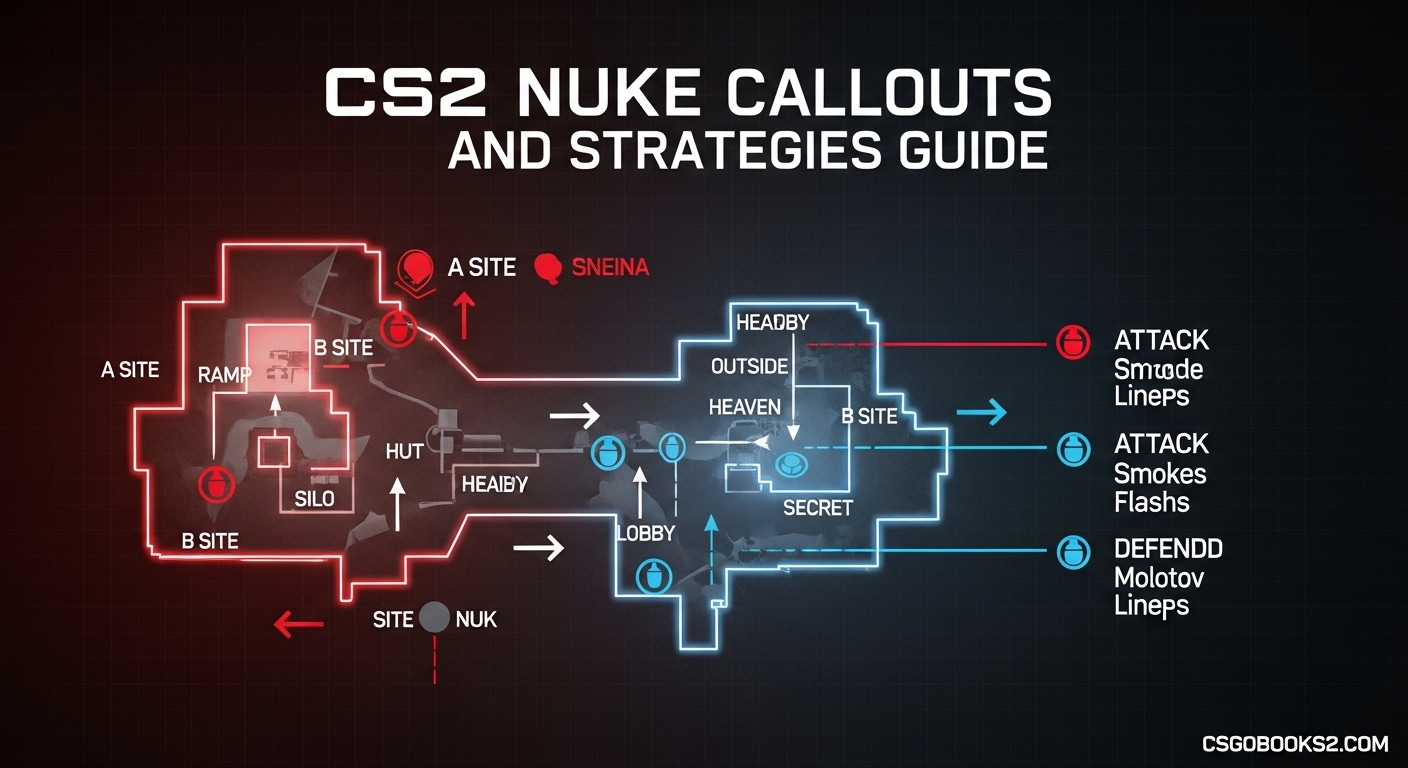
CS2 Nuke callouts are standardized location names that enable instant team communication about enemy positions and strategies on Nuke’s complex two-tiered nuclear power plant map. Mastering these callouts transforms your gameplay from confused solo queue chaos to coordinated team dominance, as precise communication means faster rotations, better utility usage, and more effective executions.
Nuke stands apart from other CS2 maps with its unique vertical design featuring an above-ground level with A Site and Outside areas, plus an underground level housing B Site. This two-tiered layout creates intense vertical gameplay where enemies can be above or below you, making generic descriptions like “he’s over there” completely useless. The map has been a Counter-Strike staple since the original game, with CS2 bringing updated visuals and refined gameplay while maintaining the core strategic elements that make Nuke both challenging and rewarding.
Whether you’re learning CS2 Nuke callouts for the first time or looking to fill gaps in your knowledge, this comprehensive guide covers every position on the map, essential smoke spots, and strategies for both T and CT sides. I’ve played thousands of hours on Nuke across multiple Counter-Strike titles, and I’ll break down the callouts that actually matter in competitive play.
Quick Reference: CS2 Nuke Callouts Overview (April 2026)
Nuke’s callouts divide the map into logical sections based on how teams actually play. The above-ground level includes A Site, Outside, Lobby, and surrounding areas like Heaven, Silo, and Ramp. The underground level contains B Site, Garage, Tunnels, and connecting passages like Vents and Secret. Each major area has sub-callouts for precise positioning.
Most confusion for new players comes from the vertical elements – knowing whether someone is in Heaven (above A Site) or Hell (below B Site), or whether enemies are in Upper or Lower areas of specific positions. This guide breaks down every location with clear descriptions of where each callout actually refers to on the map.
CS2 Nuke A Site Callouts – Upper Level
A Site sits on Nuke’s above-ground level and serves as the primary bombsite for many T side strategies. The area features multiple entrance points making it both challenging to attack and defend. Here are all the essential A Site callouts you need to know.
Heaven
Heaven is the elevated position overlooking A Site from above, located on the rafters near the radioactive symbol. CT players often hold Heaven with an AWP to watch entrances from Ramp and Secret. The position gives incredible sight lines but makes you vulnerable to players sneaking underneath or utility from below.
Silent dropping to Heaven is an advanced technique that lets CT players reach this position without making the footstep sounds that give away your position. To silent drop, crouch before dropping off the ledge onto the rafters – this eliminates the landing noise that would otherwise alert attentive T players.
Rafters
Rafters refers to the overhead beams running across the ceiling near Heaven and above A Site. Players can position on these rafters for unexpected angles, though it’s a high-risk position with limited escape options if spotted. Most commonly used for surprise plays or catching enemies pushing through without checking above.
Main
Main is the primary large entrance to A Site from Lobby. The doorway opens into A Site with plenty of room for multiple players. Main is the most common entry point for T attackers and a key choke point that CT defenders must watch. The area just inside Main from the A Site side is often called “Main default” or simply “Main.”
Mini
Mini refers to the smaller entrance to A Site located next to Main, accessible from Lobby as well. Some players and regions debate Main vs Mini terminology, but the standard competitive callout uses Main for the large door and Mini for the smaller adjacent entrance. CT players can stack Mini for surprise defense, while T attackers often push both Main and Mini simultaneously to overwhelm defenders.
Secret
Secret is the hidden passage connecting Outside to A Site. It provides a sneaky route for T attackers to flank A Site defenders or rotate between Outside and A without exposing themselves. The entrance from Outside is tucked away near Silo, while the A Site end opens near Rafters. CT players must check Secret regularly or risk being attacked from behind.
Squeaky
Squeaky is the small doorway connecting Lobby to the area outside Secret. Named for the door that makes a squeaking sound when opened in previous CS versions, though CS2 has updated audio. Squeaky provides another route for T players to access A Site areas and creates additional pressure points for CT defenders to watch.
Hut
Hut is the small structure located between A Site and Outside, accessible from both areas. It provides cover and a strategic position for players holding angles or waiting to execute. Hut can be contested from multiple directions, making it a dangerous position to hold for too long. T players often use Hut for pre-plant positions while waiting for teammates.
Lockers
Lockers refers to the area with locker units near A Site, typically on the CT spawn side of the site. It provides cover for defenders and can be used to hide during retake situations. Lockers is close enough to A Site for quick rotations but far enough back to avoid being hit by initial utility.
CT Box and Big Box
CT Box is the cover position located between A Site and CT Spawn, providing CT defenders with protection while holding the site. Big Box refers to the larger box structure typically near the middle of A Site. Both are crucial cover positions during post-plant situations, allowing defenders to play difficult angles while avoiding AWP sight lines from Heaven or Outside.
A Default Plant
The default plant position for A Site is typically in the open area near the center, easily visible from most defending positions. However, players often use alternative plant positions for hidden or safer plants. Common alternative plants include “tree plant” (near the tree/wall), “Hut plant” (closer to Hut), and “secret plant” (toward Secret entrance).
CS2 Nuke B Site Callouts – Lower Level
B Site occupies Nuke’s underground level and features tight corridors, multiple choke points, and limited escape routes. The claustrophobic nature of B Site makes utility usage critical, and positioning errors are quickly punished. These callouts cover all essential B Site locations.
Tunnels
Tunnels is the primary underground passage connecting T Spawn to B Site areas. It features a long corridor with multiple turns where players can position for ambushes or defensive holds. Tunnels provides T players with a protected route to B Site but limits visibility and makes players vulnerable to utility and wall bangs.
Garage
Garage is the large room connecting Outside (upper level) to B Site areas via stairs. The name comes from the garage-like appearance with vehicles and equipment. Garage serves as a connector area that CT players use to rotate between Outside and B, while T attackers can use it to flank or access B Site from unexpected angles.
Vents and Back Vents
Vents is the small vent passage connecting A Site (upper level) directly to B Site areas (lower level). This creates one of Nuke’s most iconic vertical plays, where players can drop through vents to rotate between sites almost instantly. Back Vents refers to the area around the vent opening on the B Site side. CT players must watch both the vent opening and surrounding areas to prevent players dropping through unexpectedly.
Doors
Doors refers to the doorway areas connecting B Site to the surrounding passages. There are multiple doorways around B Site, and the specific callout usually refers to the main entrance from Tunnels. Players can open and close these doors, creating the opportunity for door plays and surprise peek attempts.
Window
Window is the position overlooking B Site from an elevated room, accessible from Garage or areas near Ramp. CT players often hold Window with rifles or AWPers to watch B Site entrances and provide information. The position offers good visibility but makes the player predictable if used every round.
Dark
Dark refers to the dimly lit corner area of B Site, typically on the side opposite the main entrance from Tunnels. The name comes from the poor lighting in this corner, making it easier for players to hide. CT defenders occasionally use Dark for off-angle holds, while T attackers might hide there to catch rotating CT players.
Toxic
Toxic is the area near the toxic hazard symbols located around B Site, typically referring to a specific corner or wall section. Like Dark, it provides cover and can be used for hiding or off-angle positioning. The exact location varies by team and region, so confirm with your teammates which specific area they mean by Toxic.
B Default Plant
The default plant position for B Site is typically in the more open area near the center, visible from common defending positions. However, hidden plants are common on B due to the site’s enclosed nature. Popular alternative plants include “Tunnels plant” (closer to Tunnels entrance), “Window plant” (toward Window room), and “behind box” plants that are harder to defuse quickly.
CS2 Nuke Outside, Lobby and Ramp Callouts
The exterior areas of Nuke are just as important as the bombsites themselves. Outside provides key sight lines and rotation paths, Lobby serves as the central connector, and Ramp offers direct access to key areas. Mastering these callouts is essential for map control and successful rotations.
T-Spawn and CT-Spawn
T-Spawn is the terrorist starting area located outside near the exterior walls of the nuclear facility. It provides immediate access to Outside areas and routes toward both bombsites. CT-Spawn is the counter-terrorist starting area located inside the facility above A Site, giving CT players quick access to A Site and Interior areas.
Outside
Outside refers to the entire exterior area of the nuclear facility map. It’s the large open space between the outer walls and the building proper, featuring multiple key positions and sight lines. Outside is critical for map control, as holding this area limits T side options and provides CT players with information and pick opportunities.
Silo
Silo is the large cylindrical silo structure located in the Outside area, providing significant cover from multiple angles. Players can position behind Silo for protection while watching other areas of Outside. It’s a common position for AWPers holding long sight lines and for riflers playing off-angles to catch pushing enemies.
Radio
Radio is the area near the red trailer/structure in Outside, named after the radio equipment visible on or near it. The position provides cover and sight lines toward key areas. CT players often use Radio to hold Outside and watch for T pushes, while T attackers might use it as a staging area before executing toward a site.
Trophy
Trophy refers to a specific area or structure in Outside, typically near a prominent landmark or trophy-like object. The exact location varies by region and team preference, so confirm with your teammates which specific area they mean when using this callout.
Control
Control typically refers to a strategic position in Outside that provides oversight of key routes and sight lines. Holding Control gives your team map dominance and information about enemy movements. It’s often contested in the early rounds as teams fight for Outside control.
Decon
Decon is the decontamination area located in the Outside section of the map, typically near one of the building entrances. The area is characterized by decon showers and equipment. Decon provides cover and can be used to position players for various angles or to avoid enemy sight lines.
Ramp
Ramp is the sloping passage connecting Outside to Lobby, providing a direct route between the exterior and interior of the facility. It’s a key choke point that must be controlled for successful rotations. T players often rush Ramp to quickly access Lobby and A Site, while CT defenders must hold this area to prevent T side map control.
Lobby
Lobby is the large central room connecting multiple areas of the map, including Ramp, Main, Mini, and routes toward both bombsites. Lobby serves as the central hub for rotations and is heavily contested throughout rounds. Control of Lobby allows quick rotations between sites and puts pressure on the enemy team.
Turnpike
Turnpike refers to a specific area or passage, typically near Lobby or connecting routes. The callout varies by region and team, so establish consistent usage with your teammates. It often refers to a turn or intersection where players can position for crossfires or ambushes.
Smoke and Utility Guide for Nuke
Effective utility usage separates average players from great players on Nuke. The map’s vertical design and multiple choke points make smokes, molotovs, and flashes essential for both attacking and defending. Here are the most impactful utility spots from common positions.
Essential T Side Smokes from T Spawn
From T Spawn, critical smokes include Heaven smoke (blocks AWP sight lines from above A Site), Ramp smoke (blocks vision from Ramp into Lobby), and Garage smoke (blocks CT view from Garage into Outside). These smokes create safe passage for T players moving toward execution areas. Throw the Heaven smoke from the corner near T Spawn, aiming at the specific point on the wall or sky indicated in smoke tutorials.
A Site Execution Smokes
When executing A Site, smokes should block CT vision from Heaven, Main, and Mini. Standard smokes include Heaven smoke (from Lobby or Secret), Main smoke (from Lobby or Tunnels drop), and Mini smoke (from Lobby). These create confusion and limit CT defender effectiveness. Flashbangs should follow smokes to blind defenders holding tight angles.
B Site Execution Smokes
B Site smokes should block vision from Window, Tunnels exit, and Garage connector. Key smokes include Window smoke (from Tunnels or B entrance), Tunnels smoke (from B Site toward Tunnels), and Garage smoke (from B toward Garage stairs). Molotovs are crucial on B to clear CT positions in Dark, Toxic, and behind boxes.
CT Side Utility for Defense
CT defending utility focuses on delaying pushes and gathering information. Early round molotovs at Ramp and Lobby entrances can catch rushing T players. Flashbangs from Heaven can support teammates retaking A Site. CT players should save smokes for post-plant situations or to block retakes if sites fall.
Utility Combinations
Advanced players use utility combinations for maximum effectiveness. Common combos include smoke-flash sequences where a flash follows immediately after a smoke to catch players pushing through, and molly-smoke combos where a molotov is followed by a smoke to reset position. Practice these combinations in deathmatch and offline modes to develop muscle memory.
T Side Strategies for Nuke
Nuke is traditionally CT-sided due to the defensible nature of the sites and the vertical advantage CT players enjoy. However, effective T side strategies can exploit predictable CT positions and create advantages through proper utility usage and timing.
Default Round Setup
In default rounds, T players should focus on map control and gathering information. Send players to Outside, Ramp, and Secret to put pressure on multiple areas. This forces CT rotations and reveals which positions are heavily defended. Once weaknesses are identified, execute toward the weaker site with proper utility support.
A Site Execution
Successful A Site attacks require coordinated utility and timing. Smokes must block Heaven and Main/Mini vision simultaneously. Flashbangs should blind defenders holding tight angles. Entry fraggers push through smoke while trade partners are ready to swing. Have players outside Secret to catch rotating CT players or flank from behind.
B Site Execution
B Site attacks are slower due to the enclosed nature of the area. Use smokes to block Window and Garage vision, then molotov common CT positions in Dark, Toxic, and behind boxes. Entry the site with proper spacing to avoid being traded easily. Post-plant positions should watch for retakes from Tunnels, Garage, and Vents.
Ramp Rush
The Ramp rush is a classic Nuke strategy that works especially well on eco rounds or pistol rounds. Multiple players rush Ramp simultaneously to overwhelm the CT player holding, then flood Lobby and A Site before CT players can rotate from other positions. Speed and numbers are key – don’t stop in Lobby, commit fully to the site.
Outside Control
Controlling Outside gives T players multiple options. From Outside, you can execute A via Secret, pressure Garage to access B, or fake one site and hit the other. AWPers can pick CT players pushing outside. Establish Outside control early in the round to keep CT defenders guessing and create opportunities for delayed attacks.
CT Side Setups for Nuke
CT side success on Nuke comes from proper positioning, good communication, and efficient rotations. The vertical design gives CT players natural advantages, but these must be leveraged correctly through smart positioning and utility usage.
Default CT Positions
Standard CT setup places one player Heaven with AWP, one player watching Main/Mini, one player watching Secret/Squeaky, one player Outside watching Ramp, and one player Garage/B flexible. This covers all major attack routes while maintaining flexibility to rotate. The Heaven player is crucial – their picks can shut down entire T side approaches.
AWP Positions
Nuke offers excellent AWP positions. Heaven is the most iconic, providing sight lines over A Site and approaches from Ramp and Secret. Outside positions near Silo and Radio give picks on players crossing through. Garage Window can watch B Site and Tunnels. Rotate your AWPs between positions to keep T players guessing.
Rifle Positions
Rifle players should hold positions that allow them to support each other and trade kills. On A Site, players near CT Box and Main can support Heaven and watch for pushes. On B, players near Tunnels and Garage entrance can crossfire with Window players. Avoid holding positions where you can’t be traded quickly.
Rotation Priorities
When T side commits to a site, nearby CT players rotate first while distant players hold their areas to prevent fakes. If A is hit, the Garage player and Outside players rotate first while B players hold longer. If B is hit, A players rotate through Lobby while Outside players watch for flanks. Communication about numbers and utility is essential for proper rotations.
Retake Setups
When retaking a lost site, approach from multiple angles simultaneously to confuse defenders. Use utility to clear common positions before pushing. Have players trade each other’s deaths – don’t push alone. On A retakes, approach from Heaven and CT Spawn simultaneously. On B retakes, approach from Tunnels and Garage at the same time.
FAQs
What are callouts on a CS2 map?
Callouts are standardized names for specific locations on a CS2 map that enable quick team communication about enemy positions, strategies, and movements without lengthy explanations. Instead of saying ‘he’s in that room by the thing,’ you simply say the callout name, and every teammate knows exactly where you mean. This precision is critical for effective team coordination.
What distinguishes the Nuke map in CS2?
Nuke is unique in CS2 for its two-tiered vertical design featuring an above-ground level with A Site and Outside areas, plus an underground level housing B Site. This nuclear power plant setting creates intense vertical gameplay where enemies can be above or below you, requiring special awareness and making generic descriptions useless. The map has been a Counter-Strike staple since the original game.
How can I effectively use smoke grenades on Nuke?
Effective smoke usage on Nuke requires knowing key sight lines and choke points. Critical smokes include Heaven smoke (blocks AWP vision over A Site), Ramp smoke (blocks vision into Lobby), and Garage smoke (blocks CT view from Garage). When attacking, smoke multiple angles simultaneously to confuse defenders. When defending, use smokes to delay pushes and block retake routes.
Is Nuke T or CT sided?
Nuke is generally considered CT-sided due to the defensible nature of the sites and the vertical advantage CT players enjoy. Professional statistics typically show CT win rates around 52-55% on Nuke. However, effective T side strategies with proper utility usage and timing can exploit predictable CT positions and win consistently.
How to silent drop Nuke heaven in CS2?
To silent drop to Heaven, crouch before dropping off the ledge onto the rafters – this eliminates the landing noise that would otherwise alert attentive T players. The technique requires practice to master but gives CT players a significant advantage when holding Heaven, as T players won’t hear you take position.
How old is Nuke CS2?
Nuke is one of the oldest maps in Counter-Strike history, originally appearing in the very first Counter-Strike 1.0 release in 2000. The map has been updated and refined through every Counter-Strike iteration including CS:GO and now CS2, making it over 25 years old in Counter-Strike history while maintaining its core strategic elements.
How to play ramp on Nuke CS2?
Playing Ramp requires understanding its importance as a key choke point connecting Outside to Lobby. CT players should hold Ramp with utility support and proper crossfire from Lobby teammates. T players can rush Ramp with speed and numbers to overwhelm defenders, or use it as a fake to draw rotations while executing to the other site.
Conclusion: Master CS2 Nuke Callouts for Better Teamplay
Learning CS2 Nuke callouts transforms your experience on this iconic map from frustrating confusion to coordinated dominance. The two-tiered nuclear power plant design creates unique challenges that make precise communication absolutely essential. Whether you’re holding Heaven with an AWP, rushing Ramp on pistol round, or rotating through Secret to catch defenders off guard, using the right callouts at the right time gives your team the competitive edge.
Start by mastering the major areas – A Site, B Site, Outside, Lobby, and the key sub-positions like Heaven, Main, Mini, Secret, Silo, and Garage. Practice these callouts in deathmatch and casual matches until they become second nature. Watch professional matches to hear how top-tier teams communicate on Nuke, and incorporate their terminology into your own gameplay.
Remember that consistency within your team matters more than using the “correct” callouts. If your team calls the small entrance “Mini” but another team uses “Side,” stick with what works for your group. The goal is instant understanding, not semantic perfection.
The most effective way to learn CS2 Nuke callouts is to play the map regularly while actively using the terminology. Don’t be afraid to ask teammates for clarification if you’re unsure about a callout – most players would rather explain than deal with confused communication. With time and practice, these callouts will become automatic, and you’ll find yourself executing complex strategies with the precision of a professional team.