
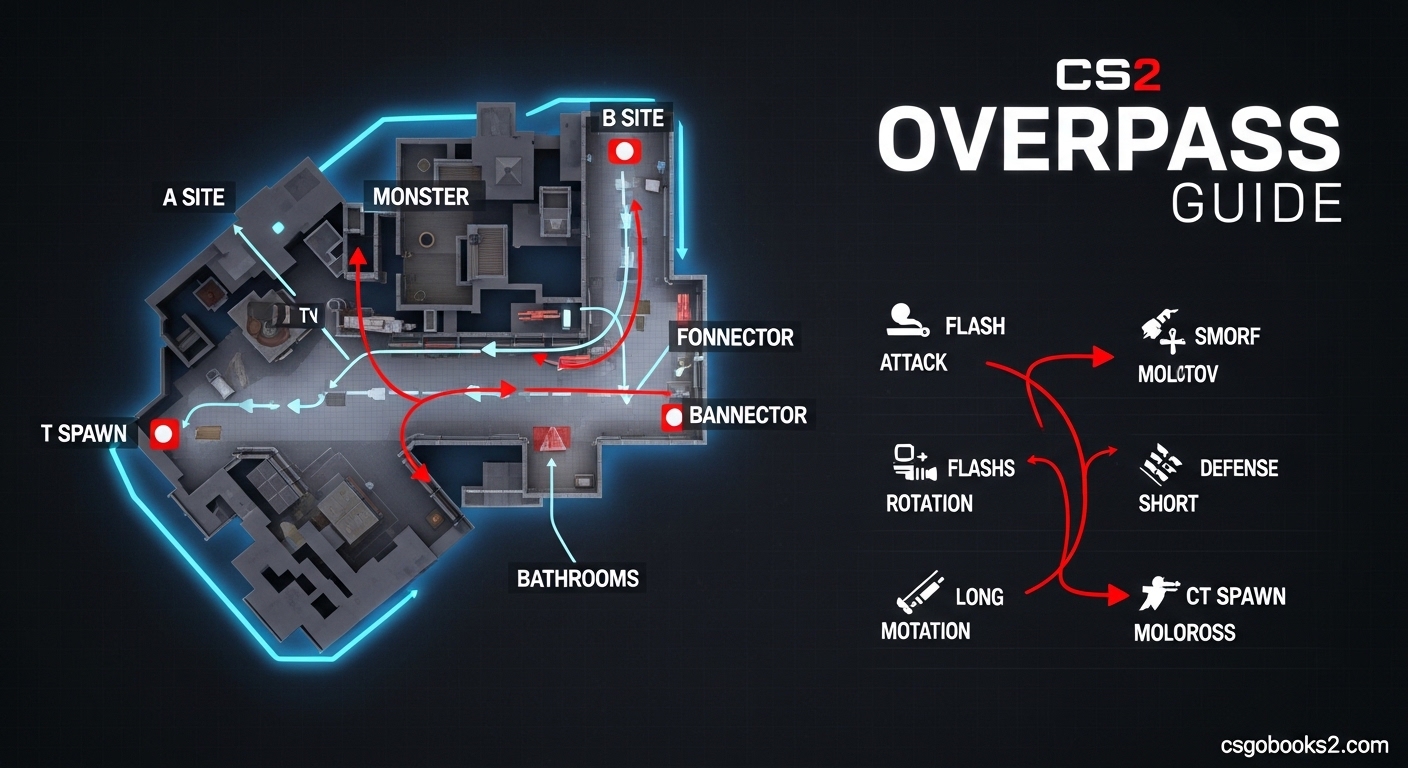
Overpass returned to Counter-Strike 2 in 2026 after being remastered with Source 2 engine updates. The map, set in a canal overpass and park in Berlin, Germany, has been a competitive staple since its original CS:GO release. Learning CS2 Overpass callouts is essential for team coordination, as this vertical map features over 40 named positions across its three main areas: A Site, B Site, and Mid.
The unique layout of Overpass makes it one of the most CT-sided maps in the competitive pool. Elevated positions like Heaven and Pillar give defenders significant advantages, while the complex rotation paths through Connector and Sewers require precise communication. Whether you’re defending sites or executing as terrorists, knowing the exact location names helps your team react faster and make smarter decisions.
After analyzing professional matches and competitive play at the Faceit level, I’ve compiled the most comprehensive CS2 Overpass callouts guide available. This breakdown includes every major position, rotation timing data, and practical tips for learning the map efficiently.
Quick Reference: Essential Overpass Callouts
Before diving into each area, here are the 15 most-used callouts you’ll hear in competitive matches. These positions account for roughly 80% of all callouts during a typical match:
- Monster: The tunnel connecting Mid to A Long, named after the graffiti on the wall
- Connector: The corridor linking Mid to B Short, the primary rotation path
- Heaven: The elevated position above A Site, accessed from Long or CT spawn
- Water: The canal area running beneath the map, accessible from multiple points
- Pillar: The stone column on A Site providing cover to planted bombs
- Bank: The building area on B Site with vault access
- Fountain: The open area in front of B Site with the water feature
- Playground: The area with playground equipment near B Long
- Sandbags: The defensive position on B Site with stacked barriers
- Optimus: The truck position near B Site named after the Transformer design
- Restrooms/Toilets: The connector building between Mid and B Site
- A Long: The extended approach to A Site from Mid
- A Short: The quick approach to A Site from CT spawn area
- Van: The parked vehicle position near A Site entrance
- Graffiti: The Mid area position marked by wall art
CS2 Overpass Guide: Complete Callouts & Rotations
Understanding how these positions connect is crucial for effective rotations and map control. Let’s break down each area systematically.
A Site Callouts: Complete Breakdown
A Site on Overpass is defined by its vertical gameplay and multiple approach angles. The bombsite itself is relatively open, with the Pillar providing the primary cover for planted bombs. Defenders typically hold Heaven, the elevated position overlooking the site, while attackers approach through Monster tunnel or A Short.
Key A Site Positions:
- Heaven: The elevated platform accessed from A Long or CT spawn. Provides sightlines to the entire site and Monster entrance. CTs often hold this position with AWP or rifle.
- Pillar: The large stone column in the center of A Site. Primary cover for defending planted bombs. CTs often play behind this during retakes.
- Backsite: The area behind the bombsite toward CT spawn. CTs rotate through here when rotating from B or Mid.
- Van: The position near the parked vehicle at the A Site entrance. Used for initial peek and trading kills.
- A Long: The extended route from Mid through Monster tunnel to A Site. Primary T-side approach path.
- A Short: The quick connector from CT spawn area to A Site. Fastest CT rotation to the site.
- Monster: The tunnel featuring graffiti artwork. Named for the “monster” graffiti on the wall. Connects Mid to A Long.
- Graveyard: The area near the edge of the map with tombstone-like monuments. Provides cover for T-side players approaching from Long.
- CT Spawn: The initial spawn area for counter-terrorists, providing quick access to both sites.
- Stairs: The staircase leading from water level up to A Site position.
First Contact Points for A Site:
When terrorists execute onto A Site, first contact typically happens at one of three positions: the entrance to Monster tunnel (T-side peeking), the top of A Long (CTs holding angle), or Heaven (AWP watching Long). As a CT player holding A, your first contact point depends on your position. Heaven players get first contact on Long pushes, while Pillar players see site entry first.
CT Perspective on A Site:
Defending A Site requires balancing aggressive holds with passive positions. The most common setup involves one player Heaven with an AWP watching Monster and Long, while a second player holds Pillar or plays a more passive angle on the site itself. When rotated from B or Mid, CTs typically enter through Backsite to retake.
T Perspective on A Site:
Executing onto A Site as terrorists typically involves smoking Heaven and flashing into the site. The Long approach through Monster is the most common, with support players flashing for the entry fragger. Some teams prefer a split approach, sending players through both Monster and Connector to catch defenders off guard.
B Site Callouts: Complete Breakdown
B Site on Overpass offers more verticality and complex angles than A Site. The area features multiple defensive positions including Bank, Fountain, and Playground, making it challenging for terrorists to clear efficiently. The site connects to Mid through Restrooms/Toilets and to CT spawn through multiple paths.
Key B Site Positions:
- Bank: The building with vault-like features on B Site. Provides elevated defensive position and cover for CTs holding the site.
- Fountain: The open area featuring a water fountain in front of B Site. Common first contact point for T-side approaches.
- Sandbags: The defensive position with stacked barriers on B Site. Strong CT hold position with cover to reload.
- Playground: The area with playground equipment near B Long approach. Used for T-side positioning and CT flanking.
- Optimus: Named after the truck’s resemblance to Optimus Prime. Provides cover for both CTs and Ts.
- B Short: The quick route from Connector to B Site. Fastest path for rotations between sites.
- B Long: The extended approach to B Site from the playground area and CT spawn side.
- Restrooms/Toilets: The building connecting Mid to B Short. Primary rotation path from Mid to B Site.
- Cafeteria: The indoor area with tables near B Site approach. Provides cover and positioning options.
- Bench: The seating area position on B Site used for cover and positioning.
First Contact Points for B Site:
First contact on B Site typically occurs at Fountain for T-side pushes from Short, or at Playground for approaches from Long. CTs holding Bank often get first contact on players pushing through Fountain, while those in Sandbags see players crossing into the site. The Restrooms connector is another crucial first contact point, as players rotating through Mid must clear this angle.
CT Perspective on B Site:
Defending B Site often involves two players holding crossfire positions. One player typically holds Bank with an angle on Fountain, while a second player holds Sandbags or a more passive site position. The verticality of B Site allows CTs to trade kills effectively if one player is peeked. When rotating from A or Mid, CTs typically enter through Short or Backsite areas.
T Perspective on B Site:
Executing onto B Site requires careful utility usage and coordination. Smoking Bank and flashing Sandbags are essential for a successful execute. Most teams approach through B Short from Connector, though some prefer a split approach through both Short and Long. Clearing Bank and the elevated positions is critical before planting the bomb.
Mid Map Callouts: Control & Rotations
Mid is the control center of Overpass, connecting both bomb sites through multiple paths. Controlling Mid gives your team information about enemy movements and enables quick rotations between sites. The area features multiple positions including Connector, Water, and various tunnel systems.
Key Mid Positions:
- Connector: The primary corridor linking Mid to B Short. The most important rotation path on the map.
- Water: The canal area running beneath the map. Provides covered movement between areas.
- Pit: The lower area within Water that provides additional cover. Sometimes called “Dropdown” by players.
- Monster: The tunnel connecting Mid to A Long. Named for the graffiti artwork on the wall.
- Graffiti: The Mid position marked by wall art. Common holding position for CTs.
- Optimus: The truck position near Mid approach to B Site.
- Sewers: The underground system providing alternative rotation paths between sites.
- T Spawn: The terrorist spawn area providing access to both Mid approaches.
- Construction: The area with construction materials near Mid. Used for cover and positioning.
- Arches: The architectural feature providing cover in Mid area.
First Contact Points for Mid:
Mid first contact typically happens at one of three positions: Graffiti (CTs holding from Connector side), Monster entrance (CTs watching A Long), or Water entrance (players crossing through the lower area). Controlling these first contact points gives your team information about enemy pushes and enables faster rotations.
Mid Control Importance:
Controlling Mid on Overpass is crucial for several reasons. First, it enables quick rotations between sites through Connector. Second, it provides information about enemy movements and potential executes. Third, it allows players to flank opponents who have committed to a site. Teams that lose Mid control often find themselves in difficult retake situations with limited time.
Sewer System:
The Sewer system provides an alternative rotation path that many players overlook. This underground route connects various points on the map and can be used for flanking or unexpected rotates. However, the Sewers are risky because they offer limited escape options if spotted. Most professional teams use Sewers sparingly, preferring the faster and more direct Connector rotation.
Rotation Paths & Timing
Understanding rotation timing on Overpass separates average players from great ones. The map’s unique layout creates multiple rotation paths with different timings, and knowing which path to take can win or lose rounds. Let me break down the most important rotations with actual timing data.
CT Rotation Timings (A to B):
- Through Connector: 6-7 seconds – Fastest path but requires Mid control
- Through CT Spawn: 7-8 seconds – Safer route but slightly longer
- Through Sewers: 9-10 seconds – Risky but can catch players off guard
CT Rotation Timings (B to A):
- Through Connector: 6-7 seconds – Primary rotation path for B players
- Through CT Spawn: 7-8 seconds – Standard rotation route
- Through Water: 8-9 seconds – Alternative route with cover
T-Side Rotation Options:
Terrorists have more flexibility in rotations but must be careful about making noise. Rotating through Connector takes 5-6 seconds and is the most direct path. Rotating through Water takes 7-8 seconds but provides more cover. Rotating through Sewers takes 8-10 seconds but can be completely silent if done correctly.
Common Rotation Mistakes:
After watching hundreds of matches at various ranks, I’ve identified several rotation mistakes that cost teams rounds. The most common is rotating too early without information. CTs often leave their site at the first sound of footsteps, only to realize it was a fake. Another mistake is making too much noise during rotations, giving away your position to alert enemies.
Using the wrong rotation path for the situation is another frequent error. For example, trying to rotate through Connector when you don’t have Mid control often results in dying in the connector. Finally, rotating alone instead of with teammates makes you an easy target for enemies waiting for rotates.
Rotation Tips for Each Role:
Entry fraggers should avoid rotating early unless necessary. Support players should be the ones rotating to anchor sites. AWP players should rotate last to provide covering fire. Lurkers should rotate through alternative paths like Water or Sewers to catch enemies off guard. IGLs should communicate rotation timing clearly to avoid confusion.
CS2 vs CS:GO Overpass Changes
When Overpass returned to CS2 in 2026, several changes affected both gameplay and callouts. The Source 2 engine brought visual updates, lighting changes, and sound propagation differences that players needed to adapt to. Understanding these changes helps explain why some callouts have evolved and why certain positions play differently than before.
Visual Updates:
The most obvious changes in CS2 are visual. Lighting has been completely overhauled, with more realistic shadows and ambient occlusion. This affects how positions are held, as some angles that were previously dark are now more visible. Textures have been updated throughout the map, making some positions stand out more than others. The water physics in the canal area have also been improved, affecting how players move through Water.
Sound Propagation:
Sound works differently in CS2 compared to CS:GO. Footsteps are more directional and travel further in some cases. This affects how you communicate enemy positions, as footsteps in Connector might be heard from multiple locations. The updated sound system also affects how you use sound to fake rotates or bait enemies into overcommitting.
Position Changes:
While the core layout remains the same, some positions have been slightly adjusted. The Pillar on A Site has been modified, affecting how CTs hold the position. Some boxes and cover positions have been moved or removed, changing angles and sightlines. The Heaven position has also been tweaked, affecting how AWP players hold the angle.
Callout Evolution:
Despite the visual and gameplay changes, most callouts remain the same. However, some newer positions have emerged that players call by different names. For example, some players now use “Dropdown” instead of “Pit” for the lower Water area. Regional differences in callouts have also emerged, with some regions using different names for the same positions.
What Hasn’t Changed:
The core layout of Overpass remains intact, meaning old callout knowledge still applies. The fundamental rotation paths are the same, and the strategic importance of areas like Connector and Mid hasn’t changed. Players returning to the map will find that most of their knowledge transfers directly to CS2.
How to Learn Overpass Callouts Fast?
Learning 40+ position names can feel overwhelming, but with the right approach, you can master Overpass callouts in just a few focused sessions. I’ve developed a systematic learning method that has helped hundreds of players quickly learn new maps. Here’s my proven approach:
Step 1: Learn the 15 Essential Callouts First
Don’t try to learn everything at once. Start with the 15 most-used callouts listed in the Quick Reference section above. These positions account for the vast majority of communication during matches. Focus on learning one area at a time: start with A Site (Heaven, Pillar, Monster, Long), then move to B Site (Bank, Fountain, Sandbags, Connector), and finally Mid (Connector, Water, Graffiti).
Step 2: Use an Empty Server
Loading into an empty server with friends is the fastest way to learn callouts. Have one person stand in a position while the other names it. Then switch roles and repeat. This active learning is much more effective than passively looking at callout maps. Spend 30-45 minutes per session, and you’ll be surprised how quickly the names stick.
Step 3: Practice with Callout Maps Open
When you first start playing matches, keep a callout map open on a second screen or print it out. Refer to it during buy time or when you’re dead. Over time, you’ll need to reference it less frequently until you no longer need it at all. This gradual transition from reference to memory is the most natural way to learn.
Step 4: Watch Pro Matches
Professional players use consistent callouts, and watching their matches helps reinforce proper terminology. Pay attention to how teams communicate during executes and retakes. Notice which callouts they use most frequently and how they describe positions. Try to mimic their communication style in your own matches.
Step 5: Focus on One Area Per Session
Don’t try to learn the entire map in one session. Dedicate one session to A Site, another to B Site, and a third to Mid. Within each session, focus on 5-7 callouts maximum. This focused approach prevents information overload and helps build strong mental associations between positions and names.
Common Learning Mistakes:
The biggest mistake players make is trying to learn too many callouts at once. This leads to confusion and frustration. Another mistake is learning callouts passively by just looking at maps without actually visiting the positions in-game. Active learning, where you physically stand in each position and say the name out loud, is much more effective.
Some players make the mistake of learning callouts without understanding their strategic importance. It’s better to learn why a position is called what it is and how it fits into the broader map strategy. This deeper understanding helps the names stick and makes you a better player overall.
Practice Drill Routine:
Here’s a 30-minute practice routine I recommend: Spend 10 minutes in an empty server visiting each position and saying the name out loud. Then spend 10 minutes watching a pro match and noting which callouts they use. Finally, spend 10 minutes in deathmatch focusing on calling out positions as you encounter them. Repeat this routine 3-4 times over a week, and you’ll have the callouts memorized.
Regional Callout Differences:
Be aware that different regions sometimes use different names for the same positions. For example, some players call the lower Water area “Dropdown” while others call it “Pit.” When playing with new teammates, take a moment to clarify any confusing callouts. Consistency within your team is more important than using the “correct” name.
Frequently Asked Questions
Why is Overpass not in CS2?
Overpass was initially removed from the CS2 map pool when the game launched, as Valve focused on remastering the most popular competitive maps. The map returned to active duty in 2024 after being updated with Source 2 engine improvements including better lighting, updated textures, and enhanced sound propagation. The removal was temporary while the development team completed the remake.
Is Overpass CT-sided?
Yes, Overpass is considered one of the most CT-sided maps in competitive CS2. The elevated positions like Heaven and Pillar give defenders significant advantages, and the narrow chokepoints make it difficult for terrorists to execute effectively. Professional teams typically win 55-60% of rounds on the CT side, though proper utility usage and coordinated executes can balance this advantage.
What country is Overpass CS2?
Overpass is set in Berlin, Germany. The map depicts a canal overpass and park area in the German capital, with architectural elements and environmental design reflecting modern European urban design. The setting is particularly noticeable in the industrial areas, canal features, and building architecture throughout the map.
How do I learn Overpass callouts fast?
The fastest way to learn Overpass callouts is to start with the 15 most-used positions, practice in an empty server with friends, and keep a callout map open during your first few matches. Focus on one area per session (A Site, then B Site, then Mid), use active learning by physically standing in each position and saying the name out loud, and watch pro matches to reinforce proper terminology. Most players can learn the essential callouts in 3-4 focused practice sessions.
What does Overpass mean in CS2?
In CS2, Overpass refers to the specific competitive map set on a canal overpass in Berlin. The name describes the map’s central feature: an elevated roadway crossing over a canal system. This vertical layout defines the map’s gameplay, with multiple height levels creating complex sightlines and strategic positioning options. The overpass structure itself creates key areas like Water beneath and various elevated positions above.
Conclusion
Mastering CS2 Overpass callouts is essential for competitive play. The map’s vertical layout, complex rotation paths, and 40+ named positions make it one of the most challenging maps to communicate effectively on. By learning the essential callouts first, practicing systematically, and understanding the strategic importance of each position, you’ll significantly improve your team coordination and win more rounds.
Focus on consistency over perfection. It’s better to use consistent callouts with your team than to worry about using the “correct” names. Spend time in empty servers, watch pro matches, and don’t be afraid to ask teammates for clarification. With focused practice over 3-4 sessions, you’ll have the CS2 Overpass callouts memorized and be communicating like a pro player.