
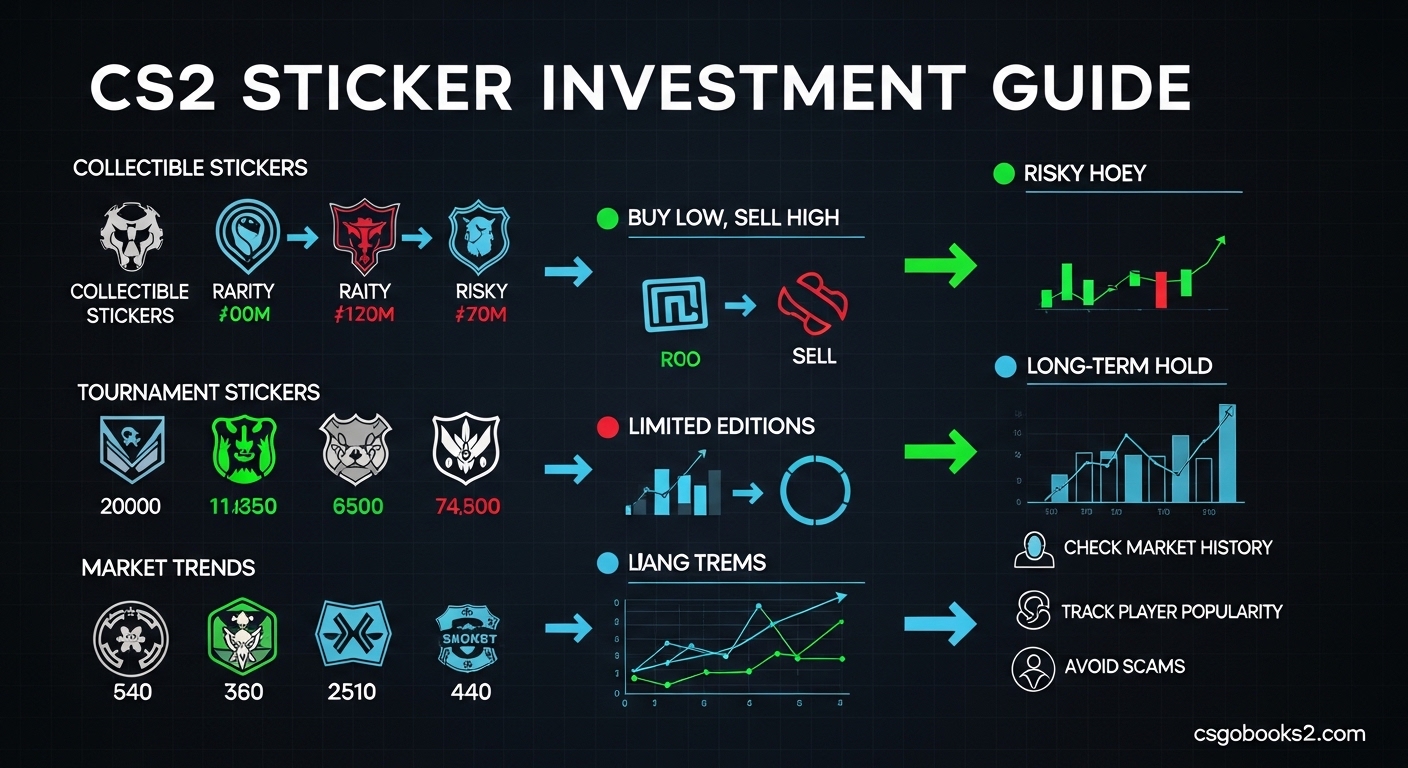
If you’ve been watching the CS2 economy, you’ve probably noticed stickers aren’t just decorative items anymore. They’ve become a legitimate investment class with some stickers delivering 500%+ returns over a few years. But like any market, the sticker economy has its rules, risks, and strategies that separate profitable investors from those holding bags.
This CS2 sticker investment guide breaks down everything you need to know about investing in CS2 stickers. I’ve spent years analyzing sticker markets, tracking price movements, and learning from both successes and costly mistakes. Whether you’re looking to build a long-term portfolio or flip stickers for short-term profits, understanding the fundamentals is crucial.
What makes stickers different from other CS2 items? They’re consumable. Once a sticker is applied to a weapon, it’s gone forever. This permanent removal from circulation creates natural scarcity that drives value over time. But not all stickers are created equal, and knowing the difference between a holographic souvenir and a paper capsule sticker can mean the difference between profit and loss.
In this guide, I’ll cover why stickers are worth investing in, how prices actually work, where to buy and sell safely, and the common mistakes that burn new investors. You’ll learn about different sticker types, tournament cycles, fee structures, and how to build a diversified portfolio that can weather market volatility.
Why CS2 Stickers Are Worth Investing In?
CS2 stickers offer a unique investment proposition in the gaming economy. Unlike skins which can be traded indefinitely, stickers are permanently consumed when applied to weapons. This mechanic creates continuous supply reduction, meaning the total supply of any given sticker only goes down over time.
Historical performance backs this up. Katowice 2014 holographic stickers, originally sold for a few dollars, now command hundreds of dollars each. Berlin 2019 and Stockholm 2021 capsules have shown similar exponential growth patterns 3-5 years after release. The best returns typically come from holding tournament stickers through multiple market cycles.
Market liquidity is another advantage. High-demand stickers sell quickly on Steam Market and third-party platforms, meaning you can exit positions when needed. The global player base ensures 24/7 market activity, unlike traditional markets with fixed trading hours.
The entry barrier is relatively low compared to skin investment. While a knife skin might cost $100+, many investment-worthy stickers start under $10. This allows new investors to build diversified portfolios without massive capital. Sticker capsules, in particular, offer exposure to multiple designs at once.
However, sticker investment isn’t passive income. Prices can be volatile, especially for newer releases. Understanding market psychology, team performance impact, and seasonal patterns is essential for consistent returns. The most successful investors I know treat this as a serious business, not a casino.
Understanding CS2 Sticker Types
Not all stickers carry the same investment potential. The rarity system fundamentally affects value, and understanding the hierarchy is crucial before making any purchase decisions.
Holographic (Holo) stickers represent the premium tier. These feature rainbow-colored holographic effects that shift when viewed from different angles. Holo stickers typically command 3-5x the price of their paper counterparts. Tournament holographics are particularly valuable because they combine the premium finish with limited supply from major events.
Foil stickers offer a shiny, metallic appearance distinct from holographics. They’re generally less expensive than holos but more valuable than paper stickers. Some collectors actually prefer foils for their cleaner aesthetic, making them a solid mid-tier investment option.
Paper (Regular) stickers are the base tier with no special effects. While individually less valuable, paper stickers from popular tournaments can still appreciate significantly. The advantage is lower entry price, allowing you to accumulate more capsules for the same capital.
Glitter and Lenticular stickers are special editions released periodically. Glitter stickers feature embedded sparkles, while lenticular stickers change images when tilted. These often have limited release windows, creating scarcity that drives long-term value.
Gold stickers are the rarest tier, awarded to Major tournament champions. These are extreme investments, often costing thousands of dollars. Only serious collectors with substantial capital typically target gold stickers.
| Sticker Type | Rarity Level | Price Multiple vs Paper | Investment Potential |
|---|---|---|---|
| Holographic | Premium | 3-5x | High (especially tournament holos) |
| Foil | Mid-Tier | 2-3x | Medium-High |
| Paper | Base | 1x (baseline) | Medium (volume plays) |
| Glitter/Lenticular | Special | Varies | High (limited releases) |
| Gold | Ultra-Rare | 50-100x+ | Niche (high capital required) |
How CS2 Sticker Prices Are Determined?
Sticker pricing follows basic economic principles but with gaming-market twists. Understanding these mechanics helps you identify undervalued assets and avoid overhyped traps.
Supply mechanics are the first piece of the puzzle. Tournament stickers have fixed caps – once a Major ends, no more capsules enter circulation. Operation stickers follow similar patterns, though some remain available longer. The key is identifying which supply streams are truly closed versus those that might return.
Demand drivers are more complex and require ongoing attention. Player popularity matters – stickers from legendary players like s1mple or ZywOo carry premiums regardless of team. Team performance impacts value, with winning teams seeing increased demand. Craft usage is crucial; stickers used in popular crafts (like AK-47 Redline builds) see sustained demand.
Market psychology creates price swings that smart investors can exploit. Hype cycles around tournaments can inflate prices 20-30% temporarily. Fear of missing out (FOMO) drives new investors in at peaks, while panic selling creates buying opportunities during dips. The most successful investors I know buy when others are fearful and sell when hype is at maximum.
Chinese market influence is a unique factor in CS2 stickers. The Chinese player base has distinct preferences and can drive prices for certain stickers significantly higher. This creates arbitrage opportunities for investors who understand cross-regional demand differences.
Price tracking is essential. Use sites like CSFloat or Buff163 to monitor historical trends. I maintain a spreadsheet of 50+ key stickers, updating prices weekly. This data reveals patterns you’ll miss by checking prices sporadically.
CS2 Sticker Investment Guide: Tournament Sticker Lifecycle
Tournament stickers follow predictable cycles that savvy investors can leverage. Understanding where a sticker sits in its lifecycle helps time entries and exits for maximum profit.
Pre-tournament phase begins when capsules go on sale, typically 2-4 weeks before the Major. Prices start at Valve’s fixed rate ($2-7 depending on capsule type). Smart investors buy early, anticipating post-tournament price increases. Limited edition capsules often sell out quickly, creating immediate scarcity.
During tournament, prices fluctuate based on team performance. Teams making deep runs see their stickers spike 50-100% as fans buy in. Underdog stories create explosive price action – Copenhagen 2024 saw Mouz stickers jump 300% after their surprise finals run. This volatility creates both opportunities and risks.
Post-tournament phase typically sees prices stabilize 2-4 weeks after the event. The hype cycle cools, and supply/demand find equilibrium. This is often the best accumulation period for long-term holders. Many investors overextend during the tournament and sell during this stabilization, creating bargains.
Long-term holding (3-5+ years) is where the biggest gains happen. Katowice 2014 stickers appreciated 10,000% over a decade. Stockholm 2021 capsules are up 400-600% since release. The key is identifying tournaments that will be historically significant – the ones people will still care about years later.
Tournament age matters. Stickers from the first 10 Majors (2013-2016) carry historical premium. The “OG” tournaments like Katowice 2014 and Cologne 2014 are blue-chip assets. Newer tournaments have yet to prove their long-term value, making them higher-risk, higher-reward plays.
Where to Buy CS2 Stickers Safely?
Choosing the right platform is crucial for safe sticker investment. Each option has distinct advantages and drawbacks that affect your profitability.
Steam Market is the official marketplace with maximum security. You’re dealing directly with Valve’s system, which virtually eliminates scam risk. However, the 15% fee eats significantly into profits, especially on smaller trades. Steam Wallet funds are also locked to the ecosystem – you can’t cash out to real money without using third-party services.
CS.MONEY offers trading with lower fees than Steam, typically 2-5%. The platform has strong reputation with millions of trades completed. However, you’re trading skins for stickers, not buying with cash. This works well if you have a skin inventory to leverage, but adds complexity for pure cash investors.
DMarket provides cash trading with reasonable fees around 6-8%. The platform offers good liquidity on popular stickers and has solid Trustpilot ratings. However, KYC verification is required, which some users prefer to avoid. Payment processing can also add 2-3 days to transactions.
CSFloat is a newer platform gaining traction for competitive fees and user-friendly interface. The community aspect helps verify reputable traders. However, as a newer platform, liquidity can be lower on less popular items. Always check Trustpilot and Reddit feedback before using any third-party platform.
Red flags to watch for include unsolicited API key requests, deals too good to be true, and platforms without verifiable reputations. Never share your Steam API key with anyone. Legitimate platforms don’t need it. If a site asks for your login credentials, it’s a scam – period.
Platform reputation matters. Check Trustpilot, Reddit discussions, and Steam community feedback before trusting any site with your assets. The extra time spent verifying saves you from costly mistakes.
| Platform | Fees | Payment Type | Liquidity | Best For |
|---|---|---|---|---|
| Steam Market | 15% | Steam Wallet | Excellent | Maximum security |
| CS.MONEY | 2-5% | Skin trading | Excellent | Skin-to-sticker trades |
| DMarket | 6-8% | Cash | Good | Cash buyers/sellers |
| CSFloat | 5-7% | Cash | Good (growing) | Lower fees, community |
Understanding Fees and Spread Mechanics
Fees and spreads silently destroy returns if you don’t account for them properly. Every transaction costs money, and understanding these costs is essential for accurate profit calculations.
Steam Market fee is straightforward but expensive. Valve charges 15% on every transaction (5% base fee + 10% game-specific fee). This means selling a $10 sticker only nets you $8.50. To break even on a flip, you need the price to increase by more than 30% – 15% when buying and 15% when selling.
Buy-sell spread refers to the difference between what sellers ask and buyers bid. On Steam, you can instantly buy at the lowest listing price but must wait to sell at your chosen price. Third-party platforms often have tighter spreads but higher fees. This spread represents real cost – if you need to exit quickly, you’ll sell at the bid price.
Fee calculator example: You buy a sticker for $10. With Steam’s 15% fee, you pay $11.50 total. To make a 20% profit ($2), you need to sell for $15. But after the 15% selling fee, you receive $12.75. Your actual profit is only $1.25, not $2. That’s a 10.9% return, not 20%. This math trips up many new investors.
Trade locks are another hidden cost. Items purchased on Steam have a 7-day trade hold before they can be resold. Third-party platforms may have longer locks. During this time, prices can move against you. I’ve seen prices drop 15% during a week-long lock, turning a planned profit into a loss.
Third-party fees add up too. Payment processors typically charge 2-3% on deposits and withdrawals. Currency conversion fees can add another 1-2% if you’re trading across regions. These seemingly small percentages compound over many trades.
The best investors I know track every cost in a spreadsheet. They know their exact break-even price on every position before entering. This discipline separates profitable traders from gamblers hoping prices go up.
Where to Sell CS2 Stickers for Maximum Profit?
Knowing when and where to sell is just as important as knowing what to buy. Many investors hold too long or sell on the wrong platform, leaving significant profits on the table.
Timing your exit requires reading market cycles. Tournament stickers typically peak 6-12 months post-event as hype fades and supply stabilizes. Operation stickers often spike when the operation ends and capsules disappear. I set target prices when buying – if a sticker hits my target, I sell regardless of FOMO. Greed kills more profits than bad entries.
Platform selection affects your final take. Steam Market offers fastest liquidity but highest fees. Third-party platforms have lower fees but slower sales. For high-value stickers, the fee savings from third-party sites can be substantial. For quick flips, Steam’s speed might justify the higher cost.
Trade lock considerations impact timing decisions. If a sticker is in a 7-day hold, you can’t react to sudden price moves. This is particularly risky during volatile periods. Experienced traders plan around locks, often selling before major events even if it means leaving some profit on the table.
Partial exits are a smart strategy. If you hold 50 capsules, consider selling 25 when you hit your first target. This locks in profit while keeping exposure to further upside. You can always sell the remainder at higher targets. I’ve seen too many investors hold everything, watch prices peak, then crash back down.
Market depth matters for larger positions. If you’re holding 100+ capsules, selling all at once on a thin market can crash the price against you. Spread exits over days or weeks to avoid moving the market. Patient sellers get better prices than desperate dumpers.
Investment Horizon Strategies
Different investment goals require different time horizons. Matching your strategy to your timeline is essential for managing expectations and risk.
Short-term trading (3-6 months) focuses on event-driven price movements. Tournament cycles, operation releases, and team performance create predictable catalysts. This approach requires active monitoring and quick decision-making. Profits per trade are smaller but compound faster. The best short-term traders treat it as a full-time job.
Mid-term holding (1-2 years) balances active management with patience. This horizon works well for tournament stickers during their post-event appreciation phase. You capture the bulk of the growth cycle while avoiding long-term holding risks. Many successful investors run portfolios with staggered mid-term positions.
Long-term holding (3-5+ years) targets historical appreciation. Katowice 2014 and Cologne 2014 stickers are proof of patience paying off. This strategy requires conviction through market volatility and dry spells. The best long-term picks are tournaments with historical significance – the ones that become part of CS lore.
| Horizon | Timeframe | Target ROI | Risk Level | Best For |
|---|---|---|---|---|
| Short-term | 3-6 months | 20-50% | High | Active traders, event plays |
| Mid-term | 1-2 years | 50-200% | Medium | Tournament cycles |
| Long-term | 3-5+ years | 200%+ | High (time risk) | Historic tournaments |
Hybrid approaches work well too. You might hold a core long-term portfolio while actively trading around it. Or ladder out of positions over time, selling portions at different targets. The key is having a clear strategy before entering any position.
Portfolio Diversification for Sticker Investors
Putting all your capital into one sticker or tournament is gambling, not investing. Smart diversification protects you from single-point failures while maintaining upside potential.
Sticker type allocation spreads risk across different rarity tiers. I typically allocate 40% to holographics (premium growth), 30% to foils (balanced risk/reward), and 30% to paper stickers (volume plays). This mix captures different market segments and reduces dependence on any single tier performing.
Tournament diversification is equally important. Don’t load up entirely on the latest Major. Spread across multiple tournaments, including some proven historical performers. I maintain positions in at least 5 different tournaments at any time, with newer tournaments representing smaller portions of the portfolio.
Operation vs tournament balance adds another diversification layer. Operation stickers offer different supply dynamics and can outperform during certain market conditions. A 70/30 split between tournament and operation stickers provides exposure to both segments.
Position sizing prevents any single loss from devastating your portfolio. I never allocate more than 10% of my capital to any single sticker capsule. This means even if a position goes to zero (unlikely but possible with pump-and-dumps), the overall portfolio survives. New investors should start even smaller, 5% max per position.
Rebalancing maintains your target allocations as prices change. If holographic stickers run up and become 60% of your portfolio, sell some to get back to 40%. This forces you to sell high and buy low automatically. I rebalance quarterly or when any category moves more than 10% from its target.
Diversification doesn’t guarantee profits, but it does manage risk. The most successful investors I know aren’t trying to hit home runs on every pick – they’re building consistent returns through balanced exposure.
Common Beginner Mistakes to Avoid
Every sticker investor makes mistakes starting out. The key is learning from others’ errors instead of paying for your own education. These are the most common ways new investors lose money.
Buying into hype is the number one mistake. When Reddit is buzzing about a sticker and YouTubers are calling it the next 100x, you’re probably too late. Smart money buys before the hype, not during. I’ve seen Evil Geniuses stickers pump 200% on hype, then crash 70% when the music stopped. The investors who bought at the top are still waiting to break even.
Ignoring fees and spread turns profitable trades into losers. Many new investors calculate returns on sticker prices only, forgetting the 15% Steam fees on both buy and sell. A 25% price increase becomes a 5% loss after fees. Always calculate your break-even price before entering any position.
Falling for pump and dump schemes destroys wealth. Organized groups buy a sticker, hype it across social media, then sell into the rush. The clueless investors buying last are left holding the bag. Red flags include sudden unexplained spikes, coordinated social media campaigns, and anonymous “insider” tips. If it sounds too good to be true, it is.
Overlooking trade locks catches investors constantly. You buy a sticker thinking you’ll flip it in a week, then discover a 7-day trade hold. During that week, prices drop 15%. By the time you can sell, you’re taking a loss. Always check trade lock status before buying, especially for short-term trades.
Not verifying platform reputation leads to scams. New third-party sites pop up constantly, and many are outright scams. They’ll take your money or API key and disappear. Only use established platforms with verifiable reputations, positive Trustpilot reviews, and active community discussions. If a site is brand new with no history, you’re the experiment.
Emotional trading decisions cost investors fortunes. Fear selling at bottoms, greed buying at tops, revenge trading after losses – these emotional responses destroy rational decision-making. The best traders I know follow strict rules and stick to them regardless of how they feel. Have an exit plan before you enter, and execute it without emotion.
Overconcentration in a single position creates unnecessary risk. I’ve seen investors put 50%+ of their capital into one “sure thing.” When that bet goes wrong, they’re devastated. No sticker is a guaranteed winner. Diversification isn’t just for hedge funds – it’s essential for anyone serious about long-term success.
Sticker Investment Evaluation Checklist
Smart investors follow a consistent evaluation process before buying any sticker. This checklist helps avoid emotional decisions and identify the best opportunities.
Step 1: Verify supply dynamics – Is this from a closed tournament or operation? When did capsules stop being sold? Are there any future release possibilities? Closed supply with historical significance is ideal. Avoid stickers that might return in future operations.
Step 2: Assess demand drivers – Which team/player is this? How popular are they currently? Is the design visually appealing? Are there craft applications? The best investments have multiple demand drivers – popular teams, legendary players, and clean designs.
Step 3: Check price history – Use CSFloat or similar tools to view 6-12 month price trends. Is this at an all-time high or recent low? What’s the trading volume? Avoid stickers with thin liquidity unless you’re planning very long holds. Look for established trends, not speculative spikes.
Step 4: Calculate total costs – Add up all fees: platform fees, payment processing, trade lock opportunity costs. What’s your realistic break-even price? If the sticker needs to appreciate 40% just to cover fees, it’s probably not a good investment.
Step 5: Identify red flags – Is there unusual recent price action? Are random accounts hyping this on social media? Does the selling platform have poor reviews? If anything feels off, walk away. There’s always another opportunity.
Step 6: Set exit strategy – What’s your target price and timeframe? What conditions would make you sell early? What’s your stop-loss if things go wrong? Having this plan before buying prevents emotional decisions later.
Step 7: Position sizing – Does this fit your portfolio allocation? Are you risking too much on a single pick? Scale position size based on conviction level. High-conviction picks might get 10% of capital, speculative ideas only 2-3%.
Following this checklist for every purchase might feel tedious, but it saves you from costly mistakes. The best investors I know are systematic and disciplined – they don’t chase, they don’t panic, and they never buy without doing the homework.
CS2 Sticker Investment Guide: Frequently Asked Questions
Are CS stickers a good investment?
CS stickers can be a good investment for those who understand the market. Historical data shows tournament stickers appreciating 300-1000% over 3-5 years, particularly from major events like Katowice 2014 and Stockholm 2021. However, not all stickers perform well – success requires understanding supply dynamics, demand drivers, and market cycles. New investors should start small, diversify across different tournaments and sticker types, and focus on proven historical performers rather than chasing hype.
Are CS2 sticker capsules worth it?
Sticker capsules are worth investing in for several reasons. They offer exposure to multiple sticker designs at once, providing natural diversification. Capsules from closed tournaments have fixed supply that only decreases over time as collectors open them. The best-performing capsules historically come from the first 10 majors and significant tournaments like Stockholm 2021 and Berlin 2019. However, newer capsules carry more uncertainty about long-term value. Smart investors allocate across capsule vintages rather than concentrating on just the latest releases.
How much do players get from stickers in CS2?
Professional players receive 50% of the revenue from stickers featuring their name or autograph. This means when you buy a player sticker capsule, half goes directly to the players. Teams also receive revenue from team stickers, which is a major income source for professional organizations. During major tournaments, popular players can earn six figures from sticker sales alone. This revenue sharing model is unique to CS and is part of what makes the sticker ecosystem sustainable – players and teams have real incentive to promote their stickers.
Why do people scrape stickers in CS2?
Sticker scraping refers to removing stickers from weapons to reveal special patterns or effects underneath. Some players scrape to apply different stickers, while others do it to create unique weapon aesthetics. From an investment perspective, scraping destroys the sticker permanently, which is why applied stickers never return to circulation – this permanent removal is what creates natural scarcity that drives long-term value appreciation. Each scraped sticker is one less in existence, theoretically increasing the value of remaining specimens.
What is the difference between holo and foil stickers?
Holographic stickers feature rainbow-colored holographic effects that shift when viewed from different angles, creating a prismatic appearance. Foil stickers have a shiny, metallic finish similar to foil wrapping paper, but without the rainbow color shift. In terms of value, holographic stickers typically command 3-5x the price of paper stickers, while foils generally sell for 2-3x. Both are premium tiers, but holos are usually more expensive. Some collectors prefer foils for their cleaner aesthetic, making them a solid mid-tier investment option.
How long should I hold tournament stickers?
Optimal holding period depends on your investment goals. Short-term traders typically hold 3-6 months around tournament cycles. Mid-term investors hold 1-2 years to capture post-tournament appreciation. Long-term holders (3-5+ years) target historical appreciation similar to Katowice 2014 stickers. The best approach is often staging exits – sell portions at different targets rather than all at once. I recommend selling 25-30% when you hit your first target, then holding the remainder for longer-term appreciation.
Is sticker investment better than skin investment?
Stickers and skins serve different investment strategies. Stickers are consumable – once applied, they’re gone forever, creating permanent supply reduction. Skins can be traded indefinitely. Stickers generally have lower entry prices, allowing better diversification with smaller capital. Skins often offer higher liquidity and more predictable pricing for rare items. Stickers from major tournaments have shown higher percentage returns than most skins. Many investors hold both – using skins for stability and stickers for higher-growth opportunities. The choice depends on your capital, risk tolerance, and investment timeline.
What are the tax implications of trading stickers?
Tax treatment of CS2 sticker trading varies by jurisdiction. In the US, profits from trading virtual items are generally considered taxable capital gains. Short-term holds (under one year) are taxed at ordinary income rates, while long-term holds benefit from lower capital gains rates. You should track all purchases, sales, and associated fees to calculate cost basis accurately. Some countries treat virtual item trading as gambling income with different tax rules. Consult a tax professional familiar with virtual asset trading in your jurisdiction. Many serious investors keep detailed spreadsheets of every transaction for tax reporting purposes.
Final Thoughts on CS2 Sticker Investment
This CS2 sticker investment guide has covered the fundamentals, but successful investing requires continuous learning and adaptation. The market evolves with each tournament, operation, and game update. The strategies that worked in 2024 might need adjustment in 2026.
Start small, diversify broadly, and never invest more than you can afford to lose. The sticker market offers legitimate profit opportunities, but it’s not a guaranteed path to wealth. Treat it like any serious investment – do your research, manage your risks, and stay disciplined through market cycles.
Track your results rigorously. Maintain a spreadsheet of every purchase, sale, and fee. This data reveals what’s actually working versus what you think is working. The best investors I know are constantly analyzing their performance and adapting based on evidence, not emotion.
The community is your greatest resource. Engage with fellow investors on Reddit and Steam forums. Share insights, ask questions, and learn from others’ experiences. The sticker investment community is generally welcoming to newcomers who ask thoughtful questions and show willingness to learn.
Sticker investment can be rewarding both financially and intellectually. There’s satisfaction in building a portfolio, understanding market dynamics, and watching strategic decisions pay off. Just remember that patience and discipline matter more than finding the next 100x winner. Consistent, sustainable returns beat occasional home runs every time.