
Counter-Strike 2 has been out for over a year, and players are still figuring out what their PCs actually need to run it well. If you’re wondering whether your current setup can handle CS2 or if it’s time for an upgrade, you’re in the right place.
Understanding CS2 system requirements matters because this isn’t just about launching the game. It’s about maintaining stable FPS during clutch moments when smokes are popping and multiple players are peeking. The Source 2 engine brought significant improvements over CS:GO, but those improvements come with higher hardware demands.
I’ve analyzed the official Valve specifications, real-world user benchmarks from Reddit communities, and competitive player setups to give you a complete picture of what you actually need for CS2 in 2026.
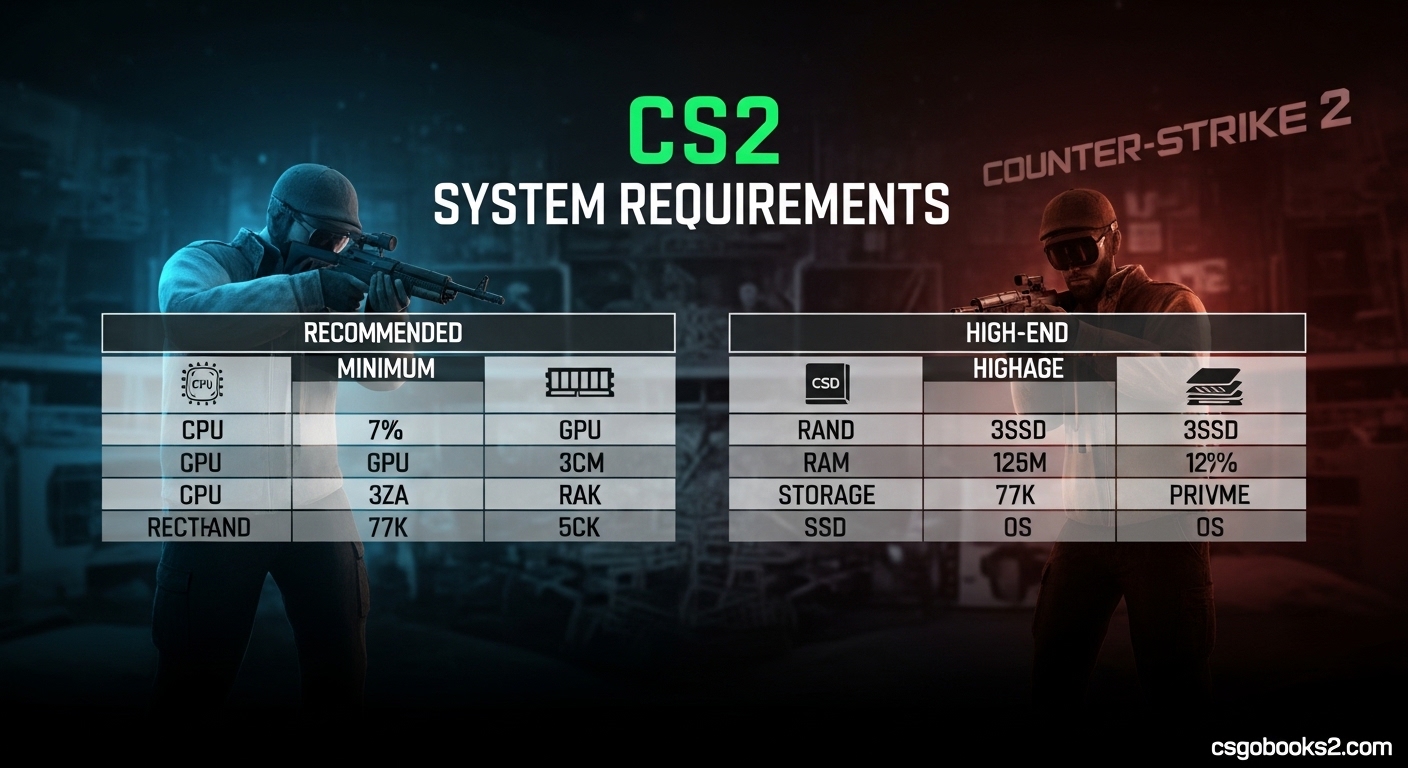
CS2 System Requirements (2026) Complete Breakdown
Valve provides baseline specifications, but they only tell part of the story. The official minimum specs will get you into the game, but competitive play requires significantly more. Let’s break down what you actually need based on how you play.
Official CS2 Minimum Requirements
These are the absolute minimum specs to launch CS2. You’ll get around 60 FPS on low settings at 1080p, but expect frame drops during intense moments.
OS: Windows 10 64-bit or SteamOS 3.0+
CPU: Intel Core i5-750 or AMD Phenom II X4 965 (4 hardware threads)
RAM: 8 GB
GPU: NVIDIA GeForce GTX 660 or AMD Radeon HD 7950 (DirectX 11, Shader Model 5.0)
Storage: 85 GB available space on SSD
Official CS2 Recommended Requirements
For smooth competitive gameplay at 1080p with medium settings, aim for these specs. You’ll see 120-144 FPS consistently.
OS: Windows 10/11 64-bit
CPU: Intel Core i7-9700K or AMD Ryzen 7 2700X (8 hardware threads)
RAM: 16 GB DDR4
GPU: NVIDIA GeForce GTX 1080 or AMD Radeon RX 5700 XT
Storage: 85 GB SSD (NVMe recommended)
CS2 System Requirements Comparison
| Component | Minimum (60 FPS) | Recommended (144 FPS) | Competitive (240+ FPS) |
|---|---|---|---|
| CPU | Intel Core i5-750 / AMD Phenom II X4 | Intel Core i7-9700K / AMD Ryzen 7 2700X | Intel Core i5-13600K / AMD Ryzen 5 7600X |
| GPU | NVIDIA GTX 660 / AMD HD 7950 | NVIDIA GTX 1080 / AMD RX 5700 XT | NVIDIA RTX 4060 / AMD RX 7600 |
| RAM | 8 GB DDR3 | 16 GB DDR4 | 32 GB DDR4/DDR5 |
| Storage | 85 GB SSD (SATA) | 85 GB SSD (NVMe recommended) | 85 GB NVMe SSD |
| Settings | 1080p Low | 1080p Medium | 1080p/1440p Competitive |
Minimum vs Recommended vs Competitive Specs
The minimum specs will let you play CS2, but you’ll experience stutters during chaotic rounds. When smoke grenades fill a bombsite and multiple players are engaging, the Source 2 engine’s volumetric fog and particle effects push older hardware to its limits.
Recommended specs deliver a much better experience. You’ll get consistent 144 FPS, which is the sweet spot for most competitive players. At this tier, frame drops during intense moments are minimal, and you can take advantage of 144Hz monitors.
For serious competitive play, you’ll want the esports-tier specs. These systems push 240+ FPS, which is what most professional players use. The extra headroom ensures your FPS never drops below your monitor’s refresh rate during critical moments.
CPU Requirements for CS2
CS2 is more CPU-dependent than GPU-dependent. The Source 2 engine’s subtick matchmaking system and improved physics calculations put significant load on your processor. This is why upgrading your CPU often gives bigger FPS gains than upgrading your GPU in CS2.
Intel CPU Recommendations
For budget builds, an Intel Core i3-12100F delivers surprisingly good performance. Mid-range players should look at the i5-13400F or i5-13600K. High-end builds benefit from the i7-13700K or i9-13900K.
The key metric is single-core performance and thread count. CS2 benefits from 6+ physical cores, but going beyond 8 cores shows diminishing returns. Modern Intel chips with E-cores work well for CS2 since the game primarily uses the P-cores.
AMD CPU Recommendations
AMD’s Ryzen 5 5600 is an excellent budget choice. The Ryzen 5 7600X competes favorably with Intel’s i5-13600K for CS2. For high-end builds, the Ryzen 7 7800X3D is currently the king of gaming CPUs and excels in CS2.
AMD’s 3D V-Cache technology provides significant benefits for CS2, delivering better 1% low FPS compared to similarly priced Intel chips. This means fewer frame drops during chaotic moments.
GPU Requirements for CS2
While CS2 is CPU-heavy, your GPU still matters. The Source 2 engine improved lighting, shadows, and reflections compared to CS:GO. Higher-quality settings put more load on your graphics card.
NVIDIA GPU Recommendations
For 1080p competitive play, an RTX 3060 or RTX 4060 is sufficient. The RTX 4060 Ti offers better headroom for 1440p. High-end players might consider the RTX 4070 or RTX 4080, though these are overkill for CS2 specifically.
NVIDIA’s Reflex technology helps reduce system latency, which can give you a slight competitive edge. All RTX cards support this feature, and it’s worth enabling in CS2’s settings.
AMD GPU Recommendations
The RX 7600 matches the RTX 4060 for CS2 performance at a lower price point. The RX 7700 XT or RX 7800 XT provide excellent 1440p performance. AMD’s Anti-Lag technology competes with NVIDIA Reflex and works well in CS2.
One important note: AMD cards sometimes have more driver issues with new games at launch. If you choose AMD, keep your drivers updated for the best CS2 experience.
RAM and Storage Requirements
8 GB of RAM is the minimum, but I strongly recommend 16 GB. CS2 alone uses around 6-8 GB, and you want headroom for background applications like Discord, browsers, and streaming software. DDR4 is sufficient, but DDR5 offers future-proofing if you’re building new.
Storage speed matters more than you might think. An SSD is mandatory for CS2 – the game simply won’t run well on a hard drive. NVMe SSDs reduce loading times and can help with texture streaming, especially on larger maps like Anubis or Ancient.
The 85 GB storage requirement includes the base game plus all maps and assets. This will grow as Valve adds new content, so leave some extra space on your drive.
Is CS2 GPU or CPU Heavy?
CS2 is primarily CPU-heavy. The Source 2 engine’s improved physics, smoke simulations, and subtick system put more load on your processor than your graphics card. This is different from many modern games that are GPU-bound.
If you’re experiencing FPS drops, your CPU is likely the bottleneck. You can check this by monitoring your GPU usage while playing. If your GPU is at 60-70% but you’re still getting low FPS, your CPU is holding you back.
That said, don’t ignore your GPU entirely. Higher resolutions (1440p, 4K) and higher graphics settings do increase GPU load. For competitive 1080p play, focus on CPU first. For higher resolutions, balance your budget between CPU and GPU.
CS2 System Requirements for High Refresh Rate Gaming
High refresh rate monitors are essential for competitive CS2, but they demand more from your PC. Here’s what you need for different refresh rates:
For 144Hz Monitors
Aim for consistent 180-200 FPS to have headroom above your refresh rate. An RTX 3060 or RX 7600 paired with a modern 6-core CPU will get you there at 1080p low-medium settings.
For 240Hz Monitors
You need 280-300+ FPS to take full advantage. An RTX 4060 Ti or RX 7700 XT with a Ryzen 5 7600X or i5-13600K is the sweet spot. This is the setup most high-MG players use.
For 360Hz Monitors
Only the most serious competitive players need this. You’ll want an RTX 4070 or RX 7800 XT with a Ryzen 7 7800X3D or i7-13700K. At this level, diminishing returns are real – you’re paying a lot for minimal competitive advantage.
How to Check if Your PC Meets CS2 Requirements?
Checking your specs is easy. On Windows, press Windows Key + R, type “dxdiag”, and hit Enter. This window shows your CPU, RAM, and GPU information. Compare these to the requirements above.
For a more detailed look, you can use Task Manager. Press Ctrl + Shift + Esc, click on the Performance tab, and you’ll see real-time information about all your components. This is also useful for identifying bottlenecks while playing.
There are also online tools like Can You Run It that automatically detect your hardware, though I prefer checking manually for accuracy.
CS2 Optimization Tips for Better Performance
Even if you meet the requirements, you might want more FPS. Here are proven optimizations that work in 2026:
In-Game Settings
Set your resolution to 4:3 stretched (1024×768) for maximum FPS. Disable anti-aliasing, set shadows to low, and turn off ambient occlusion. Lower shader detail and effects quality. These settings have minimal impact on gameplay visibility but significantly boost performance.
Windows Optimizations
Enable Game Mode in Windows settings. Set your power plan to “High Performance” in Control Panel. Disable background apps that you don’t need while playing. Update your GPU drivers regularly – NVIDIA and AMD both release CS2-specific optimizations.
Launch Options
Add these launch options in Steam: “-novid -nojoy -freq 144” (replace 144 with your monitor’s refresh rate). These disable the intro video, remove joystick support (saves resources), and set your refresh rate properly.
Network Optimization
While not directly related to hardware, your network affects perceived performance. Use a wired Ethernet connection instead of Wi-Fi. Close bandwidth-heavy applications while playing. Choose the best server region for your location in CS2’s matchmaking settings.
Frequently Asked Questions
Is CS2 worth playing in 2026?
Yes, CS2 remains one of the most active competitive shooters in 2026. The player base is strong, Valve continues to update the game, and the esports scene is thriving. The Source 2 engine improvements make it feel modern while maintaining the classic Counter-Strike gameplay that millions love.
Does CS2 require a good PC?
CS2 requires a decent PC compared to CS:GO, but it’s not unreasonable. You need at least a modern quad-core CPU, 8GB RAM, and a DirectX 11 compatible GPU. For competitive play, aim for a 6-core CPU, 16GB RAM, and a mid-range graphics card from the last 3-4 years. Most gaming PCs built after 2018 can run CS2.
How to optimize CS2 2026?
Optimize CS2 by lowering in-game settings (shadows, anti-aliasing, effects), using 4:3 stretched resolution, enabling Windows Game Mode, setting high performance power plan, updating GPU drivers, and using launch options like -novid -nojoy. For network stability, use Ethernet instead of Wi-Fi and close background applications. These optimizations can boost FPS by 30-50% depending on your system.
Is CS2 GPU or CPU heavy?
CS2 is primarily CPU heavy due to the Source 2 engine’s physics calculations, smoke simulations, and subtick matchmaking system. Your CPU matters more than your GPU for CS2 performance. Focus on getting a modern 6-core processor with good single-core performance first, then pair it with a mid-range GPU. This is why upgrading from an older CPU often gives bigger FPS gains than upgrading your GPU in CS2.
Conclusion
Understanding CS2 system requirements in 2026 comes down to knowing how you play. Casual players can get by with the minimum specs, but competitive CS2 demands better hardware. Focus on your CPU first, add 16GB of RAM, and pair it with a mid-range GPU for the best experience.
If you’re upgrading, prioritize a modern 6-core CPU from Intel’s 13th gen or AMD’s Ryzen 7000 series. Add a budget RTX 40-series or RX 7000-series GPU, and you’ll be hitting 200+ FPS in no time. CS2 is worth the upgrade – the Source 2 engine improvements make it the best version of Counter-Strike yet.