
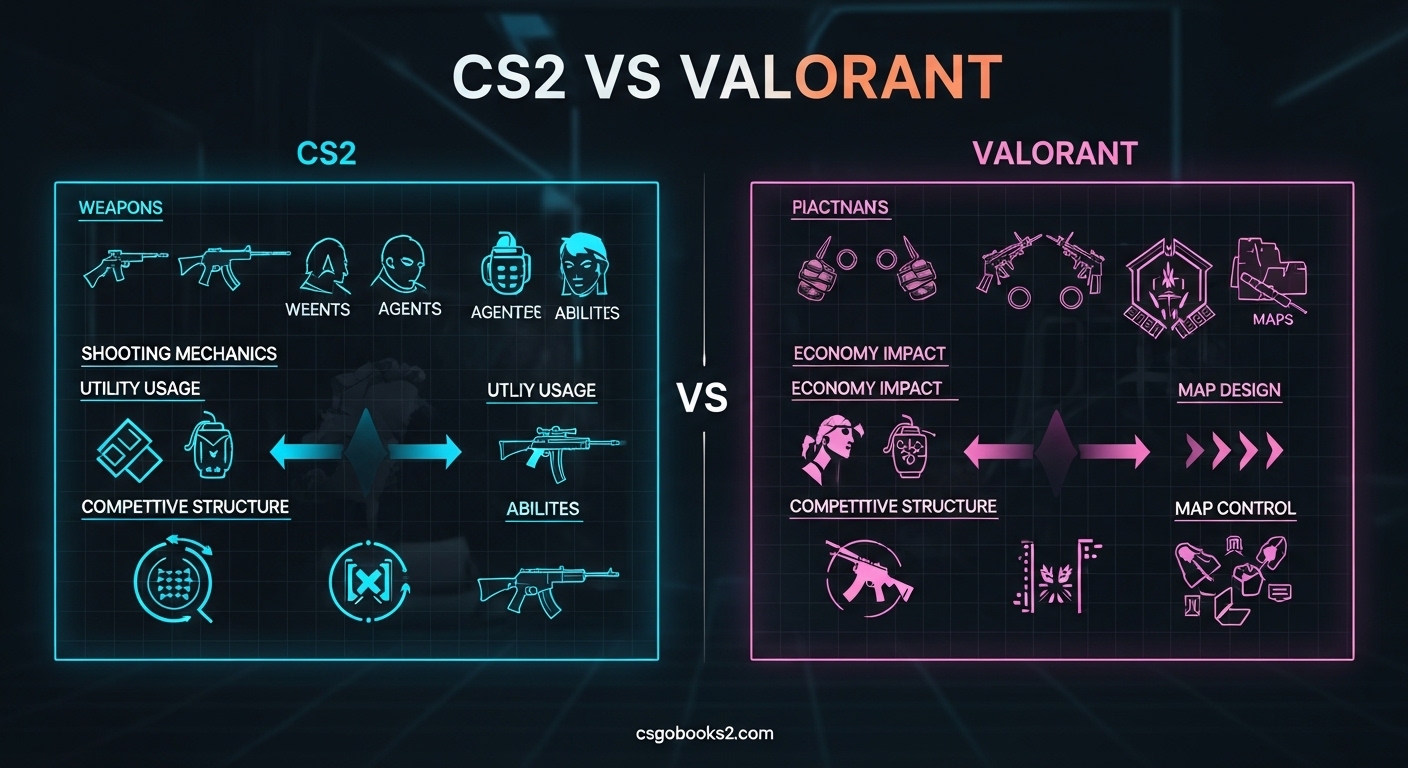
Two games dominate the competitive tactical shooter scene in 2026: Counter-Strike 2 (CS2) and Valorant. Both feature 5v5 round-based action, but they take radically different approaches to gameplay.
Our team spent months playing both games at various ranks to bring you this comprehensive CS2 vs Valorant comparison. Whether you’re a newcomer choosing your first tactical shooter or a veteran deciding which game deserves your time, this guide has you covered.
CS2 vs Valorant Overview (April 2026)
CS2 is Valve’s direct successor to CS:GO, rebuilt on the Source 2 engine. The game launched in September 2023 and brought improved graphics, subtler movement mechanics, and upgraded server infrastructure with 128-tick rates. CS2 maintains the pure tactical shooter formula that made Counter-Strike legendary: no abilities, just utility grenades and gunplay.
Valorant arrived in June 2020 from Riot Games, the studio behind League of Legends. It blended Counter-Strike’score mechanics with hero shooter-style agent abilities. This hybrid approach attracted millions of players who wanted strategic depth without the steep learning curve of traditional shooters. Valorant runs on a free-to-play model with optional cosmetic purchases.
The core difference is simple: CS2 rewards pure mechanical skill and game knowledge, while Valorant rewards both aim and ability usage. Neither approach is better; it depends on what you enjoy as a player.
Gameplay Mechanics Compared
When comparing CS2 vs Valorant gameplay, the abilities versus utility debate sits at the center. In CS2, every player on a team has access to the same utilities: smokes, flashes, HE grenades, and molotovs. Success comes from knowing when and where to throw these effectively. Communication and executes matter more than individual ability usage.
Valorant flips this formula by giving each agent unique abilities that charge over time or regenerate between rounds. Jett’s Cloudburst offers area denial, Phoenix’s Hot Hands provides self-sustain, and Sage’s Slow Orbs can clutch rounds. Abilities range from informational ( recon darts ) to transformational (Raze’s Blast Pack for movement).
Movement feels different between the games. CS2 uses subtler, momentum-based movement where peak efficiency requires mastering counter-strafing. Valorant’s movement is more responsive with faster acceleration but includes an agent called Yoru with unique teleport mechanics. High-level CS2 players report that the movement skill ceiling remains demanding, while Valorant’s abilities can compensate for poorer movement at lower ranks.
The roles systems diverge significantly. CS2 has no formal role system: you might be “entry fragger” or “AWPer” informally, but anyone can buy any weapon. Valorant formalizes roles into Duelists, Initiators, Controllers, and Sentinels, each with different team responsibilities. This makes Valorant’s learning curve more structured, while CS2 offers more freedom but requires self-directed learning.
Weapons Comparison
CS2’s weapon pool spans approximately 25 primary weapons plus secondaries and equipment. The terrorist side accesses unique weapons like the SG 553 and AK-47, while counter-terrorists get the M4A1-S and M4A4. The AWP remains the most impactful single weapon in either game, capable of one-shot kills to the torso at any range.
Valorant’s weapon pool is smaller at around 17 primary weapons, but each serves distinct purposes. The Vandal deals 40 damage per shot with a 9-bullet magazine, while the Phantom offers faster fire rate and higher magazine capacity at 30 rounds but slightly less damage per bullet. Neither rifle one-shots at long range, making spray patterns critical.
The CS2 AK-47 versus Valorant Vandal comparison comes up constantly. Both cost 2700 credits and serve as the go-to rifle for attackers. The AK-47 deals 36 damage per shot but has a more punishing recoil pattern. The Vandal’s 40 damage makes it feel punchier, and its recoil resets faster. Professional Valorant players split between Vandal and Phantom based on playstyle, while CS2 professionals almost universally prefer the AK-47 on T-side.
Side-specific weapons create asymmetry in CS2 that Valorant lacks. The CZ-75 Auto and Desert Eagle remain controversial high-risk high-reward pistols. Valorant’s Classic pistol works differently on attack and defense but doesn’t create the same pistol round imbalances that CS2 players complain about annually.
Maps Comparison
CS2 features approximately 20 maps in the active duty pool, with 7 maps in the competitive map pool for ranked play. Each map has a distinct personality: Mirage’s mid control fights, Inferno’s Banana timing, Ancient’s A-site complexity. Map design emphasizes realistic architectural layouts where utility usage creates sightline control.
Valorant currently offers 11 maps in rotation, with 7 in the competitive pool. Maps like Haven and Lotus feature multiple attack lanes unusual in CS2. Ascent’s mechanical doors and Bind’s one-way teleporters add verticality that CS2 lacks. Map design embraces the agent system with areas specifically designed for certain ability combos.
CS2 map pool changes quarterly through operations, keeping the meta fresh but requiring constant adaptation. Valorant rotates maps seasonally, with new maps like Pearl and Harbor added to diversify the pool. Both games remove maps periodically: CS2 retired Cobblestone and Overpass from competitive play, while Valorant has retired Icebox and Ruby from active duty.
Callout systems differ due to design philosophy. CS2 maps use realistic names like “A Long” and “CT Spawn” that transfer from real-world CS communities. Valorant uses stylized names like “B Main” and “Lobby” that newer players often find more intuitive. Neither system is objectively better, but Valorant’s simpler names may reduce the learning curve for absolute beginners.
Graphics and Art Direction
CS2 represents a leap forward in visual fidelity through Source 2. Character models feature realistic materials, lighting effects respond dynamically to gunfire and explosions, and dust particles float through sunbeams on maps like Mirage. The game looks like a modern military simulation, which fits the tactical theme but requires significant GPU resources.
Valorant takes a stylized approach inspired by comic books and anime. Characters feature bold outlines and saturated colors that make identifying enemies easier at a glance. This art direction reduces visual noise during chaotic firefights and makes the game more readable. The tradeoff is less immersive realism that some CS2 players prefer.
Performance implications are substantial. CS2’s enhanced graphics demand more from your system, with recommended specs calling for GTX 1060 GPUs or better. Valorant runs on integrated graphics from Intel and AMD, making it accessible to players with modest gaming PCs. On identical hardware, Valorant typically delivers 2-3 times the frames per second compared to CS2.
Both games support 128-tick servers, though CS2’s server infrastructure improved dramatically over CS:GO. Valorant’s servers handle ability traffic alongside standard hit registration, adding complexity that occasionally causes ability-related desync issues. CS2’s simpler netcode means fewer variables affecting your shots.
Ranking Systems Compared
Valorant uses an eight-tier ranking system: Iron, Bronze, Silver, Gold, Platinum, Diamond, Ascendant, Immortal, and Radiant. Each tier contains three divisions except Radiant, which is a single rank for the top 500 players per region. Your rank updates after each match based on individual performance and team outcomes.
CS2 offers two ranking systems. The standard Competitive mode uses tiers from Silver to Global Elite, with 18 individual ranks. Premier mode, introduced in 2026, uses a 0-100,000 rating system called CS Rating. Premier matches pair teams based on rating rather than hidden MMR, giving more control over your experience.
The Valorant ranking curve feels more rewarding at lower ranks because abilities can bridge gaps between skilled and less skilled players. A Gold player can win rounds against Platinums through smart ability usage. CS2 ranks correlate more directly with aim and game sense: a Silver player rarely defeats a Global Elite regardless of strategy.
Both systems suffer from smurfing, though Valorant’s free entry point makes creating alt accounts trivial. Reddit discussions suggest CS2’s smurf problem concentrates in higher ranks where Faceit provides anti-smurf measures, while Valorant’s lower ranks remain flooded with Diamond+ players on fresh accounts.
Performance and PC Requirements
CS2’s recommended specifications include an Intel Core i5-6600K or AMD Ryzen 5 1600 processor, 8GB RAM, and a GTX 1060 or equivalent graphics card. These requirements exclude many office PCs and laptops from casual play. The game regularly maxes out mid-range GPUs even at 1080p resolution.
Valorant runs comfortably on integrated graphics, officially supporting Intel HD 620 and AMD Radeon Vega 8 IGPs. The minimum CPU requirement is an Intel Core 2 Duo E8400, which predates many currently used office computers. This accessibility explains why Valorant dominates in regions with less powerful gaming infrastructure.
Frame rate differences are dramatic on identical hardware. Testing on a GTX 1070 and Ryzen 5 3600, Valorant consistently delivers 200+ FPS while CS2 hovers around 150 FPS with frequent drops during smoke and flash-heavy rounds. Competitive Valorant players often use 144Hz monitors, while CS2’s recommended 144+ FPS demands more hardware investment.
Input latency matters more in CS2 due to the precision required for peak performance. Sub-10ms latency feels noticeably different in CS2 compared to Valorant, where ability timing windows are more forgiving. High-ping players report more frustration in CS2, where shots register based on server tick rather than client prediction as aggressively.
Anti-Cheat Systems
CS2 uses Valve Anti-Cheat (VAC), a signature-based detection system that identifies known cheat software. VAC operates at the user-level, meaning sophisticated cheats can evade detection for months before detection signatures update. The system flags accounts permanently with no appeal process, creating frustration for falsely accused players.
Valorant employs Riot Vanguard, a kernel-level anti-cheat that runs with highest system privileges from boot. This approach detects cheats before they load, making bypass significantly more difficult. Kernel-level access concerns privacy-conscious users who worry about the breadth of system access, though Riot maintains the data never leaves your machine.
Community perception splits on effectiveness. Reddit users frequently cite Vanguard’s kernel access as necessary for fair gameplay, pointing to Valorant’s generally cleaner matches. CS2 players argue VAC’s open architecture allows more complex cheats to circulate, particularly wallhacks and aim assistance that go undetected.
Neither system is perfect. Kernel-level access doesn’t prevent all cheating, as demonstrated by Valorant’s periodic ban waves of thousands of accounts. VAC doesn’t catch everyone, but permanent hardware bans make circumventing it time-consuming. The debate continues in both communities without clear resolution from published data.
Esports Scene Comparison
CS2 esports represents the pinnacle of competitive FPS with prize pools exceeding $1 million for Major events. The Majors, operated by ESL and other partners, offer $1,250,000+ prize pools with qualification through regional Challengers and Legends stages. The scene has operated continuously since 2000, creating deep-rooted team rivalries and memorable tournament moments.
Valorant’s VCT (Valorant Champions Tour) has grown explosively since 2021, now featuring regional leagues, Masters events, and an annual Champions tournament with $1,000,000+ prize pools. The VCT partnership model gives established esports organizations guaranteed spots, while CS2’s open qualification allows any team to reach the top through performance.
Viewership differs significantly. CS2 Major finals regularly exceed 1 million concurrent viewers on Twitch and YouTube, with Valve’s direct integration into the Steam client providing automatic viewership. Valorant Champions attract 500,000+ concurrent viewers, boosted by Riot’s cross-promotion within League of Legends client and social media presence.
Inclusive esports opportunities distinguish the scenes. Valorant’s Game Changers provides a dedicated women’s circuit with its own Champions event and $500,000 prize pool. CS2’s ESL Impact serves a similar purpose but with smaller prize pools and fewer participating teams. Reddit discussions suggest Valorant’s inclusive esports infrastructure attracts players who feel excluded from traditional FPS scenes.
Player Count and Popularity
CS2 maintains approximately 600,000+ daily concurrent players on Steam, with peaks exceeding 1.4 million during major tournaments or updates. These numbers represent a significant recovery from CS:GO’s declining years, though the player base remains sensitive to major game updates and VAC waves.
Valorant consistently ranks among the most-played games globally, with estimated 12-15 million monthly active players according to Riot’s 2026 reports. Daily concurrent players likely exceed 3 million across all regions, making it one of the most popular games in the world by active user count.
Growth trajectories differ notably. CS2 grew in 2026 following the release but faces questions about sustained growth as Counter-Strike’s aging demographic limits new player acquisition. Valorant continues expanding into new regions and demographics, with player counts rising year-over-year since launch.
Platform availability affects these numbers. Both games remain PC-focused with no console versions announced. Valorant launched in China in 2026 with NetEase publishing, adding millions of potential players. CS2 remains unavailable in China due to Valve’s relationship with Perfect World.
Skins and Cosmetics
CS2 skins are fully tradeable items that can be bought, sold, and exchanged on the Steam Marketplace and third-party trading sites. Rare knives like the Karambit Doppler or AK-47 Fire Serpent appreciate in value over time, creating an investment community. Factory New versions of popular skins can cost hundreds to thousands of dollars.
Valorant skins are account-bound and cannot be traded between players. Riot generates revenue through direct skin sales rather than a marketplace model. The Gun Buddy system attaches cosmetic items to weapons permanently, and the Battle Pass provides seasonal content. This model provides less resale value but more predictable pricing.
Skin pricing reflects game accessibility. Valorant’s premium skins run $25-100 per weapon, comparable to CS2’s per-skin costs. However, CS2 players can recoup skin costs by selling on the marketplace, while Valorant purchases are permanent expenses. Reddit users debate which system better serves players, with valuations depending on individual playtime and collector interests.
Both games feature agent and weapon cosmetics that integrate with esports team branding. Valorant’s partnership with teams like Sentinels and Cloud9 includes in-game player cards and gun Buddies that support favorite organizations. CS2’s sticker capsules allow supporting teams through tournament souvenirs that become collector items.
Which Game Should You Play?
Choose CS2 if you want pure mechanical competition where your aim and game knowledge directly determine outcomes. The learning curve is steep but rewarding: thousands of hours invested translate linearly to improvement. CS2 rewards practice and consistency over ability cooldowns or team compositions. If you grew up on Counter-Strike or want the most competitive FPS experience available, CS2 delivers.
Choose Valorant if you prefer strategic variety through agent abilities and faster match到手忍容错率. New players feel less overwhelmed because abilities provide crutches that compensate for poor aim. The game welcomes diverse playstyles through role selection, and the free-to-play model eliminates financial barriers. Valorant suits players who enjoy learning complex ability interactions alongside aim training.
Consider your time investment realistically. CS2 requires hundreds of hours learning maps, utility, and spray patterns before competitive play feels manageable. Valorant reduces this barrier through ability assists and more forgiving mechanics, though mastering an agent still demands significant practice. Neither game respects casual play: ranked modes expect commitment regardless of which you choose.
Your hardware matters. If you own a modest gaming PC or laptop, Valorant provides better performance without upgrades. CS2 demands consistent 144+ FPS for competitive play, requiring hardware investments that Valorant players can skip. Both games run on Steam Deck with varying success, though neither officially supports the handheld.
Frequently Asked Questions
Is CS2 worth playing in 2026?
Yes, CS2 remains worth playing in 2026 for players seeking pure mechanical FPS competition. The game offers unmatched skill ceiling, established esports scene with million-dollar prize pools, and a dedicated community. However, new players should expect a steep learning curve and potentially longer queue times at lower ranks.
Is CS2 better or Valorant?
Neither game is objectively better. CS2 excels at pure mechanical competition and gunplay, while Valorant offers strategic variety through agent abilities. CS2 suits players who want skill-based outcomes without abilities; Valorant suits players who enjoy ability-driven tactics alongside aim.
Is Valorant worth playing in 2026?
Absolutely. Valorant continues growing with millions of active players, expanding esports infrastructure through VCT, and accessible hardware requirements. The game provides excellent tactical shooter gameplay with the added depth of unique agent abilities. Free-to-play model makes trying it risk-free.
Is Valorant growing or declining in popularity?
Valorant continues growing in 2026, adding new agents, maps, and esports events regularly. Player counts have increased year-over-year since launch, with Riot reporting 12-15 million monthly active players. The game’s expansion into China and ongoing esports investment suggest continued growth trajectory.
Does CS2 have more cheaters than Valorant?
Community perception suggests CS2 has more visible cheaters, likely due to VAC’s user-level detection versus Vanguard’s kernel-level approach. However, both games struggle with cheating, and neither has published official detection statistics. Valorant’s barrier to creating new accounts is lower, potentially offsetting stronger anti-cheat measures.
Which is better, CS2 or Valorant?
The answer depends on your preferences. Choose CS2 for pure aim and utility competition with no abilities. Choose Valorant for ability-driven tactics with more accessible gameplay. Both offer excellent competitive FPS experiences with active communities and thriving esports scenes.
Is VALORANT or CS2 more beginner-friendly?
Valorant is more beginner-friendly due to agent abilities providing crutches for new players, more forgiving matchmaking, and lower hardware requirements. CS2’s learning curve is steeper because success depends entirely on aim and game knowledge without abilities to compensate for mistakes.
Which game is harder, CS2 or VALORANT?
CS2 is generally harder for pure aim and mechanical skill, while Valorant’s difficulty comes from agent ability mastery and team coordination. High-ranked CS2 players report the game demands more precise aim than Valorant, but Valorant’s complexity from 27 unique agents creates different challenges.
Conclusion
The CS2 vs Valorant debate has no winner because both games deliver excellent tactical shooter experiences through different philosophies. CS2 rewards pure skill with mechanical precision and strategic utility usage. Valorant rewards ability mastery and team coordination with more accessible gameplay options.
In 2026, both games thrive with active player bases and professional esports scenes. Your choice depends on whether you prefer the hardcore competitive model of Counter-Strike or the hybrid ability-and-aim model of Valorant. We recommend trying both during free weekends or beta periods to see which click feels right for your playstyle.
The competitive FPS genre has never been healthier. Whether you main CS2, Valorant, or bounce between both, the tactical shooter community offers something for every competitive player willing to invest the time to improve.